Question 15 Marks
With the help of a diagram, explain the principle of a device which changes a low voltage into a high voltage but does not violate the law of conservation of energy. Give any one reason why the device may not be $100\%$ efficient.
Answer
View full question & answer→Device - transformer
$\varepsilon_p=- N _{ p } \frac{\Delta \phi}{\Delta t} \ldots (i)$
and emf induced in the secondary coil
$=- N _{ S } \frac{\Delta \phi}{\Delta t} \ldots( ii )$
From $(i)$ and $(ii)$
$\frac{\varepsilon_S}{\varepsilon_p}=\frac{N_S}{N_p} \ldots \text { (iii) }$
$\frac{V_S}{V_p}=\frac{\varepsilon_S}{\varepsilon_p}=\frac{N_S}{N_p}= r \text { (say) } \ldots \text { (iv) }$
$V _{ p } i _{ p }= V _{ S } i _{ S }$
$\therefore \frac{i_S}{i_p}=\frac{V_p}{V_S}=\frac{N_p}{N_S}=\frac{1}{r} \ldots \text { (v) }$
In step up transformer, $N _{ s }> N _{ p } \rightarrow r >1$;
So $V_S > V_p$ and iS i.e., step up transformer increases the voltage.
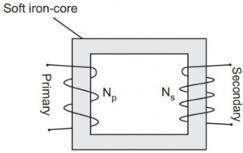
Two coils on separate limbs of the core
Principle: It is based on the principle of mutual inductance and transforms the alternating low voltage to alternating high voltage and in this the number of turns in secondary coil is more than that in primary coil.$($i.e., $N _{ S } > Np ).$
Efficiency: Assuming no energy losses, the transformer is $100 \%$ efficient i.e. $I _{ p } V _{ P }= I _{ s } V _{ s }$
$\varepsilon_p=- N _{ p } \frac{\Delta \phi}{\Delta t} \ldots (i)$
and emf induced in the secondary coil
$=- N _{ S } \frac{\Delta \phi}{\Delta t} \ldots( ii )$
From $(i)$ and $(ii)$
$\frac{\varepsilon_S}{\varepsilon_p}=\frac{N_S}{N_p} \ldots \text { (iii) }$
$\frac{V_S}{V_p}=\frac{\varepsilon_S}{\varepsilon_p}=\frac{N_S}{N_p}= r \text { (say) } \ldots \text { (iv) }$
$V _{ p } i _{ p }= V _{ S } i _{ S }$
$\therefore \frac{i_S}{i_p}=\frac{V_p}{V_S}=\frac{N_p}{N_S}=\frac{1}{r} \ldots \text { (v) }$
In step up transformer, $N _{ s }> N _{ p } \rightarrow r >1$;
So $V_S > V_p$ and iS i.e., step up transformer increases the voltage.
Two coils on separate limbs of the core
Principle: It is based on the principle of mutual inductance and transforms the alternating low voltage to alternating high voltage and in this the number of turns in secondary coil is more than that in primary coil.$($i.e., $N _{ S } > Np ).$
Efficiency: Assuming no energy losses, the transformer is $100 \%$ efficient i.e. $I _{ p } V _{ P }= I _{ s } V _{ s }$