MCQ
A far sighted man who has lost his spectacles, reads a book by looking through a small hole ($3-4 \,mm$) in a sheet of paper. The reason will be
  • A
    Because the hole produces an image of the letters at a longer distance
  • B
    Because in doing so, the focal length of the eye lens is effectively increased
  • Because in doing so, the focal length of the eye lens is effectively decreased
  • D
    None of these

Answer

Correct option: C.
Because in doing so, the focal length of the eye lens is effectively decreased
c
(c) Man is suffering from hypermetropia. The hole works like a convex lens.

Need a full question paper?

Generate a complete, print-ready paper with questions like this in minutes — across 16+ boards, with answer keys.

Start Generating Free

Similar questions

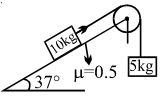
The blocks are in equilibrium. The friction force acting on $10 kg$ block is :
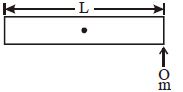
A stick of length $L$ and mass $M$ lies on a frictionless horizontal surface on which it is free to move in any ways. A ball of mass $m$ moving with speed $v$ collides elastically with the stick as shown in the figure. If after the collision the ball comes to rest, then what should be the mass of the ball ?
A smooth sphere $A$ is moving on a frictionless horizontal plane with angular speed $\omega $ and center of mass with velocity $v$. It collides elastically and head-on with an identical sphere $B$ at rest. Neglect friction everywhere. After the collision, their angular speeds are ${\omega _A}$ and ${\omega _B}$ respectively. Then
A thin $1 \,m$ long rod has a radius of $5\, mm$. A force of $50\,\pi kN$ is applied at one end to determine its Young's modulus. Assume that the force is exactly known. If the least count in the measurement of all lengths is $0.01\, mm$, which of the following statements is false ?
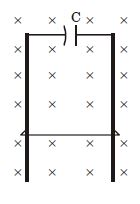
A wire of mass $m$ and length $l$ can slide freely on a pair of smooth, vertical rails (figure). A magnetic field $B$ exists in the region in the direction perpendicular to the plane of the rails. The rails are connected at the top end by a capacitor of capacitance $C$ . The acceleration of the wire neglecting any electric resistance is 
$\overrightarrow{ A }=4 \hat{ i }+3 \hat{ j }$ and $\overrightarrow{ B }=4 \hat{ i }+2 \hat{ j }$. Find a vector parallel to $\overrightarrow{ A }$ but has magnitude five times that of $\vec{B}$.
On a calm day, a boat can go across a lake and return in time $T_0$ at a speed $V$. On a rough day, there is uniform current at speed $v$ to help the onward journey and impede the return journey. If the time taken to go across and return on the rough day be $T$, then $T / T_0$ is
Given below are two statements:

Statement $I:$ For diamagnetic substance $-1 \leq \chi < 0$, where $\chi$ is the magneticsusceptibility.

Statement $II:$ Diamagnetic substances when placed in an external magnetic field, tend to move from stronger to weaker part of the field.

In the light of the above statements, choose the correct answer from the options given below.

Gas escapes from the surface of a planet because it acquires an escape velocity. The escape velocity will depend on which of the following factors :

$I.$ Mass of the planet

$II.$ Mass of the particle escaping

$III.$ Temperature of the planet

$IV.$ Radius of the planet

Select the correct answer from the codes given below :

To determine Young's modulus of a wire, the formula is $Y = \frac{F}{A}.\frac{L}{{\Delta L}}$ where $F/A$ is the stress and $L/\Delta L$ is the strain. The conversion factor to change $Y$ from $CGS$ to $MKS$ system is