To determine Young's modulus of a wire, the formula is $Y = \frac{F}{A}.\frac{L}{{\Delta L}}$ where $F/A$ is the stress and $L/\Delta L$ is the strain. The conversion factor to change $Y$ from $CGS$ to $MKS$ system is
Medium


Download our appand get started for free
Experience the future of education. Simply download our apps or reach out to us for more information. Let's shape the future of learning together!No signup needed.*
Similar Questions
- 1Young's moduli of the material of wires $A$ and $B$ are in the ratio of $1: 4$, while its area of cross sections are in the ratio of $1: 3$. If the same amount of load is applied to both the wires, the amount of elongation produced in the wires $A$ and $B$ will be in the ratio ofView Solution
[Assume length of wires $A$ and $B$ are same]
- 2$Assertion :$ Solids are least compressible and gases are most compressible.View Solution
$Reason :$ solids have definite shape and volume but gases do not have either definite shape or definite volume. - 3In a series combination of copper and steel wires of same length and same diameter, a force is applied at one of their ends while the other end is kept fixed. The combined length is increased by $2\, cm$. The wires will have ..........View Solution
- 4If the Bulk modulus of lead is $8.0 \times 10^9 \,N / m ^2$ and the initial density of the lead is $11.4 \,g / cc$, then under the pressure of $2.0 \times 10^8 \,N / m ^2$, the density of the lead is $.............g / cc$View Solution
- 5Young's modulus is determined by the equation given by $\mathrm{Y}=49000 \frac{\mathrm{m}}{\ell} \frac{\text { dyne }}{\mathrm{cm}^2}$ where $\mathrm{M}$ is the mass and $\ell$ is the extension of wre used in the experiment. Now error in Young modules $(\mathrm{Y})$ is estimated by taking data from $M-\ell$ plot in graph paper. The smallest scale divisions are $5 \mathrm{~g}$ and $0.02$ $\mathrm{cm}$ along load axis and extension axis respectively. If the value of $M$ and $\ell$ are $500 \mathrm{~g}$ and $2 \mathrm{~cm}$ respectively then percentage error of $\mathrm{Y}$ is :View Solution
- 6A steel wire having a radius of $2.0\, mm$, carrying a load of $4\, kg$, is hanging from a ceiling. Given that $g = 3.1\pi \,m{s^{ - 2}}$ , what will be the tensile stress that would be developed in the wire?View Solution
- 7Two persons pull a wire towards themselves. Each person exerts a force of $200 \mathrm{~N}$ on the wire. Young's modulus of the material of wire is $1 \times 10^{11} \mathrm{~N} \mathrm{~m}^{-2}$. Original length of the wire is $2 \mathrm{~m}$ and the area of cross section is $2 \mathrm{~cm}^2$. The wire will extend in length by . . . . . . . .$\mu \mathrm{m}$.View Solution
- 8The area of cross-section of a railway track is $0.01\, {m}^{2}$. The temperature variation is $10^{\circ} {C}$. Coefficient of linear expansion of material of track is $10^{-5} /{ }^{\circ} {C}$. The energy stored per meter in the track is ...... ${J} / {m} .$View Solution
(Young's modulus of material of track is $10^{11} \,{Nm}^{-2}$ ))
- 9View SolutionThe adiabatic elasticity of a gas is equal to
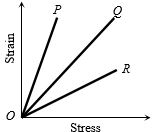
- 10The strain-stress curves of three wires of different materials are shown in the figure. $P, Q$ and $R$ are the elastic limits of the wires. The figure shows thatView Solution