MCQ
A fighter jet is flying horizontally at a certain altitude with a speed of $200 \; ms ^{-1}$. When it passes directly overhead an anti-aircraft gun, bullet is fired from the gun, at an angle $\theta$ with the horizontal, to hit the jet. If the bullet speed is $400 \; m / s$, the value of $\theta$ will be $\dots \; {}^o$
  • A
    $40$
  • B
    $50$
  • $60$
  • D
    $70$

Answer

Correct option: C.
$60$
c
Both should have same horizontal component of velocity

$200=400 \cos \theta$

$\theta=60^{\circ}$

Need a full question paper?

Generate a complete, print-ready paper with questions like this in minutes — across 16+ boards, with answer keys.

Start Generating Free

Similar questions

Two similar open organ pipe of length $50\, cm$ and $50.5\, cm$ produce $3$ beats per second when sounded together. The velocity of sound in air is ........ $m/s$
Number of base $SI$ units is
What is the value of linear velocity, if $\vec \omega = 3\hat i - 4\hat j + \hat k$ and $\vec r = 5\hat i - 6\hat j + 6\hat k$
A stationary sound source $'s'$ of frequency $334\,\, Hz$ and a stationary observer $'O'$ are placed near a reflecting surface moving away from the source with velocity $2\,\, m/sec$ as shown in the figure. If the velocity of the sound waves is air is $V = 330\,\, m/sec$, the apparent frequency of the echo is ... $Hz$
A car is moving along a straight line, say $OP$ in given figure. It moves from $O$ to $P$ in $18\; s$ and returns from $P$ to $\mathrm{Q}$ in $6.0\; s$. What are the average velocity and average speed of the car in going from $O$ to $P$?
Speed of sound in a gas is $v$ and $r.m.s.$ velocity of the gas molecules is $c.$ The ratio of $v$ to $c$ is
Energy required to form a soap bubble of diameter $20 \,cm$ will be (Surface tension for soap solution is $30$ dynes/cm)
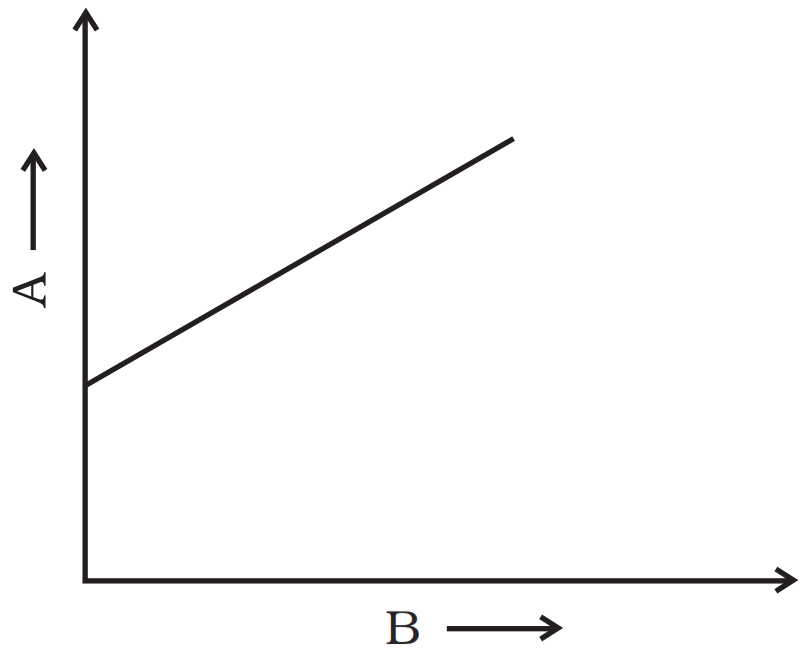
The variation of quantity $A$ with quantity $B$, plotted in Fig. describes the motion of a particle in a straight line.
Match List $I$ with List $II$

LIST$-I$ LIST$-II$
$(A)$  Torque $(I)$    $ML ^{-2} T ^{-2}$
$(B)$   Stress $(II)$   $ML ^2 T ^{-2}$
$(C)$   Pressure of gradient $(III)$   $ML ^{-1} T ^{-1}$
$(D)$   Coefficient of viscosity $(IV)$   $ML ^{-1} T ^{-2}$

Choose the correct answer from the options given below

Two identical cylindrical vessels are kept on the ground and each contain the same liquid of density $d.$ The area of the base of both vessels is $S$ but the height of liquid in one vessel is $x_{1}$ and in the other, $x_{2}$. When both cylinders are connected through a pipe of negligible volume very close to the bottom, the liquid flows from one vessel to the other until it comes to equilibrium at a new height. The change in energy of the system in the process is