MCQ
What is the value of linear velocity, if $\vec \omega = 3\hat i - 4\hat j + \hat k$ and $\vec r = 5\hat i - 6\hat j + 6\hat k$
  • A
    $6\hat i + 2\hat j - 3\hat k$
  • $ - 18\hat i - 13\hat j + 2\hat k$
  • C
    $4\hat i - 13\hat j + 6\hat k$
  • D
    $6\hat i - 2\hat j + 8\hat k$

Answer

Correct option: B.
$ - 18\hat i - 13\hat j + 2\hat k$
b
(b)$\overrightarrow v = \overrightarrow \omega \times \overrightarrow r = \left| {\begin{array}{*{20}{c}}{\hat i}&{\hat j}&{\hat k}\\3&{ - 4}&1\\5&{ - 6}&6\end{array}} \right| = - 18\hat i - 13\hat j + 2\hat k$

Need a full question paper?

Generate a complete, print-ready paper with questions like this in minutes — across 16+ boards, with answer keys.

Start Generating Free

Similar questions

$A$ block of mass $m$ moving with a velocity $v_0$ on a smooth horizontal surface strikes and compresses a spring of stiffness $k$ till mass comes to rest as shown in the figure. This phenomenon is observed by two observers:

$A$: standing on the horizontal surface

$B$: standing on the block 

To an observer $B$, when the block is compressing the spring

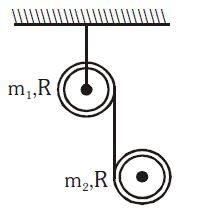
In the given figure linear acceleration of solid cylinder of mass $m_2$ is $a_2$. Then angular acceleration $\alpha_2$ is (given that there is no slipping).
Which of the following statements is not true
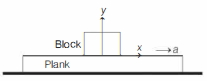
A plank is moving in a horizontal direction with a constant acceleration $\alpha \hat{ i }$. A uniform rough cubical block of side $l$ rests on the plank and is at rest relative to the plank. Let the centre of mass of the block be at $(0, l / 2)$ at a given instant. If $\alpha =g / 10$, then the normal reaction exerted by the plank on the block at that instant acts at
What is work done in holding a body of mass $20\ kg$ at a height of $2m$ above the ground? $(g = 10m/ s^2)$
If the external forces acting on a system have zero resultant, the centre of mass:
Force acting on $a$ body of mass $1 kg$ is related to its position $x$ as $F = x^3 - 3x\, N$. It is at rest at $x = 1$. Its velocity at $x = 3$ can be ......... $m/s$
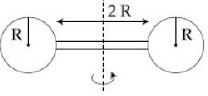
Two identical spherical balls of mass $M$ and radius $R$ each are stuck on two ends of a rod of length $2R$ and mass $M$ (see figure). The moment of inertia of the system about the axis passing perpendicularly through the centre of the rod is
The temperature of a gas is $ -68^\circ C$. At ...... $^oC$ temperature will the average kinetic energy of its molecules be twice that of at $ -68^\circ C$
Two uniform solid spheres having unequal masses and unequal radii are released from rest from the same height on a rough incline. If the spheres roll without slipping,