MCQ
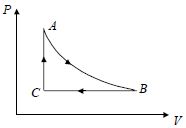
A fixed amount of a gas undergoes a thermodynamic process as shown such that heat interaction along path $B \to C \to A$ is equal to the work done by the gas along path $A \to B \to C$. Then process $A \to B$ is :-
  • A
    can only be isothermal
  • can only be adiabatic
  • C
    can be isothermal or adiabatic
  • D
    none of the above

Answer

Correct option: B.
can only be adiabatic
b
As process is cyclic $\Rightarrow \Delta \mathrm{U}_{\mathrm{ABCA}}=0$

$\Rightarrow \mathrm{Q}_{\mathrm{ABCA}}=\mathrm{W}_{\mathrm{ABCA}}$

$\Rightarrow \mathrm{Q}_{\mathrm{A} \rightarrow \mathrm{B}}+\mathrm{Q}_{\mathrm{B} \rightarrow \mathrm{C}}+\mathrm{Q}_{\mathrm{C} \rightarrow \mathrm{A}}$

$=\mathrm{W}_{\mathrm{A} \rightarrow \mathrm{B}}+\mathrm{W}_{\mathrm{B} \rightarrow \mathrm{C}}+\mathrm{W}_{\mathrm{C} \rightarrow \mathrm{A}}$   $.(1)$

Given $Q_{B \rightarrow C}+Q_{C \rightarrow A}=W_{A \rightarrow B}+W_{B \rightarrow C}$  $(2)$

Subtracting $( 2)$ from $( 1)$

$\mathrm{Q}_{\mathrm{A} \rightarrow \mathrm{B}}=\mathrm{W}_{\mathrm{C} \rightarrow \mathrm{A}}=0$

(as process $\mathrm{C} \rightarrow \mathrm{A}$ is isochoric)

process $A \rightarrow B$ is adiabatic.
Need a full question paper?

Generate a complete, print-ready paper with questions like this in minutes — across 16+ boards, with answer keys.

Start Generating Free

Similar questions

Force acting on a body varies with time as shown below. If initial momentum of the body is $\vec{p}$, then the time taken by the body to retain its momentum $\vec{p}$ again is ........... $s$
The total energy of a particle executing simple harmonic motion is
$N$ divisions on the main scale of a vernier calliper coincide with $(N + 1 )$ divisions of the vernier scale. If each division of main scale is $a$ units , then the least count of the instrument is
The r.m.s. speed of gas molecules is given by
A projectile is thrown upward with a velocity $v_0$ at an angle $\alpha$ to the horizontal. The change in velocity of the projectile when it strikes the same horizontal plane is
A string of length $1 \mathrm{~m}$ and mass $2 \times 10^{-5} \mathrm{~kg}$ is under tension $\mathrm{T}$. when the string vibrates, two successive harmonics are found to occur at frequencies $750 \mathrm{~Hz}$ and $1000 \mathrm{~Hz}$. The value of tension $\mathrm{T}$ is. . . . . . .Newton.
A slender rod of mass $M$ and length $L$ is hinged about an end to swing freely in a vertical plane. However, its density is nonuniform and varies linearly from hinged end to the free end doubling its value. The moment of inertia of the rod, about the rotation axis passing through the hinge point is
A container of fixed volume has a mixture of one mole of hydrogen and one mole of helium in equilibrium at temperature $T$. Assuming the gases are ideal, the correct statement$(s)$ is(are)

$(A)$ The average energy per mole of the gas mixture is $2RT$.

$(B)$ The ratio of speed of sound in the gas mixture to that in helium gas is $\sqrt{6 / 5}$.

$(C)$ The ratio of the rms speed of helium atoms to that of hydrogen molecules is $1 / 2$.

$(D)$ The ratio of the rms speed of helium atoms to that of hydrogen molecules is $1 / \sqrt{2}$.

A long metallic bar is carrying heat from one of its ends to the other end under steady-state. The variation of temperature $\theta$ along the length $x$ of the bar from its hot end is best described by which of the following figures?
Two trains $A$ and $B$ are running in the same direction on parallel rails such that $A$ is faster than $B$ . Packets of equal weight are transferred between them. What will happen due to this