MCQ
A flat plate of area $0.1 \,m ^2$ is placed on a flat surface and is separated from it by a film of oil $10^{-5} \,m$ thick whose coefficient of viscosity is $1.5 N \,sm s ^{-2}$. The force required to cause the plate to slide on the surface at constant speed of $1 \,mm s ^{-1}$ is ............ $N$
  • A
    $10$
  • $15$
  • C
    $20$
  • D
    $25$

Answer

Correct option: B.
$15$
b
(b)

$F=\eta A \frac{v}{l}$

Substituting values,

$=1.5 \times 0.1 \times \frac{1 \times 10^{-3}}{10^{-5}}$

$=15 \,N$

Need a full question paper?

Generate a complete, print-ready paper with questions like this in minutes — across 16+ boards, with answer keys.

Start Generating Free

Similar questions

In the three states of matter, the elastic coefficient can be
When a rolling body enters onto a smooth horizontal surface, it will ............
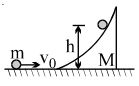
A particle of mass $m$ moving horizontally with $v_0$ strikes $a$ smooth wedge of mass $M$, as shown in figure. After collision, the ball starts moving up the inclined face of the wedge and rises to $a$ height $h$. Identify the correct statement $(s)$ related to the situation when the particle starts moving downward.
The displacement of the interfering light waves are ${y_1} = 4\sin \omega \,t$ and ${y_2} = 3\sin \left( {\omega \,t + \frac{\pi }{2}} \right)$. What is the amplitude of the resultant wave
what is the work done by a force $4N$ in moving the body from $d = 1m$ to $4m\ ?$
A bullet of mass m fired at $30^\circ$ to the horizontal leaves the barrel of the gun with a velocity $v.$ The bullet hits a soft target at a height h above the ground while it is moving downward and emerges out with half the kinetic energy it had before hitting the target. Which of the following statements are correct in respect of bullet after it emerges out of the target?
Two balls of equal mass undergo head on collision while each was moving with speed $6 \,m / s$. If the coefficient of restitution is $\frac{1}{3}$, the speed of each ball after impact will be ............ $m / s$
The dimensions of Stefan constant is :
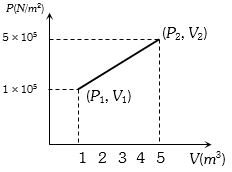
A system changes from the state $({P_1},\;{V_1})$ to $({P_2},{V_2})$ as shown in the figure. What is the work done by the system
A particle of mass $M\ kg$ describes a circle of radius $1m$. The centripetal acceleration of the particle is $4\ m/ s^2.$ What will be the momentum of the particle ?