MCQ
The displacement of the interfering light waves are ${y_1} = 4\sin \omega \,t$ and ${y_2} = 3\sin \left( {\omega \,t + \frac{\pi }{2}} \right)$. What is the amplitude of the resultant wave
  • $5$
  • B
    $7$
  • C
    $1$
  • D
    $0$

Answer

Correct option: A.
$5$
a
(a) Since $\phi = \frac{\pi }{2}$ ==> $A = \sqrt {a_1^2 + a_2^2} = \sqrt {{{(4)}^2} + {{(3)}^2}} = 5$

Need a full question paper?

Generate a complete, print-ready paper with questions like this in minutes — across 16+ boards, with answer keys.

Start Generating Free

Similar questions

The stationary wave produced on a string is represented by the equation $y = 5\cos (\pi x/3)\sin 40\pi \,t$. Where $x$ and $y$ are in cm and $t$ is in seconds. The distance between consecutive nodes is .... $cm$
The amplitude of a wave represented by displacement equation

$y = \frac{1}{{\sqrt a }}\,\sin \,\omega t \pm \frac{1}{{\sqrt b }}\,\cos \,\omega t$ will be

There is a relationship between the pressure P of an ideal gas and the average kinetic energy E of the gas in unit volume.
Two narrow bores of diameter $5.0\, {mm}$ and $8.0\, {mm}$ are joined together to form a $U-$shaped tube open at both ends. If this ${U}$-tube contains water, what is the difference in the level of two limbs of the tube.

[Take surface tension of water ${T}=7.3 \times 10^{-2} \, {Nm}^{-1}$, angle of contact $=0, {g}=10\, {ms}^{-2}$ and density of water $\left.=1.0 \times 10^{3} \,{kg} \,{m}^{-3}\right]$ (in $mm$)
Sand is being dropped on a conveyer belt at the rate of $M\, kg/s.$ The force necessary to keep the belt moving with a constant velocity of $v\,m/s$ will be
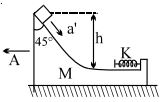
$A$ small block of mass $m$ is placed on $a$ wedge of mass $M$ as shown, which is initially at rest. All the surfaces are frictionless . The spring attached to the other end of wedge has force constant $k$. If $a'$ is the acceleration of $m$ relative to the wedge as it starts coming down and $A$ is the acceleration acquired by the wedge as the block starts coming down, then 
A string fixed at both ends is in resonance in its $2^{nd}$ harmonic with a tuning fork of frequency $f_1$. Now its one end becomes free. If the frequency of the tuning fork is increased slowly from $f_1$ then again a resonance is obtained when the frequency is $f_2$. If in this case the string vibrates in $n^{th}$ harmonic then
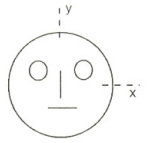
Look at the drawing given in the figure which has been drawn with ink of uniform line-thickness. The mass of ink used to draw each of the two inner circles, and each of the two line segments is $m$. The mass of the ink used to draw the outer circle is $6 \mathrm{~m}$. The coordinates of the centres of the different parts are: outer circle $(0,0)$, left inner circle $(-a, a)$, right inner circle $(a, a)$, vertical line $(0,0)$ and horizontal line $(0,-a)$. The $y$-coordinate of the centre of mass of the ink in this drawing is
An organ pipe $P_1$ closed at one end vibrating in its first overtone. Another pipe $P_2$ open at both ends is vibrating in its third overtone. They are in a resonance with a given tuning fork. The ratio of the length of $P_1$ to that of $P_2$ is
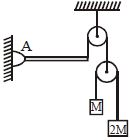
Consider the situation shown in the figure. Uniform rod of length $L$ can rotate freely about the hinge $A$ in vertical plane. Pulleys and string are light and frictionless. If therod remains horizontal at rest when the system is released then the mass of the rod is :