A flat plate of area $10\,cm^2$ is separated from a large plate by a layer of glycerine $1\, mm$ thick. If the coefficient of viscosity of glycerine is $20$ poise, the force required to keep the plate moving with a velocity of $1\,cm/sec$ is .......... $dyne$
Easy
Download our app for free and get started
${F_v}\, = \,\eta A\,\frac{{dv}}{{dy}}\, = \,20\, \times \,10\, \times \,\frac{1}{{{{10}^{ - 1}}}}\, = \,2000\,{\rm{dyne}}$

Download our appand get started for free
Experience the future of education. Simply download our apps or reach out to us for more information. Let's shape the future of learning together!No signup needed.*
Similar Questions
- 1A cubical block of wood of specific gravity $0.5$ and a chunk of concrete of specific gravity $2.5$ are fastened together. The ratio of the mass of wood to the mass of concrete which makes the combination to float with its entire volume submerged under water isView Solution
- 2View SolutionA tank filled with fresh water has a hole in its bottom and water is flowing out of it. If the size of the hole is increased, then
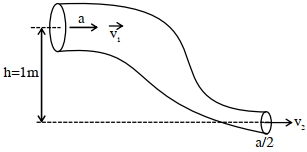
- 3An ideal fluid of density $800 \; kgm ^{-3}$, flows smoothly through a bent pipe (as shown in figure) that tapers in cross-sectional area from $a$ to $\frac{ a }{2}$. The pressure difference between the wide and narrow sections of pipe is $4100 \; Pa$. At wider section, the velocity of fluid is $\frac{\sqrt{x}}{6} \; ms ^{-1}$ for $x = \dots$ $\left(\right.$ Given $g =10 \; m ^{-2}$ )View Solution
- 4Given below are two statements: one is labelled as Assertion $A$ and the other is labelled as Reason $R$View Solution
Assertion $A:$ When you squeeze one end of a tube to get toothpaste out from the other end, Pascal's principle is observed.
Reason $R:$ A change in the pressure applied to an enclosed incompressible fluid is transmitted undiminished to every portion of the fluid and to the walls of its container.
In the light of the above statements, choose the most appropriate answer from the options given below
- 5A boy has $60\, kg$ weight. He wants to swim in a river with the help of a wooden log. If relative density of wood is $0.6$, what is the minimum volume of wooden log? (density of river water is $1000\, kg/m^3$)View Solution
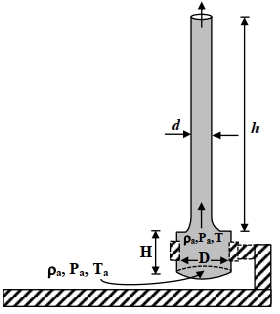
- 6A cylindrical furnace has height $(H)$ and diameter $(D)$ both $1 \mathrm{~m}$. It is maintained at temperature $360 \mathrm{~K}$. The air gets heated inside the furnace at constant pressure $P_a$ and its temperature becomes $T=360 \mathrm{~K}$. The hot air with density $\rho$ rises up a vertical chimney of diameter $d=0.1 \mathrm{~m}$ and height $h=9 \mathrm{~m}$ above the furnace and exits the chimney (see the figure). As a result, atmospheric air of density $\rho_a=1.2 \mathrm{~kg} \mathrm{~m}^{-3}$, pressure $P_a$ and temperature $T_a=300 \mathrm{~K}$ enters the furnace. Assume air as an ideal gas, neglect the variations in $\rho$ and $T$ inside the chimney and the furnace. Also ignore the viscous effects.View Solution
[Given: The acceleration due to gravity $g=10 \mathrm{~ms}^{-2}$ and $\pi=3.14$ ]
(image)
($1$) Considering the air flow to be streamline, the steady mass flow rate of air exiting the chimney is
. . . . .$\mathrm{gm} \mathrm{s}^{-1}$.
($2$) When the chimney is closed using a cap at the top, a pressure difference $\Delta P$ develops between the top and the bottom surfaces of the cap. If the changes in the temperature and density of the hot air, due to the stoppage of air flow, are negligible then the value of $\Delta P$ is. . . . .$\mathrm{Nm}^{-2}$.
- 7A tank $5\, m$ high is half-filled with water and then is filled to the top with oil of density $0.85\, g/cm^3$. The pressure at the bottom of the tank, due to these liquids is ....... $g\, dyne/cm^2$View Solution
- 8The total area of cross-section is $0.25\,m^2$. If the blood is flowing at the rate of $100\, cm^3/sec$, then the average velocity of flow of blood through the capillaries is ........ $mm/sec$View Solution
- 9Ajet of water having velocity $=$ $10 $ $m/s$ and stream cross-section $=$ $2$ $cm^2$ hits a flat plate perpendicularly, with the water splashing out parallel to plate. The plate experiences a force of ....... $N$View Solution
- 10The terminal velocity $\left( v _{ t }\right)$ of the spherical rain drop depends on the radius ( $r$ ) of the spherical rain drop asView Solution