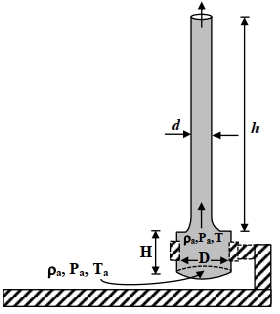
A cylindrical furnace has height $(H)$ and diameter $(D)$ both $1 \mathrm{~m}$. It is maintained at temperature $360 \mathrm{~K}$. The air gets heated inside the furnace at constant pressure $P_a$ and its temperature becomes $T=360 \mathrm{~K}$. The hot air with density $\rho$ rises up a vertical chimney of diameter $d=0.1 \mathrm{~m}$ and height $h=9 \mathrm{~m}$ above the furnace and exits the chimney (see the figure). As a result, atmospheric air of density $\rho_a=1.2 \mathrm{~kg} \mathrm{~m}^{-3}$, pressure $P_a$ and temperature $T_a=300 \mathrm{~K}$ enters the furnace. Assume air as an ideal gas, neglect the variations in $\rho$ and $T$ inside the chimney and the furnace. Also ignore the viscous effects.

[Given: The acceleration due to gravity $g=10 \mathrm{~ms}^{-2}$ and $\pi=3.14$ ]

(image)

($1$) Considering the air flow to be streamline, the steady mass flow rate of air exiting the chimney is

. . . . .$\mathrm{gm} \mathrm{s}^{-1}$.

($2$) When the chimney is closed using a cap at the top, a pressure difference $\Delta P$ develops between the top and the bottom surfaces of the cap. If the changes in the temperature and density of the hot air, due to the stoppage of air flow, are negligible then the value of $\Delta P$ is. . . . .$\mathrm{Nm}^{-2}$.
IIT 2023, Diffcult
Download our app for free and get startedPlay store
(image)

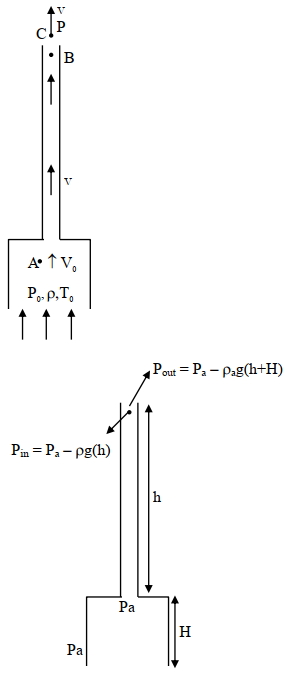
$\rho_0 T_0=\rho T$

$\Rightarrow 1.2 \times 300=\rho(360) \therefore \rho=1$

Between $A$ & $B$

$\mathrm{P}_0+\frac{1}{2} \rho \mathrm{V}_0^2=\mathrm{P}+\frac{1}{2} \rho^2+\rho \mathrm{gh}$

$\frac{\pi \mathrm{D}^2}{4} \mathrm{~V}_0=\frac{\pi \mathrm{d}^2}{4} \mathrm{~V} \ldots \ldots \ldots \text { (2) }$. . . . .

Between $B$ & $C$

$\mathrm{P}+\frac{1}{2} \rho^2=\mathrm{P}_0-\rho_0 \mathrm{~g}(\mathrm{H}+\mathrm{h})+\frac{1}{2} \rho^2 \text {. }$

from $(1)$ & $(2)$ :

$\Rightarrow P_0+\frac{1}{2} \rho\left(V \frac{d^2}{D^2}\right)^2=P+\frac{1}{2} \rho^2+\rho g h$

$\Rightarrow \rho_0 g(H+h)=\frac{1}{2} \rho V^2\left[1-\frac{d^4}{D^4}\right]+\rho g h$

$\Rightarrow V^2 \simeq \frac{2 \rho_0}{\rho} g(H+h)-2 g h$

$=2 \times 1.2 \times 10 \times 10-2 \times 10 \times 9$

$=240-180=60 \quad \therefore V=\sqrt{60 m} \mathrm{~m} / \mathrm{s}$

$Q_m=\rho \frac{\pi d^2}{4} V=1 \times \frac{\pi}{4} \times 10^{-2} \times \sqrt{60}=60.80$

(image)

$\mathrm{P}=\text { constant }$

$\Rightarrow \rho_2 \mathrm{~T}_2=\rho \mathrm{T}$

$1.2 \times 300=\rho \times 360$

$\rho=1 \mathrm{~kg} / \mathrm{m}^3$

$\Delta \mathrm{P}=\rho_2 \mathrm{~g}(\mathrm{~h}+\mathrm{H})-\rho \mathrm{gh}$

$=1.2 \times 10 \times 10-1 \times 10 \times 9$

$=120-90=30 \mathrm{~N} / \mathrm{m}^2$

art

Download our app
and get started for free

Experience the future of education. Simply download our apps or reach out to us for more information. Let's shape the future of learning together!No signup needed.*

Similar Questions

  • 1
    A water drop of radius $1\,\mu m$ falls in a situation where the effect of buoyant force is negligible. Coefficient of viscosity of air is $1.8 \times 10^{-5}\,Nsm ^{-2}$ and its density is negligible as compared to that of water $10^{6}\,gm ^{-3}$. Terminal velocity of the water drop is________ $\times 10^{-6}\,ms ^{-1}$

    (Take acceleration due to gravity $=10\,ms ^{-2}$ )

    View Solution
  • 2
    Velocity of water in a river is
    View Solution
  • 3
    The weight of a body in water is one third of its weight in air. The density of the body is ....... $g / cm ^3$
    View Solution
  • 4
    Different heads are in Column - $\mathrm{I}$ and its formulas are given in Column - $\mathrm{II}$. Match them appropriately.
    Column - $\mathrm{I}$ Column - $\mathrm{II}$
    $(a)$ Velocity head $(i)$ $\frac{P}{{\rho g}}$
    $(b)$ Pressure head $(ii)$ $h$
      $(iii)$ $\frac{{{v^2}}}{{2g}}$
    View Solution
  • 5
    To get the maximum flight, a ball must be thrown as
    View Solution
  • 6
    A bucket contains water filled upto a height $=$ $15 cm$. The bucket is tied to a rope which is passed over a frictionless light pulley and the other end of the rope is tied to a weight of mass which is half of that of the (bucket $+$ water). The water pressure above atmosphere pressure at the bottom is ....... $kPa$
    View Solution
  • 7
    A liquid is flowing in a horizontal uniform capillary tube under a constant pressure difference $P$. The value of pressure for which the rate of flow of the liquid is doubled when the radius and length both are doubled is
    View Solution
  • 8
    The area of cross-section of the wider tube shown in figure is $800$ $cm^2$. If a mass of $12$ $ kg $ is placed on the massless piston, the difference in heights $h$ in the level of water in the two tubes is  ........ $cm$
    View Solution
  • 9
    Ajet of water having velocity $=$ $10 $ $m/s$ and stream cross-section $=$ $2$ $cm^2$ hits a flat plate perpendicularly, with the water splashing out parallel to plate. The plate experiences a force of ....... $N$
    View Solution
  • 10
    Figure shows a siphon. Choose the wrong statement : ( $P_0 =$ atmospheric pressure)
    View Solution