Question
(a) For circuits used for transporting electric power, a low power factor implies large power loss in transmission. Explain.
(b) Power factor can often be improved by the use of a capacitor of appropriate capacitance in the circuit. Explain.
Answer

(a) We know that $P=I V \cos \phi$ where $\cos \phi$ is the power factor. To supply a given power at a given voltage, if $\cos \phi$ is small, we have to increase current accordingly. But this will lead to large power loss $\left(I^2 R\right)$ in transmission.
(b)Suppose in a circuit, current $I$ lags the voltage by an angle $\phi$. Then power factor $\cos \phi=R / Z$.
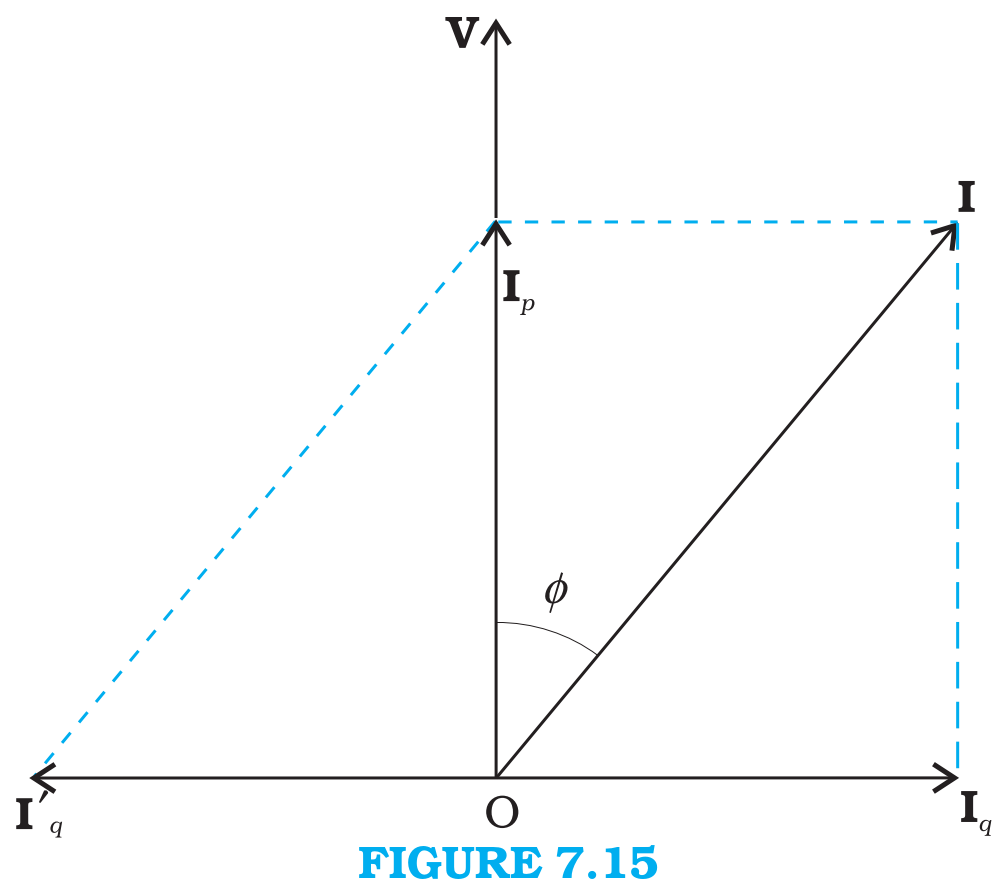
We can improve the power factor (tending to 1) by making $Z$ tend to $R$. Let us understand, with the help of a phasor diagram (Fig. 7.15)
Image
how this can be achieved. Let us resolve $I$ into two components. $I _p$ along the applied voltage $V$ and $I _q$ perpendicular to the applied voltage. $I _q$ as you have learnt in Section 7.7, is called the wattless component since corresponding to this component of current, there is no power loss. $I _{ p }$ is known as the power component because it is in phase with the voltage and corresponds to power loss in the circuit. It's clear from this analysis that if we want to improve power factor, we must completely neutralize the lagging wattless current $I _{ q }$ by an equal leading wattless current $I _q^{\prime}$. This can be done by connecting a capacitor of appropriate value in parallel so that $I _{ q }$ and $I _{ q }^{\prime}$ cancel each other and $P$ is effectively $I_{ p } V$.

Need a full question paper?

Generate a complete, print-ready paper with questions like this in minutes — across 16+ boards, with answer keys.

Start Generating Free

Similar questions

The earth revolves round the sun due to gravitational attraction. Suppose that the sun and the earth are point particles with their existing masses and that Bohr's quantization rule for angular momentum is valid in the case of gravitation. (a) Calculate the minimum radius the earth can have for its orbit. (b) What is the value of the principal quantum number n for the present radius? Mass of the earth = 6.0 × 10⁻²⁴kg. Mass of the sun = 2.0 × 1030kg, earth-sun distance = 1.5 × 10¹¹m.
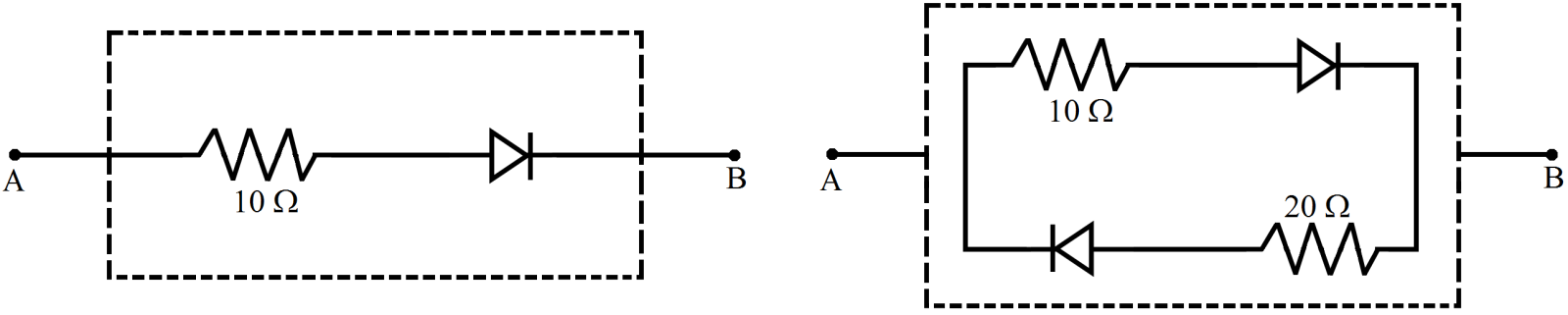
Draw the current-voltage characteristics for the device shown in figure. between the terminals A and B.

A rectangular loop of sides 25cm and 10cm carrying a current of 15A is placed with its longer side parallel to a long straight conductor 2.0cm apart carrying a current of 25A (fig). What is the net force on the loop?
Consider a circular current-carrying loop of radius R in the x-y plane with centre at origin. Consider the line intergral $\Im(\text{L})=\begin{vmatrix}\int\limits_{-\text{L}}^{\text{L}}\text{B.dl} \end{vmatrix}$ taken along z-axis.
  1. Show that $\Im(\text{L})$ monotonically increases with L.
  2. Use an appropriate Amperian loop to show that $\Im(\infty)=\mu_0\text{I}$, where I is the current in the wire.
  3. Verify directly the above result.
  4. Suppose we replace the circular coil by a square coil of sides R carrying the same current I. What can you say about $\Im(\text{L})$ and $\Im(\infty)$?
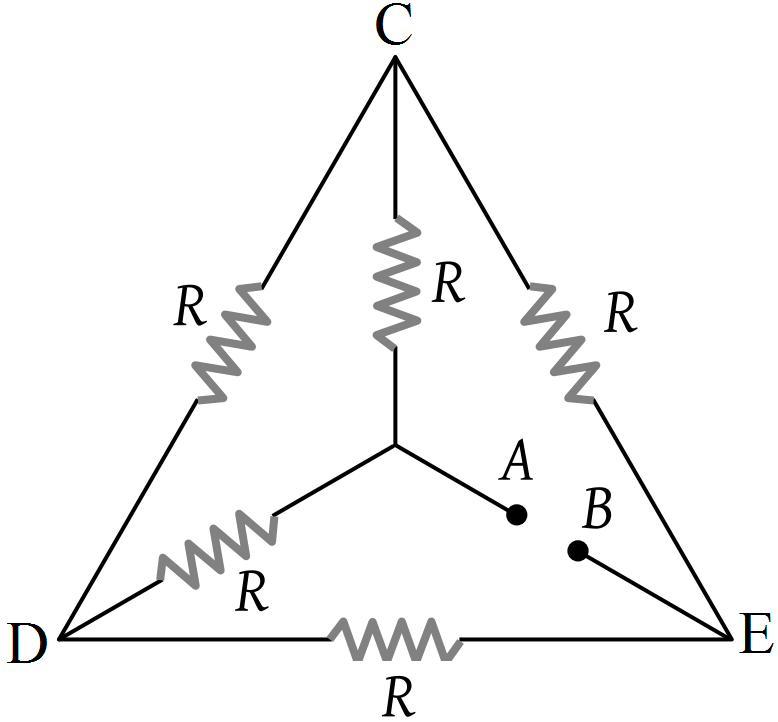
  1. Calculate the equivalent resistance of the given electrical network between points A and B.

  1. Also calculate the current through CD and ACB if a 10V dc source is connected between points A and B and the value of $\text{R}=2\Omega.$
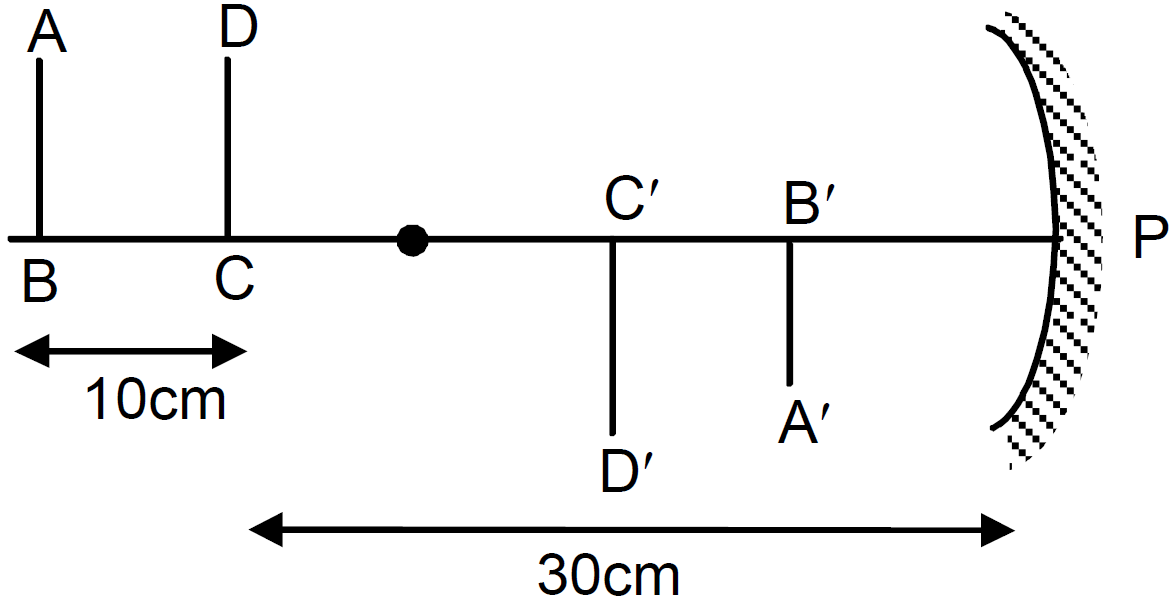
A U-shaped wire is placed before a concave mirror having radius of curvature 20cm. Find the total length of the image.

A 100 turn closely wound circular coil of radius $10 cm$ carries a current of 3.2 A. (a) What is the field at the centre of the coil? (b) What is the magnetic moment of this coil?
The coil is placed in a vertical plane and is free to rotate about a horizontal axis which coincides with its diameter. A uniform magnetic field of $2 T$ in the horizontal direction exists such that initially the axis of the coil is in the direction of the field. The coil rotates through an angle of $90^{\circ}$ under the influence of the magnetic field. (c) What are the magnitudes of the torques on the coil in the initial and final position?
(d) What is the angular speed acquired by the coil when it has rotated by $90^{\circ}$ ? The moment of inertia of the coil is $0.1 kg m ^2$.
The half-life of 40K is 1.30 × 10⁹y. A sample of 1.00g of pure KCI gives 160 counts/ s. Calculate the relative abundance of 40K (fraction of 40K present) in natural potassium.
  1. Using Biot-Savart’s law, derive an expression for the magnetic field at the centre of a circular coil of radius R, number of turns N, carrying current i.
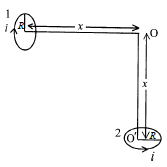
  2. Two small identical circular coils marked 1, 2 carry equal currents and are placed with their geometric axes perpendicular to each other as shown in the figure. Derive an expression for the resultant magnetic field at O.


Assume the dipole model for earth's magnetic field B which is given by BV = vertical component of magnetic field $=\frac{\mu_0}{4\pi}\frac{2\text{m}\cos\theta}{\text{r}^3}$
BH = Horizontal component of magnetic field $=\frac{\mu_0}{4\pi}\frac{\sin\theta\text{m}}{\text{r}^3}$
θ = 90º - lattitude as measured from magnetic equator. Find loci of points for which,
  1. |B| is minimum,
  2. Dip angle is zero,
  3. Dip angle is ± 45º.