Question
  1. Calculate the equivalent resistance of the given electrical network between points A and B.
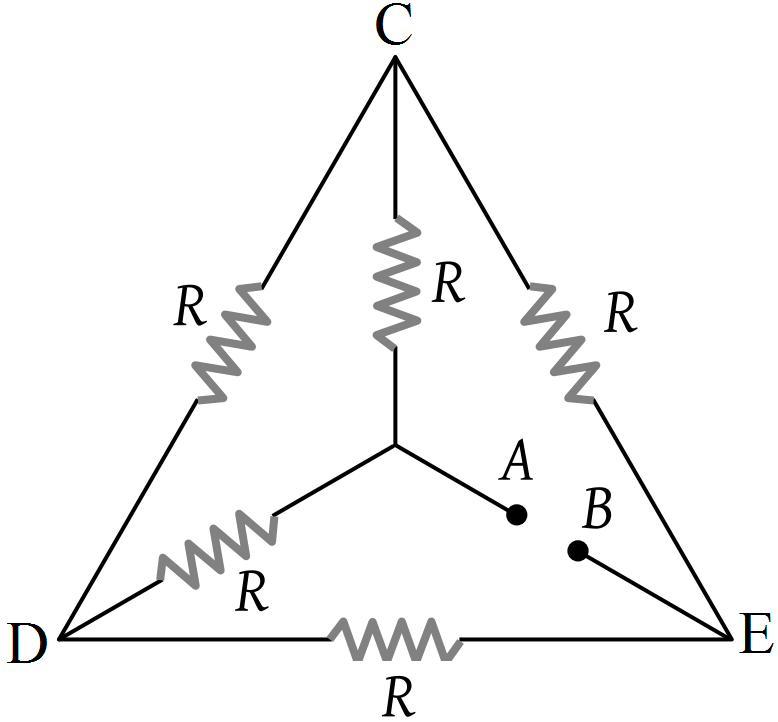
  1. Also calculate the current through CD and ACB if a 10V dc source is connected between points A and B and the value of $\text{R}=2\Omega.$
Answer


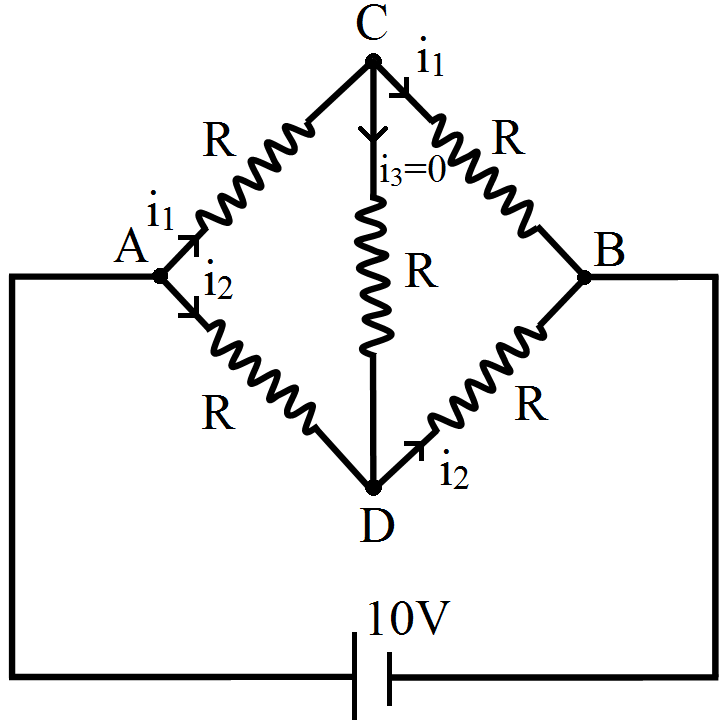
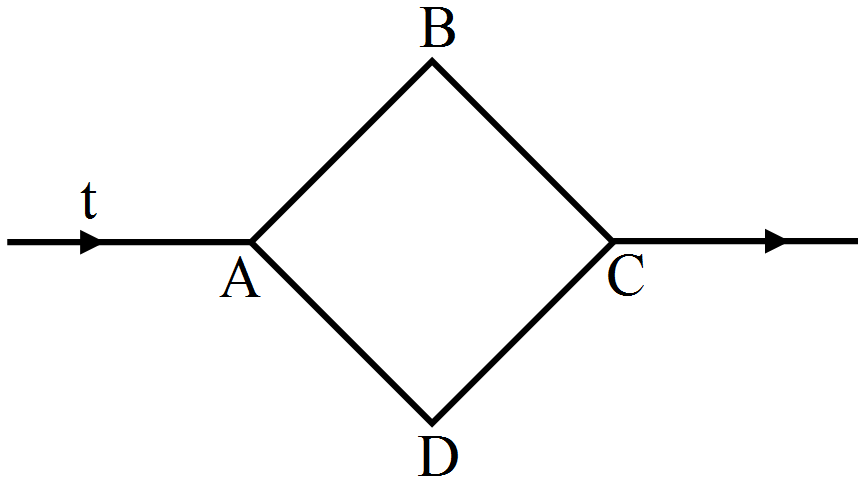
  1. The equivalent circuit is shown in fig. It is a balanced Wheatstone bridge.

So, the resistance connected between C and D is ineffective.

Resistance of arm ACB, R1 = R + R = 2R

Resistance of arm ADB, R2 = R + R = 2R

Equivalent resistance between A and B, RAB is given by

$\frac{1}{\text{R}_\text{AB}}=\frac{1}{2\text{R}}+\frac{1}{2\text{R}}=\frac{2}{2\text{R}}$

$\Rightarrow\text{R}_\text{AB}=\text{R}=2\Omega$

  1. In arm CD, there is no current, ICD = 0,

Current through arm ACB

$\text{i}_1=\frac{\text{V}}{\text{R}_1}$

$=\frac{10}{2\text{R}}=\frac{10}{2\times2}=\frac{10}{4}=2.5\text{A}$

Need a full question paper?

Generate a complete, print-ready paper with questions like this in minutes — across 16+ boards, with answer keys.
Start Generating Free

Similar questions

An electron gun with its collector at a potential of 100 V fires out electrons in a spherical bulb containing hydrogen gas at low pressure (∼10–2 mm of Hg). A magnetic field of 2.83 × 10–4 T curves the path of the electrons in a circular orbit of radius 12.0 cm. (The path can be viewed because the gas ions in the path focus the beam by attracting electrons, and emitting light by electron capture; this method is known as the ‘fine beam tube’ method.) Determine e/m from the data.
The potentiometer wire AB shown in the figure. is 40cm long. Where should the free end of the galvanometer be connected on AB so that the galvanometer may show zero deflection?

A piece of iron of mass 100g is kept inside a furnace for a long time and then put in a calorimeter of water equivalent 10g containing 240g of water at 20°C. The mixture attains and equilibrium temperature of 60°C. Find the temperature of the furnace. Specific heat capacity of iron = 470J kg-1°C-1.
A gas is enclosed in a cylindrical can fitted with a piston. The walls of the can and the piston are adiabatic. The initial pressure, volume and temperature of the gas are 100kPa, 400cm3 and 300K, respectively. The ratio of the specific heat capacities of the gas is $\frac{\text{C}_\text{P}}{\text{C}_\text{V}}=1.5.$ Find the pressure and the temperature of the gas if it is,
  1. Suddenly compressed.
  2. Slowly compressed to 100cm3.
Figure shows a square loop ABCD with edgelength a. The resistance of the wire ABC is r and that of ADC is 2r. Find the magnetic field B at the centre of the loop assuming uniform wires.

  1. With the help of a diagram, explain the principle and working of a moving coil galvanometer.
  2. What is the importance of a radial magnetic field and how is it produced?
  3. Why is it that while using a moving coil galvanometer as a voltmeter a high resistance in series is required whereas in an ammeter a shunt is used?
Consider the arrangement shown in figure. By some mechanism, the separation between the slits S3 and S4 can be changed. The intensity is measured at the point P which is at the common perpendicular bisector

of S1S2 and S3S4. When $\text{z}=\frac{\text{D}\lambda}{2\text{d}},$ intensity measured at P is I. Find this intensity when z is equal to:
  1. $\frac{\text{D}\lambda}{\text{d}}$
  2. $\frac{3\text{D}\lambda}{2\text{d}}$
  3. $\frac{2\text{D}\lambda}{\text{d}}$
A person travelling in a fast spaceship measures the distance between the earth and the moon. Is it the same, smaller or larger than the value quoted in this book?
A beam of white light is incident normally on a plane surface absorbing 70% of the light and reflecting the rest. If the incident beam carries 10W of power, find the force exerted by it on the surface.
Two waves, each having a frequency of 100Hz and a wavelength of 2.0cm, are travelling in the same direction on a string. What is the phase difference between the waves,
  1. If the second wave was produced 0.015s later than the first one at the same place.
  2. If the two waves were produced at the same instant but the first one was produced a distance 4.0cm behind the second one?
  3. If each of the waves has an amplitude of 2.0mm, what would be the amplitudes of the resultant waves in part (a) and (b)?