MCQ
A force acts on a $2\,kg$ object so that its position is given as a function of time as $x= 3t^2 + 5.$ What is the work done by this force in first $5\,seconds$ ? ................ $\mathrm{J}$
  • A
    $850$
  • B
    $950$
  • C
    $875$
  • $900$

Answer

Correct option: D.
$900$
d
$\begin{array}{l}
x = 3{t^2} + 5\\
 \Rightarrow v = 6t\\
 \Rightarrow \,\Delta W = \Delta k\\
\,\,\,\,\,\,\,\,\, = \frac{1}{2}\left( 2 \right){\left( {30} \right)^2} - \frac{1}{2}2{\left( 0 \right)^2}\\
\,\,\,\,\,\,\,\,\, = 900\,J
\end{array}$

Need a full question paper?

Generate a complete, print-ready paper with questions like this in minutes — across 16+ boards, with answer keys.

Start Generating Free

Similar questions

The pressure of an ideal gas is written as $E = \frac{3PV}{2}$ . Here $E$ stands for
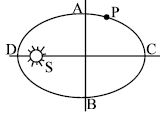
Figure shows the orbit of a planet $P$ round the sun $S.$ $AB$ and $CD$ are the minor and major axes of the ellipse.

If $U$ is the potential energy and $K$ kinetic energy then $|U| > |K|$ at
Two particles start simultaneously from the same point and move along two straight lines, one with uniform velocity $v$ and other with a uniform acceleration $a$. If $\alpha$ is the angle between the lines of motion of two particles, then the least value of relative velocity will be at time given by
Two sound waves of wavelengths $5m$ and $6m$ formed $30$ beats in $3$ seconds. The velocity of sound is  .... $ms^{-1}$
A nucleus moving with a velocity $\vec{\text{v}}$ emits an $\alpha -$particle. Let the velocities of the $\alpha -$particle and the remaining nucleus be $\vec{\text{v}}_1$ and $\vec{\text{v}}_2$ and their masses be $m_1$ and $m_2$.
A steady electric current is flowing through a cylindrical conductor.
  1. The electric field at the axis of the conductor is zero.
  2. The magnetic field at the axis of the conductor is zero.
  3. The electric field in the vicinity of the conductor is zero.
  4. The magnetic field in the vicinity of the conductor is zero.
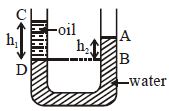
In a $U-$ tube experiment, a column $AB$ of water is balanced by a column $‘CD’$ of oil, as shown in the figure. Then the relative density of oil is
A diatomic gas follows equation $PV^m =$ constant, during a process. What should be the value of $m$ such that its molar heat capacity during process $= R$
Static friction occurs.
An object is projected in the air with initial velocity $u$ at an angle $\theta$. The projectile motion is such that the horizontal range $R$, is maximum. Another object is projected in the air with a horizontal range half of the range of first object. The initial velocity remains same in both the case. The value of the angle of projection, at which the second object is projected, will be $.......$ degree.