Question
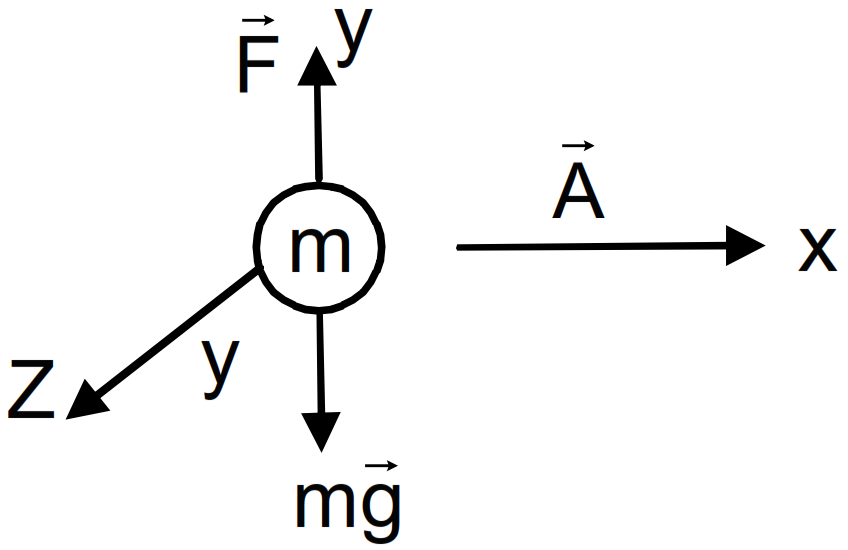
A force $\overrightarrow{\text{F}}=\overrightarrow{\text{v}}\times\overrightarrow{\text{A}}$ is exerted on a particle in addition to the force of gravity, where v is the velocity of the particle and $\overrightarrow{\text{A}}$ is a constant vector in the horizontal direction. With what minimum speed a particle of mass m be projected so that it continues to move undeflected with a constant velocity?
Answer

Given that, $\overrightarrow{\text{F}}=\overrightarrow{\text{u}}\times\overrightarrow{\text{A}}$ and $\overrightarrow{\text{mg}}$ act on the particle. For the particle to move undeflected with constant velocity, net force should be zero.$\therefore\big(\overrightarrow{\text{u}}\times\overrightarrow{\text{A}}\big)+\overrightarrow{\text{mg}}=0$
$\therefore\big(\overrightarrow{\text{u}}\times\overrightarrow{\text{A}}\big)-\overrightarrow{\text{mg}}=0$
Because, $\big(\overrightarrow{\text{u}}\times\overrightarrow{\text{A}}\big)$ is perpendicular to the plane containing $\overrightarrow{\text{u}}$ and $\overrightarrow{\text{A}},\overrightarrow{\text{u}}$ should be in the xz-plane. Again, $\text{u A}\sin\theta=\text{mg}$$\therefore\text{u}=\frac{\text{mg}}{\text{A}\sin\theta}$
u will be minimum, when $\sin\theta=1\Rightarrow\theta=90^{\circ}$$\therefore\text{u}_{\text{min}}=\frac{\text{mg}}{\text{A}}$ along Z-axis.

Need a full question paper?

Generate a complete, print-ready paper with questions like this in minutes — across 16+ boards, with answer keys.

Start Generating Free

Similar questions

Calculate the power required by a force to turn a rigid body by some angle $(\theta).$
The industrial revolution in England and Western Europe more than two centuries ago was triggered by some key scientific and technological advances. What were these advances?
On what factors the amount of heat flowing from hot face to the cold face depends? How?
What are standing waves? Discuss graphical method for formation of standing waves on stretched strings.
If a satellite is revolving around a planet of mass M in an elliptical orbit of semi major axis a, show that orbital speed v of the satellite when at a distance r from the focus will be given by $\text{v}^2=\text{GM}\Big(\frac{2}{\text{r}}-\frac{1}{\text{a}}\Big)$
A spring of force constant k has a mass M suspended from it. If the spring is cut into two halves, and the same mass is attached to one of the pieces, what will be the frequencies of oscillation of the mass?
If a piece of paper is placed at the position of a virtual image of a strong light source, will the paper burn after sufficient time? What happens if the image is real? What happens if the image is real but the source is virtual?
100 g of water is supercooled to -$10^\circC$. At this point, due to some disturbance mechanised or otherwise some of it suddenly freezes to ice. What will be the temperature of the resultant mixture and how much mass would freeze?
[Sw = 1cal/ $g/^\circC$ and $L^W$Fusion = 80cal/ g]
A capacitor of capacitance $\text{C}=(2.0\pm0.1)\mu\text{F}$ is charged to a voltage$\text{V}=(20\pm0.5)\text{V}$ Calculate the charge Q with error limits.
What are the energies involved in streamline flow of ideal liquid? Explain briefly.