MCQ
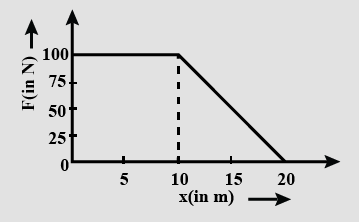
A force $F$ acting on an object varies with distance $x$ as shown in the figure. The work done by the force in moving the object from $x = 0$ and $x = 20m$ is:
  • A
    $500J$
  • B
    $1000D$
  • $1500J$
  • D
    $2000D$

Answer

Correct option: C.
$1500J$
Area under force displacement curve is the work done in that interval
Area under the given figure Area of surface Area of triangle. $= +$
Work done $= 10\times 100+\frac{1}{2}​\times 10\times 100$
$= 1000 + 500$
$= 1500J$

Need a full question paper?

Generate a complete, print-ready paper with questions like this in minutes — across 16+ boards, with answer keys.
Start Generating Free

Similar questions

A constant force acts on a body. Which of the following correctly represents the variation of the power $P$ developed with time $t$?
The position of a particle moving in the $xy-$ plane at any time $t$ is given by $x = (3t^2 -6t)\, metres$, $y = (t^2 -2t)\,metres$. Select the correct statement about the moving particle from the following
A bullet of mass m fired at $30^\circ$ to the horizontal leaves the barrel of the gun with a velocity $v.$ The bullet hits a soft target at a height h above the ground while it is moving downward and emerges out with half the kinetic energy it had before hitting the target. Which of the following statements are correct in respect of bullet after it emerges out of the target?
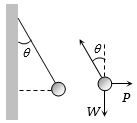
A metal sphere is hung by a string fixed to a wall. The sphere is pushed away from the wall by a stick. The forces acting on the sphere are shown in the second diagram. Which of the following statements is wrong
A closed vessel contains $0.1$ mole of a monoatomic ideal gas at $200\, K$. If $0.05$ mole of the same gas at $400\, K$ is added to it, the final  equilibrium temperature (in $K$ ) of the gas in the vessel will be closed to
$(a)$ Centre of gravity $(C.G.)$ of a body is the point at which the weight of the body acts.

$(b)$ Centre of mass coincides with the centre of gravity if the earth is assumed to have infinitely large radius

$(c)$ To evaluate the gravitational field intensity due to any body at an external point, the entire mass of the body can be considered to be concentrated at its $C.G.$

$(d)$ The radius of gyration of any body rotating about an axis is the length of the perpendicular dropped from the $C.G.$ of the body to the axis of rotation.

Which one of the following pairs of statements is correct ?
The moment of inertia of a uniform cylinder of length $l$ and radius $R$ about its perpendicular bisector is $I$. What is the ratio $l/R$ such that the moment of inertia is minimum?
An open vessel is filled completely with oil which has same coefficient of volume expansion as that of the vessel. On heating both oil and vessel,
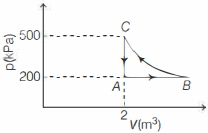
A constant amount of an ideal gas undergoes the cyclic process $A B C A$ in the $p-V$ graph shown below. The path $B C$ is an isothermal. The work done by the gas during one complete cycle, beginning and ending at $A$ is nearly .......... $\,kJ$
A block of mass $M$ is hanging over a smooth and light pulley through a light string. The other end of the string is pulled by a constant force $F$. The kinetic energy of the block increases by $20\,J$ in $1\, s$.