MCQ
A force $F$ is needed to break a copper wire having radius $R$. The force needed to break a copper wire of radius $2 R$ will be
  • A
    $F / 2$
  • B
    $2 F$
  • $4 F$
  • D
    $F / 4$

Answer

Correct option: C.
$4 F$
(c) Breaking Force $\propto$ Area of cross section of wire $(\pi r)$If radius of wire is double then breaking force will become four times.

Need a full question paper?

Generate a complete, print-ready paper with questions like this in minutes — across 16+ boards, with answer keys.
Start Generating Free

Similar questions

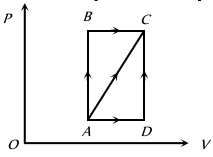
A thermodynamic process is shown in the figure. The pressures and volumes corresponding to some points in the figure are :
$P_A=3 \times 10^4 \mathrm{~Pa}, P_B=8 \times 10^4 \mathrm{~Pa} \text { and }$
$ V_A=2 \times 10^{-3} \mathrm{~m}^3, V_D=5 \times 10^{-3} \mathrm{~m}^3$
In process $A B, 600 \mathrm{~J}$ of heat is added to the system and in process $B C, 200 \mathrm{~J}$ of heat is added to the system. The change in internal energy of the system in process $A C$ would be
Image
Two springs have their force constant as $k_1$ and $k_2\left(k_1>k_2\right)$. When they are stretched by the same force
When the wave of hydrogen atom comes from infinity into the first orbit then the value of wave number is
No bias is applied to a $P-N$ junction, then the current
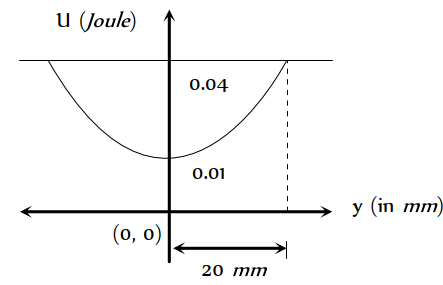
The variation of potential energy of harmonic oscillator is as shown in figure. The spring constant is
If the energy of a photon corresponding to a wavelength of $6000 \mathring A$ is $3.32 \times 10^{-19} \mathrm{~J}$, the photon energy for a wavelength of $4000 \mathring A$ will be
If force and displacement of particle in direction of force are doubled. Work would be
In the Ingen Hauz's experiment the wax melts up to lengths 10 and $25 \mathrm{~cm}$ on two identical rods of different materials. The ratio of thermal conductivities of the two materials is
If $\lambda_1$ and $\lambda_2$ are the wavelengths of characteristic X-rays and gamma rays respectively, then the relation between them is
Which of the following is not an example of perfectly inelastic collision