MCQ 11 Mark
A pan with set of weights is attached with a light spring. When disturbed, the mass-spring system oscillates with a time period of $0.6 s$. When some additional weights are added then time period is $0.7 s$. The extension caused by the additional weights is approximately given by
- A
$1.38 cm$
- ✓
$3.5 cm$
- C
$1.75 cm$
- D
$2.45 cm$
AnswerCorrect option: B. $3.5 cm$
$2 \pi \sqrt{\frac{m}{k}}=0.6 \quad \ldots(\mathrm{i})$ and $2 \pi\sqrt{\frac{m+m^{\prime}}{k}}=0.7$
Dividing (ii) by (i) we get $\left(\frac{7}{6}\right)^2=\frac{m+m^{\prime}}{m}=\frac{49}{36}$
$\frac{m+m^{\prime}}{m}-1=\frac{49}{36}-1 \Rightarrow \frac{m^{\prime}}{m}=\frac{13}{36} \Rightarrow m^{\prime}=\frac{13 m}{36}$
Also $\frac{k}{m}=\frac{4 \pi^2}{(0.6)^2}$
Desired extension $=\frac{m^{\prime} g}{k}=\frac{13}{36} \times \frac{m g}{k}$
$=\frac{13}{36} \times 10 \times \frac{0.36}{4 \pi^2} \approx 3.5 \mathrm{~cm}$
View full question & answer→MCQ 21 Mark
A particle of mass $m$ is under the influence of a force $F$ which varies with the displacement $x$ according to the relation $F=-k x+F_0$ in which $k$ and $F_0$ are constants. The particle when disturbed will oscillate
- A
about $x=0$, with $\omega \neq \sqrt{k / m}$
- B
about $x=0$, with $\omega=\sqrt{k / m}$
- ✓
about $x=F_0 / k$ with $\omega=\sqrt{k / m}$
- D
about $x=F_0 / k$ with $\omega \neq \sqrt{k / m}$
AnswerCorrect option: C. about $x=F_0 / k$ with $\omega=\sqrt{k / m}$
Restoring force is zero at mean position$F=-K x+F_0 \Rightarrow 0=-K x+F_0 \Rightarrow x=\frac{F_0}{K}$
i.e. the particle will oscillate about $x=\frac{F_0}{K}$
View full question & answer→MCQ 31 Mark
A steel wire of $1 m$ long and $1 mm ^2$ cross section area is hang from rigid end. When weight of $1 kg$ is hung from it then change in length will be (given $Y=2 \times 10^{11} N / m ^2$ )
- A
$0.5 mm$
- B
$0.25 mm$
- ✓
$0.05 mm$
- D
$5 mm$
AnswerCorrect option: C. $0.05 mm$
(c) $l=\frac{M g L}{Y A}=\frac{1 \times 10 \times 1}{2 \times 10^{11} \times 10^{-6}}=0.05 \mathrm{~mm}$
View full question & answer→MCQ 41 Mark
When load of $5 kg$ is hung on a wire then extension of $3 m$ takes place, then work done will be
Answer(a) $W=\frac{1}{2} F l=\frac{1}{2} \times M g \times l=\frac{1}{2} \times 5 \times 10 \times 3=75 \mathrm{~J}$
View full question & answer→MCQ 51 Mark
A force $F$ is applied on the wire of radius $r$ and length $L$ and change in the length of wire is $l$. If the same force $F$ is applied on the wire of the same material and radius $2 r$ and length $2 L$, Then the change in length of the other wire is
AnswerCorrect option: C. $1 / 2$
$ l=\frac{F L}{A Y} \Rightarrow l \propto \frac{L}{r^2}(F \text { and } Y \text { are constant }) $
$ \frac{l_2}{l_1}=\frac{L_2}{L_1}\times\left(\frac{r_1}{r_2}\right)^2=2 \times\left(\frac{1}{2}\right)^2=\frac{1}{2} $
$\therefore l_2=\frac{l_1}{2}$
i.e. the change in the length of other wire is $\frac{l}{2}$
View full question & answer→MCQ 61 Mark
In the Young's experiment, If length of wire and radius both are doubled then the value of $Y$ will become
View full question & answer→MCQ 71 Mark
According to Hook's law force is proportional to
- A
$\frac{1}{x}$
- B
$\frac{1}{x^2}$
- ✓
$x$
- D
$x^2$
View full question & answer→MCQ 81 Mark
Shearing stress causes change in
MCQ 91 Mark
If the interatomic spacing in a steel wire is $3.0 \mathring A$ and $Y_{\text {steel }}=$ $20 \times 10^{10} N / m ^2$ then force constant is
- A
$6 \times 10^{-2} N / \mathring A$
- ✓
$6 \times 10^{-9} N / \mathring A$
- C
$4 \times 10^{-5} N / \mathring A$
- D
$6 \times 10^{-5} N / A$
AnswerCorrect option: B. $6 \times 10^{-9} N / \mathring A$
$K=Y r_0 =20 \times 10^{10} \times 3 \times 10^{-10}=60 \mathrm{~N} / \mathrm{m}$
$ =6 \times 10^{-9} \mathrm{~N} / \mathring A$
View full question & answer→MCQ 101 Mark
Which is correct relation
- A
$Y<\sigma$
- ✓
$Y>\sigma$
- C
$Y=\sigma$
- D
$\sigma=+1$
AnswerCorrect option: B. $Y>\sigma$
View full question & answer→MCQ 111 Mark
Stress to strain ratio is equivalent to
MCQ 121 Mark
Which of the following is true for elastic potential energy density
- ✓
Energy density $=\frac{1}{2} \times$ strain $\times$ stress
- B
Energy density $=(\text { strain })^2 \times$ volume
- C
Energy density $=($ strain $) \times$ volume
- D
Energy density $=($ stress $) \times$ volume
AnswerCorrect option: A. Energy density $=\frac{1}{2} \times$ strain $\times$ stress
View full question & answer→MCQ 131 Mark
A load $W$ produces an extension of $1 mm$ in a thread of radius $r$ : Now if the load is made $4 W$ and radius is made $2 r$ all other things remaining same, the extension will become
- A
$4\ mm$
- B
$16\ mm$
- ✓
$1\ mm$
- D
$0.25 \ mm$
AnswerCorrect option: C. $1\ mm$
$ l=\frac{F L}{A Y} \therefore l \propto \frac{F}{r^2} $
$ \frac{l_1}{l_2}=\frac{F_2}{F_1}\left(\frac{r_1}{r_2}\right)^2=(4) \times\left(\frac{1}{2}\right)^2=1 \therefore l_2=l_1=1 \mathrm{~mm}$
View full question & answer→MCQ 141 Mark
Modulus of rigidity of a liquid
MCQ 151 Mark
The work per unit volume to stretch the length by $1 \%$ of a wire with cross sectional area of $1 mm ^2$ will be. $\left[Y=9 \times 10^{11} N / m ^2\right]$
- A
$9 \times 10^{11} J$
- ✓
$4.5 \times 10^7 J$
- C
$9 \times 10^7 J$
- D
$4.5 \times 10^{11} J$
AnswerCorrect option: B. $4.5 \times 10^7 J$
$U=\frac{1}{2} \times Y \times(\text { Strain })^2 =\frac{1}{2} \times 9 \times 10^{11} \times\left(\frac{1}{100}\right)^2 $
$ =4.5 \times 10^7 \mathrm{~J}$
View full question & answer→MCQ 161 Mark
A wire of length $50 cm$ and cross sectional area of $1 sq . mm$ is extended by $1 mm$. The required work will be $\left(Y=2 \times 10^{10} Nm ^{-2}\right)$
- A
$6 \times 10^{-2} J$
- B
$4 \times 10^{-2} J$
- ✓
$2 \times 10^{-2} J$
- D
$1 \times 10^{-2} J$
AnswerCorrect option: C. $2 \times 10^{-2} J$
(c)$W=\frac{Y A l^2}{2 L}=\frac{2 \times 10^{10} \times 10^{-6} \times\left(10^{-3}\right)^2}{2 \times 50 \times 10^{-2}}=2 \times 10^{-2} J$
View full question & answer→MCQ 171 Mark
A rod is fixed between two points at $20^{\circ} C$. The coefficient of linear expansion of material of rod is $1.1 \times 10^{-5} /{ }^{\circ} C$ and Young's modulus is $1.2 \times 10^{11} N / m$. Find the stress developed in the rod if temperature of rod becomes $10^{\circ} C$
- ✓
$1.32 \times 10^7 N / m ^2$
- B
$1.10 \times 10^{15} N / m ^2$
- C
$1.32 \times 10^8 N / m ^2$
- D
$1.10 \times 10^6 N / m ^2$
AnswerCorrect option: A. $1.32 \times 10^7 N / m ^2$
$ \text { Thermal stress }=Y \alpha \Delta \theta$
$ =1.2 \times 10^{11} \times 1.1 \times 10^{-5} \times(20-10)=1.32 \times 10^7 \mathrm{~N} / \mathrm{m}^2$
View full question & answer→MCQ 181 Mark
A rod of length $l$ and radius $r$ is joined to a rod of length $l / 2$ and radius $r / 2$ of same material. The free end of small rod is fixed to a rigid base and the free end of larger rod is given a twist of $\theta^{\circ}$, the twist angle at the joint will be
- A
$\theta / 4$
- B
$\theta / 2$
- C
$5 \theta / 6$
- ✓
$8 \theta / 9$
AnswerCorrect option: D. $8 \theta / 9$
View full question & answer→MCQ 191 Mark
To break a wire, a force of $10^6 N / m ^2$ is required. If the density of the material is $3 \times 10^3 kg / m ^3$, then the length of the wire which will break by its own weight will be
- ✓
$34 m$
- B
$30 m$
- C
$300 m$
- D
$3 m$
AnswerCorrect option: A. $34 m$
(a) $L=\frac{P}{d g}=\frac{6}{3 \times 10^3 \times 10}=\frac{100}{3}=34 \mathrm{~m}$
View full question & answer→MCQ 201 Mark
A rubber cord $10 m$ long is suspended vertically. How much does it stretch under its own weight (Density of rubber is $1500 kg / m , Y=$ $5 \times 10^{\circ} N / m , g =10 m / s$ )
- ✓
$15 \times 10^{-4} m$
- B
$7.5 \times 10^{-6} m$
- C
$12 \times 10^{-9} m$
- D
$25 \times 10^{-7}m$
AnswerCorrect option: A. $15 \times 10^{-4} m$
$l=\frac{L^2 d g}{2 Y}=\frac{(10)^2 \times 1500 \times 10}{2 \times 5 \times 10^8}=15 \times 10^{-4} \mathrm{~m}$
View full question & answer→MCQ 211 Mark
A wire of diameter $1 mm$ breaks under a tension of $1000 N$. Another wire, of same material as that of the first one, but of diameter $2 mm$ breaks under a tension of
- A
$500 N$
- B
$1000 N$
- C
$10000 N$
- ✓
$4000 N$
AnswerCorrect option: D. $4000 N$
(d) Breaking force $\propto r$If diameter becomes double then breaking force will become four times i.e. $1000 \times 4=4000 \mathrm{~N}$
View full question & answer→MCQ 221 Mark
Two wires $A$ and $B$ are of same materials. Their lengths are in the ratio $1: 2$ and diameters are in the ratio $2: 1$ when stretched by force $F_A$ and $F_B$ respectively they get equal increase in their lengths. Then the ratio $F_A / F_B$ should be
- A
$1: 2$
- B
$1: 1$
- C
$2: 1$
- ✓
$8: 1$
AnswerCorrect option: D. $8: 1$
$ F=Y \times A \times \frac{l}{L} \Rightarrow F \propto \frac{r^2}{L}(Y \text { and } / \text { are constant }) $
$ \frac{F_A}{F_B}=\left(\frac{r_A}{r_B}\right)^2 \times\left(\frac{L_B}{L_A}\right)=\left(\frac{2}{1}\right)^2 \times\left(\frac{2}{1}\right)=\frac{8}{1}$
View full question & answer→MCQ 231 Mark
The upper end of a wire of radius $4 mm$ and length $100 cm$ is clamped and its other end is twisted through an angle of $30^{\circ}$. Then angle of shear is
- A
$12^{\circ}$
- ✓
$0.12^{\circ}$
- C
$1.2^{\circ}$
- D
$0.012^{\circ}$
AnswerCorrect option: B. $0.12^{\circ}$
(b) Angle of shear $\phi=\frac{r \theta}{L}=\frac{4 \times 10^{-1}}{100} \times 30^{\circ}=0.12^{\circ}$
View full question & answer→MCQ 241 Mark
The work done in stretching an elastic wire per unit volume is or strain energy in a stretched string is
AnswerCorrect option: B. $\frac{1}{2} \times$ Stress $\times$ Strain
View full question & answer→MCQ 251 Mark
A wire of length $L$ and radius $r$ is rigidly fixed at one end. On stretching the other end of the wire with a force $F$, the increase in its length is $l$. If another wire of same material but of length $2 L$ and radius $2 r$ is stretched with a force of $2 F$, the increase in its length will be
- ✓
$I$
- B
$2 l$
- C
$\frac{l}{2}$
- D
$\frac{l}{4}$
Answer$ l=\frac{F L}{A Y}=\frac{F L}{\pi r^2 Y} \therefore l \propto \frac{F L}{r^2} \quad(Y=\text { constant }) $
$ \therefore \frac{l_2}{l_1}=\frac{F_2}{F_1} \times \frac{L_2}{L_1}\left(\frac{r_1}{r_2}\right)^2=2 \times 2 \times\left(\frac{1}{2}\right)^2=1$
$\therefore l_2=l_1$ i.e. increment in its length will be $l$.
View full question & answer→MCQ 261 Mark
The graph shown was obtained from experimental measurements of the period of oscillations $T$ for different masses $M$ placed in the scale pan on the lower end of the spring balance. The most likely reason for the line not passing through the origin is that the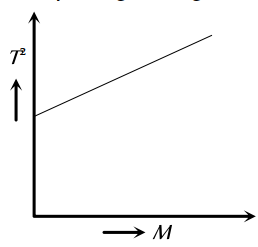
- A
Spring did not obey Hooke's Law
- B
Amplitude of the oscillations was too large
- C
Clock used needed regulating
- ✓
Mass of the pan was neglected
AnswerCorrect option: D. Mass of the pan was neglected
(d)$T=2 \pi \sqrt{\frac{M}{K}} \Rightarrow T^2 \propto M$If we draw a graph between $T^2$ and $M$ then it will be straight line.and for $M=0, T=0$i.e. the graph should pass through the origin.but from the it is not reflected it means the mass of pan was neglected.
View full question & answer→MCQ 271 Mark
The temperature of a wire of length 1 metre and area of crosssection $1 cm ^2$ is increased from $0^{\circ} C$ to $100^{\circ} C$. If the rod is not allowed to increase in length, the force required will be $\left(\alpha=10^{-5} /{ }^{\circ} C\right.$ and $\left.Y=10^{11} N / m ^2\right)$
- A
$10^3 N$
- ✓
$10^4 N$
- C
$10^5 N$
- D
$10^9 N$
AnswerCorrect option: B. $10^4 N$
$ F=\text { force developed }=Y A \alpha(\Delta \theta)$
$ =10^{11} \times 10^{-4} \times 10^{-5} \times 100=10^4 N$
View full question & answer→MCQ 281 Mark
The length of an iron wire is $L$ and area of cross-section is $A$. The increase in length is $l$ on applying the force $F$ on its two ends. Which of the statement is correct
- A
Increase in length is inversely proportional to its length $L$
- B
Increase in length is proportional to area of cross-section $A$
- ✓
Increase in length is inversely proportional to $A$
- D
Increase in length is proportional to Young's modulus
AnswerCorrect option: C. Increase in length is inversely proportional to $A$
(c) $\quad l=\frac{F L}{Y A} \Rightarrow l \propto \frac{1}{A}$
View full question & answer→MCQ 291 Mark
View full question & answer→MCQ 301 Mark
The bulk modulus of an ideal gas at constant temperature
AnswerCorrect option: C. ls equal to its pressure $p$
(c) 1sothermal bulk modulus $=$ Pressure of gas
View full question & answer→MCQ 311 Mark
- A
Sliding of molecular layer is much easier than compression or expansion
- B
Reciprocal of bulk modulus of elasticity is called compressibility
- ✓
It is difficult to twist a long rod as compared to small rod
- D
Hollow shaft is much stronger than a solid rod of same length and same mass
AnswerCorrect option: C. It is difficult to twist a long rod as compared to small rod
(c) For twisting, Angle of shear $\phi \propto \frac{1}{L}$ i.e. if $L$ is more then $\phi$ will be small.
View full question & answer→MCQ 321 Mark
A metal bar of length $L$ and area of cross-section $A$ is clamped between two rigid supports. For the material of the rod, its Young's modulus is $Y$ and coefficient of linear expansion is $\alpha$. If the temperature of the rod is increased by $\Delta t^{\circ} C$, the force exerted by the rod on the supports is
AnswerCorrect option: B. $Y A \alpha \Delta t$
View full question & answer→MCQ 331 Mark
How much force is required to produce an increase of $0.2 \%$ in the length of a brass wire of diameter $0.6 mm$
- A
Nearly $17 N$
- B
Nearly $34 N$
- ✓
Nearly $51 N$
- D
Nearly $68 N$
AnswerCorrect option: C. Nearly $51 N$
(c) $F=\frac{Y A l}{L}=0.9 \times 10^{11} \times \pi \times\left(0.3 \times 10^{-3}\right)^2 \times \frac{0.2}{100}=51 \mathrm{~N}$
View full question & answer→MCQ 341 Mark
A fixed volume of iron is drawn into a wire of length $L$. The extension $x$ produced in this wire by a constant force $F$ is proportional to
- A
$\frac{1}{L^2}$
- B
$\frac{1}{L}$
- ✓
$L^2$
- D
$L$
Answer(c) $l=\frac{F L}{A Y}=\frac{F L^2}{(A L) Y}=\frac{F L^2}{V Y}$.If volume is fixed then $l \propto L^2$
View full question & answer→MCQ 351 Mark
The elastic energy stored in a wire of Young's modulus $Y$ is
- A
$Y \times \frac{\text { Strain }^2}{\text { Volume }}$
- B
Stress $\times$ Strain $\times$ Volume
- ✓
$\frac{\text { Stress }^2 \times \text { Volume }}{2 Y}$
- D
$\frac{1}{2} Y \times$ Stress $\times$ Strain $\times$ Volume
AnswerCorrect option: C. $\frac{\text { Stress }^2 \times \text { Volume }}{2 Y}$
View full question & answer→MCQ 361 Mark
When a $4\ kg$ mass is hung vertically on a light spring that obeys Hooke's law, the spring stretches by $2\ cms$. The work required to be done by an external agent in stretching this spring by $5\ cms$ will be $\left(g=9.8\right.$ metres $\left./ \operatorname{sexc}^2\right)$
- A
$4.900$ joule
- ✓
$2.450$ joule
- C
$0.495$ joule
- D
$0.245$ joule
AnswerCorrect option: B. $2.450$ joule
$ K=\frac{F}{x}=\frac{40}{2 \times 10^{-2}}=0.2 \mathrm{~N} / \mathrm{m}$
$ \text { Work done }=\frac{1}{2} K x^2=\frac{1}{2} \times(0.2) \times(0.05)^2=2.5 \mathrm{~J}$
View full question & answer→MCQ 371 Mark
When a weight of $10\ kg$ is suspended from a copper wire of length $3$ metres and diameter $0.\ mm$, its length increases by $2.4\ cm$. If the diameter of the wire is doubled, then the extension in its length will be
- A
$9.6\ cm$
- B
$4.8\ cm$
- C
$1.2\ cm$
- ✓
$0.6\ cm$
AnswerCorrect option: D. $0.6\ cm$
$l \propto \frac{1}{r^2}(F, L$ and $Y$ are constant $)$
$\frac{l_2}{l_1}=\left(\frac{r_1}{r_2}\right)^2=\left(\frac{1}{2}\right)^2 $
$\Rightarrow l_2=\frac{l_1}{4}=\frac{2.4}{4} $
$\Rightarrow l_2=0.6 \mathrm{~cm}$
View full question & answer→MCQ 381 Mark
$A$ and $B$ are two wires. The radius of $A$ is twice that of $B$. They are stretched by the some load. Then the stress on $B$ is
- A
Equal to that on $A$
- ✓
Four times that on $A$
- C
Two times that on $A$
- D
Half that on $A$
AnswerCorrect option: B. Four times that on $A$
$ \text { Stress }=\frac{\text { force }}{\text { Area }} \therefore \text { Stress } \propto \frac{1}{\pi \mathrm{r}^2}$
$ \frac{S_B}{S_A}=\left(\frac{r_A}{r_B}\right)^2=(2)^2 \Rightarrow S_B=4 S_A$
View full question & answer→MCQ 391 Mark
Which one of the following substances possesses the highest elasticity
MCQ 401 Mark
A copper wire and a steel wire of the same diameter and length are connected end to end and a force is applied, which stretches their combined length by $1 cm$. The two wires will have
- A
Different stresses and strains
- B
The same stress and strain
- C
The same strain but different stresses
- ✓
The same stress but different strains
AnswerCorrect option: D. The same stress but different strains
(d) Stress $=\frac{\text { Force }}{\text { area }}$.In the present case, force applied and area of cross-section of wires are same, therefore stress has to be the same.${ Strain }=\frac{\ { Stress }}{Y}$Since the Young's modulus of steel wire is greater than the copper wire, therefore, strain in case of steel wire is less than that in case of copper wire.
View full question & answer→MCQ 411 Mark
Which one of the following quantities does not have the unit of force per unit area
- A
- ✓
- C
Young's modulus of elasticity
- D
Answer(b) Because strain is a dimensionless and unitless quantity.
View full question & answer→MCQ 421 Mark
An aluminum rod (Young's modulus $=7 \times 10^9 N / m ^2$ ) has a breaking strain of $0.2 \%$. The minimum cross-sectional area of the rod in order to support a load of $10^4$ Newton's is
- A
$1 \times 10^{-2} m ^2$
- B
$1.4 \times 10^{-3} m ^2$
- C
$3.5 \times 10^{-3} m ^2$
- ✓
$7.1 \times 10^{-4} m ^2$
AnswerCorrect option: D. $7.1 \times 10^{-4} m ^2$
$ Y=\frac{F / A}{\text { strain }} \Rightarrow A=\frac{F}{Y \times \text { strain }}=\frac{10^4}{7 \times 10^9 \times 0.002}$
$ =\frac{1}{14} \times 10^{-2}=7.1 \times 10^{-4} \mathrm{~m}^2$
View full question & answer→MCQ 431 Mark
A brass rod of cross-sectional area $1\ cm ^2$ and length $0.2 m$ is compressed lengthwise by a weight of $5 \ kg$. If Young's modulus of elasticity of brass is $1 \times 10^{11} N / m ^2$ and $g=10 m / sec ^2$, then increase in the energy of the rod will be
- A
$10^{-5} J$
- ✓
$2.5 \times 10^{-5} J$
- C
$5 \times 10^{-5} J$
- D
$2.5 \times 10^{-4} J$
AnswerCorrect option: B. $2.5 \times 10^{-5} J$
$U=\frac{1}{2} \times \frac{(\text { stress })^2}{Y} \times \text { volume }=\frac{1}{2} \times \frac{F^2 \times A \times L}{A^2 \times Y}$
$ =\frac{1}{2} \times \frac{F^2 L}{A Y}=\frac{1}{2} \times \frac{(50)^2 \times 0.2}{1 \times 10^{-4} \times 1 \times 10^{11}}=2.5 \times 10^{-5}$
View full question & answer→MCQ 441 Mark
If a rubber ball is taken at the depth of $200 m$ in a pool, its volume decreases by $0.1 \%$. If the density of the water is $1 \times 10^3 kg / m ^3$ and $g=10 m / s ^2$, then the volume elasticity in $N / m ^2$ will be
- A
$10^8$
- B
$2 \times 10^8$
- C
$10^9$
- ✓
$2 \times 10^9$
AnswerCorrect option: D. $2 \times 10^9$
(d) $K=\frac{\Delta P}{\Delta V / V}=\frac{h \rho g}{\Delta V / V}=\frac{200 \times 10^3 \times 10}{0.1 / 100}=2 \times 10^9$
View full question & answer→MCQ 451 Mark
The compressibility of water is $4 \times 10^{-5}$ per unit atmospheric pressure. The decrease in volume of 100 cubic centimeter of water under a pressure of 100 atmosphere will be
- ✓
$0.4 c c$
- B
$4 \times 10^{-5} c c$
- C
$0.025 c c$
- D
$0.004 c c$
AnswerCorrect option: A. $0.4 c c$
$ C=\frac{1}{K}=\frac{\Delta V / V}{\Delta P} \Rightarrow \Delta V=C \times \Delta P \times V$
$ =4 \times 10^{-5} \times 100 \times 100=0.4 c c$
View full question & answer→MCQ 461 Mark
The specific heat at constant pressure and at constant volume for an ideal gas are $C_p$ and $C_v$ and its adiabatic and isothermal elasticities are $E_\phi$ and $E_\theta$ respectively. The ratio of $E_\phi$ to $E_\theta$ is
- A
$C_v / C_p$
- ✓
$C_p / C_v$
- C
$C_p C_v$
- D
$1 / C_p C_v$
AnswerCorrect option: B. $C_p / C_v$
(b) Ratio of adiabatic and isothermal elasticities$\frac{E \phi}{E \theta}=\frac{\gamma P}{P}=\gamma=\frac{C_p}{C_v}$
View full question & answer→MCQ 471 Mark
In CGS system, the Young's modulus of a steel wire is $2 \times 10^{12}$. To double the length of a wire of unit cross-section area, the force required is
AnswerCorrect option: B. $2 \times 10^{12}$ dynes
To double the length of wire, Stress = Young's modulus
$\therefore \frac{F}{A}=2 \times 10^{12} \frac{dyne}{\mathrm{~cm}^2}\text {. }$
If $A=1$ then $F=2 \times 10^{12}\ d y n e$
View full question & answer→MCQ 481 Mark
If the force constant of a wire is $K$, the work done in increasing the length of the wire by $l$ is
- A
$K I / 2$
- B
$K l$
- ✓
$K l^2 / 2$
- D
$K l^2$
AnswerCorrect option: C. $K l^2 / 2$
(c) $K=\frac{F}{l}$ and $W=\frac{1}{2} F l=\frac{1}{2} K l \times l=\frac{1}{2} K l^2$
View full question & answer→MCQ 491 Mark
A wire is loaded by $6 \ kg$ at its one end, the increase in length is $12\ mm$. If the radius of the wire is doubled and all other magnitudes are unchanged, then increase in length will be
- A
$6\ mm$
- ✓
$3\ mm$
- C
$24 \ mm$
- D
$48\ mm$
AnswerCorrect option: B. $3\ mm$
(b) $l \propto \frac{1}{r^2}$. If radius of the wire is doubled then increment in length will become $\frac{1}{4}$ times i.e. $\frac{12}{4}=3 \mathrm{~mm}$
View full question & answer→MCQ 501 Mark
If $x$ longitudinal strain is produced in a wire of Young's modulus $y$, then energy stored in the material of the wire per unit volume is
- A
$y x^2$
- B
$2 y x^2$
- C
$\frac{1}{2} y^2 x$
- ✓
$\frac{1}{2} y x^2$
AnswerCorrect option: D. $\frac{1}{2} y x^2$
(d) Energy stored per unit volume $=\frac{1}{2} \times$ Stress $\times$ Strain $=\frac{1}{2} \times$ Young's modulus $\times(\text { Strain })^2=\frac{1}{2} \times Y \times x^2$
View full question & answer→