A force of ${10^3}$ newton stretches the length of a hanging wire by $1$ millimetre. The force required to stretch a wire of same material and length but having four times the diameter by $1$ millimetre is
Medium


Download our appand get started for free
Experience the future of education. Simply download our apps or reach out to us for more information. Let's shape the future of learning together!No signup needed.*
Similar Questions
- 1Four identical hollow cylindrical columns of mild steel support a big structure of mass $50 \times 10^{3} {kg}$, The inner and outer radii of each column are $50\; {cm}$ and $100 \;{cm}$ respectively. Assuming uniform local distribution, calculate the compression strain of each column. [Use $\left.{Y}=2.0 \times 10^{11} \;{Pa}, {g}=9.8\; {m} / {s}^{2}\right]$View Solution
- 2The mass and length of a wire are $M$ and $L$ respectively. The density of the material of the wire is $d$. On applying the force $F$ on the wire, the increase in length is $l$, then the Young's modulus of the material of the wire will beView Solution
- 3A square aluminium (shear modulus is $25 \times 10^{9}\,Nm ^{-2}$ ) slab of side $60\,cm$ and thickness $15\,cm$ is subjected to a shearing force (on its narrow face) of $18.0 \times 10^{4}\,N$. The lower edge is riveted to the floor. The displacement of the upper edge is $.......\mu\,m$.View Solution
- 4The area of cross section of a steel wire $(Y = 2.0 \times {10^{11}}N/{m^2})$ is $0.1\;c{m^2}$. The force required to double its length will beView Solution
- 5The ratio of Young's modulus of the material of two wires is $2 : 3.$ If the same stress is applied on both, then the ratio of elastic energy per unit volume will beView Solution
- 6In an experiment, brass and steel wires of length $1\,m$ each with areas of cross section $1\,mm^2$ are used. The wires are connected in series and one end of the combined wire is connected to a rigid support and other end is subjected to elongation. The stress requires to produced a new elongation of $0.2\,mm$ is [Given, the Young’s Modulus for steel and brass are respectively $120\times 10^9\,N/m^2$ and $60\times 10^9\,N/m^2$ ]View Solution
- 7View SolutionLiquids have no Poisson's ratio, because
- 8A steel wire is stretched with a definite load. If the Young's modulus of the wire is $Y$. For decreasing the value of $Y$View Solution
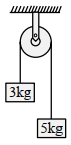
- 9Two blocks of masses $3 \,{kg}$ and $5\, {kg}$ are connected by a metal wire going over a smooth pulley. The breaking stress of the metal is $\frac{24}{\pi} \times 10^{2}\, {Nm}^{-2}$. What is the minimum radius of the wire? (Take $\left.g=10\, {ms}^{-2}\right)$ (in $cm$)View Solution
- 10Young’s moduli of two wires $A$ and $B$ are in the ratio $7 : 4$. Wire $A$ is $2\, m$ long and has radius $R$. Wire $A$ is $2\, m$ long and has radius $R$. Wire $B$ is $1.5\, m$ long and has radius $2\, mm$. If the two wires stretch by the same length for a given load, then the value of $R$ is close to ......... $mm$View Solution