MCQ
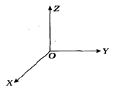
A force of $-F$$\hat k$ acts on $O$, the origin of the coordinate system. The torque about the point $(1, -1)$ is
  • A
    $-F$($\hat i$ - $\hat j$)
  • B
    $F$($\hat i$ - $\hat j$)
  • $F$($\hat i$ + $\hat j$)
  • D
    $-F$($\hat i$ + $\hat j$)

Answer

Correct option: C.
$F$($\hat i$ + $\hat j$)
c
$\begin{array}{l}
Torque\,\overline \tau   = \,\overline r  \times \overline F  = \left( {\hat i - \hat j} \right) \times \left( { - F\hat k} \right)\\
 =  F\left( {\hat i + \hat j} \right)
\end{array}$

Need a full question paper?

Generate a complete, print-ready paper with questions like this in minutes — across 16+ boards, with answer keys.

Start Generating Free

Similar questions

The X-ray beam emerging from an X-ray tube:
A $2\,kg$ block slides on a horizontal floor with a speed of $4\, m/s$. It strikes a  uncompressed spring, and compresses it till the block is motionless. The kinetic friction  force is $110\,N$ and spring constant is $1000\, N/m$. The spring compresses by ........ $cm$
Particles of masses 2M, m and M are respectively at points A, B and C with AB = ½ (BC). m is muchmuch smaller than M and at time t = 0, they are all at rest. At subsequent times before any collision takes place:
A particle stays at rest as seen in a frame. We can conclude that:
  1. The frame is inertial.
  2. Resultant force on the particle is zero.
  3. The frame may be inertial but the resultant force on the particle is zero.
  4. The frame may be non$-$inertial but there is a non$-$zero resultant force.
The radius of a disc is $1.2\; cm$. Its area according to the concept of significant figures will be given by
Three identical spheres, each of mass $M ,$ are placed at the corners of a right angle triangle with mutually perpendicular sides equal to $2 \;m$ (see figure). Taking the point of intersection of the two mutually perpendicular sides as the origin, find the position vector of centre of mass.
This question has Statement $1$ and Statement $2$. Of the four choices given after the Statements, choose the one that best describes the two Statements.

Statement $1$: If you push on a cart being pulled by a horse so that it does not move, the cart pushes you back with an equal and opposite force.

Statemf'nt $2$: The cart does not move because the force described in statement $1$ cancel each other

A cricket ball of mass $150g$ has an initial velocity $\text{u}=(3\hat{\text{i}}+4\hat{\text{j}})\text{m s}^{-1}$ and a final velocity $\text{v}=-(3\hat{\text{i}}+4\hat{\text{j}})\text{m s}^{-1}$ after being hit. The change in momentum $($final momentum$-$initial momentum$)$ is $($in $kg m s^1):$
Consider a carnot's cycle operating between $T_1 = 500\,K$ and $T_2 = 300\,K$ producing $1\,kJ$ of mechanical work per cycle. Find the heat transferred to the engine by the reservoirs  .... $J$
A steel ball and a rubber ball of equal weight are dropped from the same height on a firm surface then: