MCQ
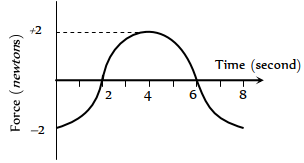
A force-time graph for a linear motion is shown in figure where the segments are circular. The linear momentum gained between zero and 8 second is
Image

  • A
    $-2 \pi$ newton $\times$ second
  • Zero newton $\times$ second
  • C
    $+4 \pi$ newton $\times$ second
  • D
    $-6 \pi n$ newton $\times$ second

Answer

Correct option: B.
Zero newton $\times$ second
(b) As the area above the time axis is numerically equal to area below the time axis therefore net momentum gained by body will be zero because momentum is a vector quantity.

Need a full question paper?

Generate a complete, print-ready paper with questions like this in minutes — across 16+ boards, with answer keys.

Start Generating Free

Similar questions

Which one of the following statements is true for the speed $v$ and the acceleration $a$ of a particle executing simple harmonic motion
Number of particles is given by $n=-D \frac{n_2-n_1}{x_2-x_1}$ crossing a unit area perpendicular to $X$-axis in unit time, where $n_1$ and $n_2$ are number of particles per unit volume for the value of $x$ meant to $x_2$ and $x_1$. Find dimensions of $D$ called as diffusion constant
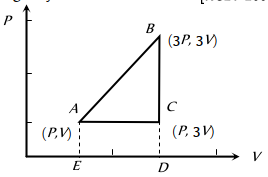
An ideal gas is taken around $\text{ABCA}$ as shown in the above $\text{P-V}$ diagram. The work done during a cycle is Image
The energy that should be added to an electron, to reduce its deBroglie wavelengths from $10^{-10} \mathrm{~m}$ to $0.5 \times 10^{-10} \mathrm{~m}$, will be
A whistle sends out 256 waves in a second. If the whistle approaches the observer with velocity $1 / 3$ of the velocity of sound in air, the number of waves per second the observer will receive
An air bubble in a water tank rises from the bottom to the top. Which of the following statements are true
  1. Bubble rises upwards because pressure at the bottom is less than that at the top.
  2. Bubble rises upwards because pressure at the bottom is greater than that at the top.
  3. As the bubble rises, its size increases
  4. As the bubble rises, its size decreases
Sinusoidal carrier voltage of frequency $1.5 \mathrm{MHz}$ and amplitude $50 \mathrm{~V}$ is amplitude modulated by sinusoidal voltage of frequency $10 \mathrm{kHz}$ producing $50 \%$ modulation. The lower and upper side-band frequencies in $\mathrm{kHz}$ are
An ideal coil of $10$ henry is joined in series with a resistance of $5$ ohm and a battery of $5$ volt. $2$ second after joining, the current flowing in ampere in the circuit will be
A $U$ tube of uniform bore of cross-sectional area $A$ has been set up vertically with open ends facing up. Now $m$ gm of a liquid of density $d$ is poured into it. The column of liquid in this tube will oscillate with a period $T$ such that
If 97.52 is divided by 2.54 , the correct result in terms of significant figures is