Questions · Page 1 of 11

MCQ

🎯

Test yourself on this topic

50 questions · timed · auto-graded

MCQ 11 Mark
Four smooth steel balls of equal mass at rest are free to move along a straight line without friction. The first ball is given a velocity of $0.4 \mathrm{~m} / \mathrm{s}$. It collides head on with the second elastically, the second one similarly with the third and so on. The velocity of the last ball is
  • $0.4 \mathrm{~m} / \mathrm{s}$
  • B
    $0.2 \mathrm{~m} / \mathrm{s}$
  • C
    $0.1 \mathrm{~m} / \mathrm{s}$
  • D
    $0.05 \mathrm{~m} / \mathrm{s}$
Answer
Correct option: A.
$0.4 \mathrm{~m} / \mathrm{s}$
In head on elastic collision velocity get interchanged (if masses of particle are equal). i.e. the last ball will move with the velocity of first ball i.e $0.4 \mathrm{~m} /\mathrm{s}$
View full question & answer
MCQ 21 Mark
Consider elastic collision of a particle of mass $m$ moving with a velocity $u$ with another particle of the same mass at rest. After the collision the projectile and the struck particle move in directions making angles $\theta_1$ and $\theta_2$ respectively with the initial direction of motion. The sum of the angles. $\theta_1+\theta_2$, is
  • A
    $45^{\circ}$
  • $90^{\circ}$
  • C
    $135^{\circ}$
  • D
    $180^{\circ}$
Answer
Correct option: B.
$90^{\circ}$
If the masses are equal and target is at rest and after collision both masses moves in different direction.
Then angle between direction of velocity will be $90^{\circ}$,ifcollision is elastic.
View full question & answer
MCQ 31 Mark
An object of mass $3 \mathrm{~m}$ splits into three equal fragments. Two fragments have velocities $\hat{v j}$ and $\hat{v i}$. The velocity of the third fragment is
  • A
    $v(\hat{j}-\hat{i})$
  • B
    $v(\hat{i}-\hat{j})$
  • $-v(\hat{i}+\hat{j})$
  • D
    $\frac{v(\hat{i}+\hat{j})}{\sqrt{2}}$
Answer
Correct option: C.
$-v(\hat{i}+\hat{j})$
View full question & answer
MCQ 41 Mark
A drop of mercury of radius $2 \mathrm{~mm}$ is split into $8$ identical droplets. Find the increase in surface energy. (Surface tension of mercury is $0.465 \mathrm{~J} / \mathrm{m}^2$ )
  • $23.4 \mu \mathrm{J}$
  • B
    $18.5 \mu \mathrm{J}$
  • C
    $26.8 \mu \mathrm{J}$
  • D
    $16.8 \mu \mathrm{J}$
Answer
Correct option: A.
$23.4 \mu \mathrm{J}$
Increase in surface energy or work done in splitting a big drop
$=4 \pi R^2 T\left(n^{1 / 3}-1\right)$
$ \Rightarrow W=4 \pi \times\left(2 \times 10^{-3}\right)^2 \times 0.465\left(8^{1 / 3}-1\right)=23.4 \mu J$
View full question & answer
MCQ 51 Mark
Water rises in a vertical capillary tube upto a height of $2.0 \mathrm{~cm}$. If the tube is inclined at an angle of $60^{\circ}$ with the vertical, then upto what length the water will rise in the tube
  • A
    $2.0 \mathrm{~cm}$
  • $4.0 \mathrm{~cm}$
  • C
    $\frac{4}{\sqrt{3}} \mathrm{~cm}$
  • D
    $2 \sqrt{2} \mathrm{~cm}$
Answer
Correct option: B.
$4.0 \mathrm{~cm}$
$l=\frac{h}{\cos \theta}=\frac{2}{\cos 60^{\circ}}=4.0 \mathrm{~cm}$
View full question & answer
MCQ 61 Mark
Two bubbles $A$ and $B(A>B)$ are joined through a narrow tube. Then
  • The size of $A$ will increase
  • B
    The size of $B$ will increase
  • C
    The size of $B$ will increase until the pressure equals
  • D
    None of these
Answer
Correct option: A.
The size of $A$ will increase
View full question & answer
MCQ 71 Mark
$1$ a.m.u. is equivalent to
  • A
    $1.6 \times 10^{-12}$ Joule
  • B
    $1.6 \times 10^{-19}$ Joule
  • $1.5 \times 10^{-10}$ Joule
  • D
    $1.5 \times 10^{-19}$ Joule
Answer
Correct option: C.
$1.5 \times 10^{-10}$ Joule
$1 \mathrm{amu}=1.66 \times 10^{-27} \mathrm{~kg}$
$E=mc^2=1.66\times10^{-27}\times\left(3 \times 10^8\right)^2=1.5 \times 10^{-10} \mathrm{~J}$
View full question & answer
MCQ 81 Mark
A particle of mass ' $m$ ' and charge ' $q$ ' is accelerated through a potential difference of ' $\mathrm{V}$ ' volt. Its energy is
  • $q V$
  • B
    $m q V$
  • C
    $\left(\frac{q}{m}\right) V$
  • D
    $\frac{q}{m V}$
Answer
Correct option: A.
$q V$
(a)
View full question & answer
MCQ 91 Mark
The energy which an $e^{-}$acquires when accelerated through a potential difference of 1 volt is called
  • A
    1 Joule
  • 1 Electron volt
  • C
    1 Erg
  • D
    1 Watt.
Answer
Correct option: B.
1 Electron volt
(b)
View full question & answer
MCQ 101 Mark
Two bodies of masses $1 \mathrm{~kg}$ and $5 \mathrm{~kg}$ are dropped gently from the top of a tower. At a point $20 \mathrm{~cm}$ from the ground, both the bodies will have the same
  • A
    Momentum
  • B
    Kinetic energy
  • Velocity
  • D
    Total energy
Answer
Correct option: C.
Velocity
(c) Velocity of fall is independent of the mass of the falling body.
View full question & answer
MCQ 111 Mark
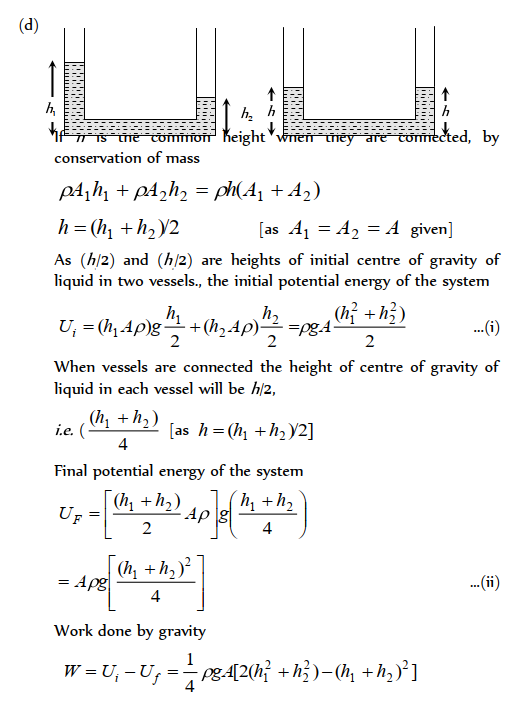
Two identical cylindrical vessels with their bases at same level each contains a liquid of density $\rho$. The height of the liquid in one vessel is $h_1$ and that in the other vessel is $h_2$. The area of either base is$A$. The work done by gravity in equalizing the levels when the two vessels are connected, is
  • A
    $\left(h_1-h_2\right) g \rho$
  • B
    $\left(h_1-h_2\right) g A \rho$
  • C
    $\frac{1}{2}\left(h_1-h_2\right)^2 g A \rho$
  • $\frac{1}{4}\left(h_1-h_2\right)^2 g A \rho$
Answer
Correct option: D.
$\frac{1}{4}\left(h_1-h_2\right)^2 g A \rho$

Image
$=\frac{1}{4} \rho g A\left(h_1 \sim h_2\right)^2$
View full question & answer
MCQ 121 Mark
The average power required to lift a $100 \mathrm{~kg}$ mass through a height of $50$ metres in approximately $50$ seconds would be
  • A
    $50 \mathrm{~J} / \mathrm{s}$
  • B
    $5000 \mathrm{~J} / \mathrm{s}$
  • C
    $100 \mathrm{~J} / \mathrm{s}$
  • $980 \mathrm{~J} / \mathrm{s}$
Answer
Correct option: D.
$980 \mathrm{~J} / \mathrm{s}$
$ P=\frac{m g h}{t}=\frac{100 \times 9.8 \times 50}{50}=980\mathrm{~J}\mathrm{s}$
View full question & answer
MCQ 131 Mark
A body of mass $10 \mathrm{~kg}$ is dropped to the ground from a height of $10$ metres. The work done by the gravitational force is $\left(g=9.8 \mathrm{~m} / \mathrm{sec}^2\right)$
  • A
    $-490$ Joules
  • B
    $+490$ Joules
  • C
    $-980$ Joules
  • $+980$ Joules
Answer
Correct option: D.
$+980$ Joules
As the body moves in the direction of force therefore work done by gravitationalforcewill be positive.
$W=F S=m g h=10 \times 9.8 \times 10=980 J$
View full question & answer
MCQ 141 Mark
The excess pressure in a soap bubble is thrice that in other one. Then the ratio of their volume is
  • A
    $1: 3$
  • B
    $1:9$
  • C
    $27: 1$
  • $1: 27$
Answer
Correct option: D.
$1: 27$
$\Delta P \propto \frac{1}{r} \Rightarrow \frac{r_1}{r_2}=\frac{\Delta P_2}{\Delta P_1}=\frac{1}{3} $
$\Rightarrow \frac{V_1}{V_2}=\left(\frac{r_1}{r_2}\right)^3=\frac{1}{27}$
View full question & answer
MCQ 151 Mark
Two masses $m_A$ and $m_B$ moving with velocities $v_A$ and $v_B$ in opposite directions collide elastically. After that the masses $m_A$ and $m_B$ move with velocity $v_B$ and $v_A$ respectively. The ratio $\left(m_A / m_B\right)$ is
  • 1
  • B
    $\frac{v_A-v_B}{v_A+v_B}$
  • C
    $\left(m_A+m_B\right) / m_A$
  • D
    $v_A / v_B$
Answer
Correct option: A.
1
(a) Since bodies exchange their velocities, hence their masses are equal so that $\frac{m_A}{m_B}=1$
View full question & answer
MCQ 161 Mark
In order to float a ring of area $0.04 \mathrm{~m}$ in a liquid of surface tension $75 \mathrm{~N} / \mathrm{m}$, the required surface energy will be
  • $3\ J$
  • B
    $6.5 \mathrm{~J}$
  • C
    $1.5 \mathrm{~J}$
  • D
    $4 \mathrm{~J}$
Answer
Correct option: A.
$3\ J$
$E=T \times \Delta A=75 \times 0.04=3 \mathrm{~J}$
View full question & answer
MCQ 171 Mark
A liquid film is formed in a loop of area $0.05 \mathrm{~m}$. Increase in its potential energy will be $(T=0.2 \mathrm{~N} / \mathrm{m})$
  • A
    $5 \times 10^{-2} J$
  • $2 \times 10^{-2} \mathrm{~J}$
  • C
    $3 \times 10^{-2} J$
  • D
    None of these
Answer
Correct option: B.
$2 \times 10^{-2} \mathrm{~J}$
Increment in Potential energy $=T \times \Delta A$$=0.02 \times 2 \times 0.05=2 \times 10^{-2} \mathrm{~J}$
View full question & answer
MCQ 181 Mark
The correct relation is
  • $r=\frac{2 T \cos \theta}{h d g}$
  • B
    $r=\frac{h d g}{2 T \cos \theta}$
  • C
    $r=\frac{2 T d g h}{\cos \theta}$
  • D
    $r=\frac{T \cos \theta}{2 h d g}$
Answer
Correct option: A.
$r=\frac{2 T \cos \theta}{h d g}$
(a)
View full question & answer
MCQ 191 Mark
lt is easy to wash clothes in hot water because its
  • A
    Surface tension is more
  • Surface tension is less
  • C
    Consumes less soap
  • D
    None of these
Answer
Correct option: B.
Surface tension is less
(b) Surface tension of water decrease with rise in temperature.
View full question & answer
MCQ 201 Mark
A shell having a hole of radius $r$ is dipped in water. It holds the water upto a depth of $h$ then the value of $r$ is
  • $r=\frac{2 T}{h d g}$
  • B
    $r=\frac{T}{h d g}$
  • C
    $r=\frac{T g}{h d}$
  • D
    None of these
Answer
Correct option: A.
$r=\frac{2 T}{h d g}$
(a) $\frac{2 T}{r}=h d g \Rightarrow r=\frac{2 T}{h d g}$
View full question & answer
MCQ 211 Mark
The value of contact angle for kerosene with solid surface.
  • $0^{\circ}$
  • B
    $90^{\circ}$
  • C
    $45^{\circ}$
  • D
    $33^{\circ}$
Answer
Correct option: A.
$0^{\circ}$
(a)
View full question & answer
MCQ 221 Mark
The work done against gravity in taking $10 \mathrm{~kg}$ mass at $1 \mathrm{~m}$ height in lsec will be
  • A
    $49 \mathrm{~J}$
  • $98 \mathrm{~J}$
  • C
    $196 J$
  • D
    None of these
Answer
Correct option: B.
$98 \mathrm{~J}$
(b) Work done $=m g h=10 \times 9.8 \times 1=98 \mathrm{~J}$
View full question & answer
MCQ 231 Mark
A ball is released from certain height. It loses $50 \%$ of its kinetic energy on striking the ground. It will attain a height again equal to
  • A
    One fourth the initial height
  • Half the initial height
  • C
    Three fourth initial height
  • D
    None of these
Answer
Correct option: B.
Half the initial height
(b) Because $50 \%$ loss in kinetic energy will affect its potential energy and due to this ball will attain only half of the initial height.
View full question & answer
MCQ 241 Mark
Due to which property of water, tiny particles of camphor dance on the surface of water
  • A
    Viscosity
  • Surface tension
  • C
    Weight
  • D
    Floating force
Answer
Correct option: B.
Surface tension
(b)
View full question & answer
MCQ 251 Mark
When $10^6$ small drops coalesce to make a new larger drop then the drop
  • A
    Density increases
  • B
    Density decreases
  • Temperature increases
  • D
    Temperature decreases
Answer
Correct option: C.
Temperature increases
(c) Because energy is liberated
View full question & answer
MCQ 261 Mark
A space craft of mass $M$ is moving with velocity $V$ and suddenly explodes into two pieces. A part of it of mass $m$ becomes at rest, then the velocity of other part will be
  • $\frac{M V}{M-m}$
  • B
    $\frac{M V}{M+m}$
  • C
    $\frac{m V}{M-m}$
  • D
    $\frac{(M+m) V}{m}$
Answer
Correct option: A.
$\frac{M V}{M-m}$
After explosion $m$ mass comes at rest and let Rest $(M-m)$ mass moves with velocity$v$.By the law of conservation of momentum
$M V=(M-m) v$$\Rightarrow v=\frac{M V}{(M-m)}$
View full question & answer
MCQ 271 Mark
A steel ball of radius $2 \mathrm{~cm}$ is at rest on a frictionless surface. Another ball of radius $4 \mathrm{~cm}$ moving at a velocity of $81 \mathrm{~cm} / \mathrm{sec}$ collides elastically with first ball. After collision the smaller ball moves with speed of
  • A
    $81 \mathrm{~cm} / \mathrm{sec}$
  • B
    $63 \mathrm{~cm} / \mathrm{sec}$
  • $144 \mathrm{~cm} / \mathrm{sec}$
  • D
    None of these
Answer
Correct option: C.
$144 \mathrm{~cm} / \mathrm{sec}$
View full question & answer
MCQ 281 Mark
A body of mass $50 \mathrm{~kg}$ is projected vertically upwards with velocity of $100 \mathrm{~m} / \mathrm{sec} .5$ seconds after this body breaks into $20 \mathrm{~kg}$ and $30 \mathrm{~kg}$. If $20 \mathrm{~kg}$ piece travels upwards with $150 \mathrm{~m} / \mathrm{sec}$, then the velocity of other block will be
  • $15 \mathrm{~m} / \mathrm{sec}$ downwards
  • B
    $15 \mathrm{~m} / \mathrm{sec}$ upwards
  • C
    $51 \mathrm{~m} / \mathrm{sec}$ downwards
  • D
    $51 \mathrm{~m} / \mathrm{sec}$ upwards
Answer
Correct option: A.
$15 \mathrm{~m} / \mathrm{sec}$ downwards
(a) Velocity of $50 \mathrm{~kg}$.mass after $5\mathrm{sec}$of  projection $v=ugt=100-9.8\times 5=51 \mathrm{~m} / \mathrm{s}$
At this instant momentum of body is in upward direction $P_{\text{initial }}=50 \times 51=2550 \mathrm{~kg}-\mathrm{m} / \mathrm{s}$
After breaking $20 \mathrm{~kg}$ piece travels upwards with $150 \mathrm{~m} / \mathrm{s}$
let the speed of $30\mathrm{~kg}$ mass is $V$
$P_{\text {final }}=20 \times 150+30 \times V$
By the law of conservation of momentum $P_{\text {initial }}=P_{\text {final }} $
$\Rightarrow2550=20\times150+30\times V \Rightarrow V=-15 \mathrm{~m} / \mathrm{s}$
i.e. it moves in downward direction.
View full question & answer
MCQ 291 Mark
An object of $1 \mathrm{~kg}$ mass has a momentum of $10 \mathrm{~kg} \mathrm{~m} / \mathrm{sec}$ then the kinetic energy of the object will be
  • A
    $100 \mathrm{~J}$
  • $50 \mathrm{~J}$
  • C
    $1000 \mathrm{~J}$
  • D
    $200 \mathrm{~J}$
Answer
Correct option: B.
$50 \mathrm{~J}$
(b) $E=\frac{P^2}{2 m}=\frac{(10)^2}{2 \times 1}=50 \mathrm{~J}$
View full question & answer
MCQ 301 Mark
A capillary tube of radius $R$ is immersed in water and water rises in it to a height $H$. Mass of water in the capillary tube is $M$. If the radius of the tube is doubled, mass of water that will rise in the capillary tube will now be
  • A
    $M$
  • $2 M$
  • C
    $M / 2$
  • D
    $4 M$
Answer
Correct option: B.
$2 M$
(b) Mass of liquid in capillary tube$M=\pi R^2 H \times \rho \therefore M \propto R^2 \times\left(\frac{1}{R}\right)(\text { As } H \propto 1 / R)$$\therefore \mathrm{M} \propto R$. If radius becomes double then mass will becomes twice.
View full question & answer
MCQ 311 Mark
When a drop of water is dropped on oil surface, then
  • A
    It will mix up with oil
  • B
    lt spreads in the form of a film
  • C
    It will deform
  • lt remains spherical
Answer
Correct option: D.
lt remains spherical
(d) Because surface tension of water $>$ surface tension of oil
View full question & answer
MCQ 321 Mark
A ball is dropped from a height $h$. If the coefficient of restitution be $e$, then to what height will it rise after jumping twice from the ground
  • A
    $e h / 2$
  • B
    $2 e h$
  • C
    $e h$
  • $e^4 h$
Answer
Correct option: D.
$e^4 h$
(d) $h_n=h e^{2 n}$, if $n=2$ then $h_n=h e^4$
View full question & answer
MCQ 331 Mark
A sphere of mass $m$ moving with a constant velocity $u$ hits another stationary sphere of the same mass. If $e$ is the coefficient of restitution, then the ratio of the velocity of two spheres after collision will be
  • $\frac{1-e}{1+e}$
  • B
    $\frac{1+e}{1-e}$
  • C
    $\frac{e+1}{e-1}$
  • D
    $\frac{e-1}{e+1} t^2$
Answer
Correct option: A.
$\frac{1-e}{1+e}$
(a)
View full question & answer
MCQ 341 Mark
An inelastic ball is dropped from a height of $100 \mathrm{~m}$. Due to earth, $20 \%$ of its energy is lost. To what height the ball will rise
  • $80 \mathrm{~m}$
  • B
    $40 \mathrm{~m}$
  • C
    $60 \mathrm{~m}$
  • D
    $20 \mathrm{~m}$
Answer
Correct option: A.
$80 \mathrm{~m}$
(a) $m g h=\frac{80}{100} \times m g \times 100 \Rightarrow h=80 m$
View full question & answer
MCQ 351 Mark
Radius of a capillary is $2 \times 10^{-3} \mathrm{~m}$. A liquid of weight $6.28 \times 10^{-4} N$ may remain in the capillary then the surface tension of liquid will be
  • A
    $5 \times 10^{-3} \mathrm{~N} / \mathrm{m}$
  • $5 \times 10^{-2} \mathrm{~N} / \mathrm{m}$
  • C
    $5 \mathrm{~N} / \mathrm{m}$
  • D
    $50 \mathrm{~N} / \mathrm{m}$
Answer
Correct option: B.
$5 \times 10^{-2} \mathrm{~N} / \mathrm{m}$
(b) $T=\frac{F}{2 \pi r}=\frac{6.28 \times 10^{-4}}{2 \times 3.14 \times 2 \times 10^{-3}}=5 \times 10^{-2} \mathrm{~N} / \mathrm{m}$
View full question & answer
MCQ 361 Mark
In the elastic collision of objects
  • A
    Only momentum remains constant
  • B
    Only K.E. remains constant
  • Both remains constant
  • D
    None of these
Answer
Correct option: C.
Both remains constant
(c)
View full question & answer
MCQ 371 Mark
In Jager's method, at the time of bursting of the bubble
  • The internal pressure of the bubble is always greater than external pressure
  • B
    The internal pressure of the bubble is always equal to external pressure
  • C
    The internal pressure of the bubble is always less than external pressure
  • D
    The internal pressure of the bubble is always slightly greater than external pressure
Answer
Correct option: A.
The internal pressure of the bubble is always greater than external pressure
(a)
View full question & answer
MCQ 381 Mark
A tennis ball is released from height $h$ above ground level. If the ball makes inelastic collision with the ground, to what height will it rise after third collision
  • $h e^6$
  • B
    $e^2 h$
  • C
    $e^3 h$
  • D
    None of these
Answer
Correct option: A.
$h e^6$
(a) $\quad h_n=h e^{2 n}$ after third collision $h_3=h e^6 \quad$ [as $n=3$ ]
View full question & answer
MCQ 391 Mark
A particle of mass $m$ moving with velocity $V_0$ strikes a simple pendulum of mass $m$ and sticks to it. The maximum height attained by the pendulum will be
  • $h=\frac{V_0^2}{8 g}$
  • B
    $\sqrt{V_0 g}$
  • C
    $2 \sqrt{\frac{V_0}{g}}$
  • D
    $\frac{V_0^2}{4 g}$
Answer
Correct option: A.
$h=\frac{V_0^2}{8 g}$
View full question & answer
MCQ 401 Mark
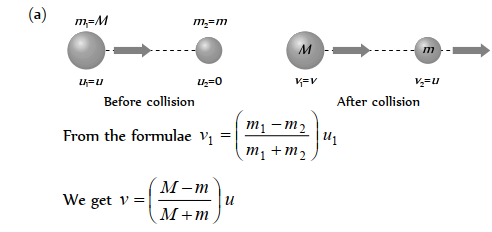
A big ball of mass $M$, moving with velocity $u$ strikes a small ball of mass $m$, which is at rest. Finally small ball obtains velocity $u$ and big ball $v$. Then what is the value of $v$
  • $\frac{M-m}{M+m} u$
  • B
    $\frac{m}{M+m} u$
  • C
    $\frac{2 m}{M+m} u$
  • D
    $\frac{M}{M+m} u$
Answer
Correct option: A.
$\frac{M-m}{M+m} u$

Image
View full question & answer
MCQ 411 Mark
If liquid level falls in a capillary then radius of capillary will
  • Increase
  • B
    Decrease
  • C
    Unchanged
  • D
    None of these
Answer
Correct option: A.
Increase
(a) $h \propto \frac{1}{r} \therefore r h=\mathrm{constant}$
View full question & answer
MCQ 421 Mark
If capillary experiment is performed in vacuum then for a liquid there
  • It will rise
  • B
    Will remain same
  • C
    It will fall
  • D
    Rise to the top
Answer
Correct option: A.
It will rise
(a)
View full question & answer
MCQ 431 Mark
Nature of meniscus for liquid of $0^{\circ}$ angle of contact
  • A
    Plane
  • B
    Parabolic
  • Semi-spherical
  • D
    Cylindrical
Answer
Correct option: C.
Semi-spherical
(c)
View full question & answer
MCQ 441 Mark
If two identical mercury drops are combined to form a single drop, then its temperature will
  • A
    Decrease
  • Increase
  • C
    Remains the same
  • D
    None of the above
Answer
Correct option: B.
Increase
(b) Surface energy of combined drop will be lowered, so excess surface energy will raise the temperature of the drop.
View full question & answer
MCQ 451 Mark
If pressure at half the depth of a lake is equal to $2 / 3$ pressure at the bottom of the lake then what is the depth of the lake
  • A
    $10 \mathrm{~m}$
  • $20 \mathrm{~m}$
  • C
    $60 \mathrm{~m}$
  • D
    $30 \mathrm{~m}$
Answer
Correct option: B.
$20 \mathrm{~m}$
(b) Pressure at half the depth $=P_0+\frac{h}{2} d g$Pressure at the bottom $=P_0+h d g$According to given condition$\begin{aligned}& P_0+\frac{h}{2} d g=\frac{2}{3}\left(P_0+h d g\right) \\& \Rightarrow 3 P_0+\frac{3 h}{2} d g=2 P_0+2 h d g \\& \Rightarrow h=\frac{2 P_0}{d g}=\frac{2 \times 10^5}{10^3 \times 10}=20 \mathrm{~m}\end{aligned}$
View full question & answer
MCQ 461 Mark
A car of mass $1250 \mathrm{~kg}$ is moving at $30 \mathrm{~m} / \mathrm{s}$. Its engine delivers $30 \mathrm{~kW}$ while resistive force due to surface is $750 N$. What max acceleration can be given in the car
  • A
    $\frac{1}{3} \mathrm{~m} / \mathrm{s}^2$
  • B
    $\frac{1}{4} m / s^2$
  • $\frac{1}{5} \mathrm{~m} / \mathrm{s}^2$
  • D
    $\frac{1}{6} m / \mathrm{s}^2$
Answer
Correct option: C.
$\frac{1}{5} \mathrm{~m} / \mathrm{s}^2$
Force produced by the engine $F=\frac{P}{v}=\frac{30 \times 10^3}{30}=10 \mathrm{~N}$
$\text { Acceleration }=\frac{\text{Forward force by engine}}{\text{resistiveforce}}{\text { mass of car }}$
$ =\frac{1000-750}{1250}=\frac{250}{1250}=\frac{1}{5}\mathrm{~m}\mathrm{s}^2$
View full question & answer
MCQ 471 Mark
A bomb of $12 \mathrm{~kg}$ divides in two parts whose ratio of masses is $1: 3$. If kinetic energy of smaller part is $216 \mathrm{~J}$, then momentum of bigger part in $\mathrm{kgm} / \mathrm{sec}$ will be
  • $36$
  • B
    $72$
  • C
    $108$
  • D
    Data is incomplete
Answer
Correct option: A.
$36$
The bomb of mass $12$ kg divides into two masses $m$ and $m$ then $m_1+m_2=12\dots(i)$
and $\frac{m_1}{m_2}=\frac{1}{3}\dots(ii)$
by solving we get $m_1=3 kg$ and $m_2=9 kg$
Kinetic energy of smaller part $=\frac{1}{2} m_1 v_1^2=216 J$
$\therefore v_1^2=\frac{216 \times 2}{3} \Rightarrow v_1=12 m / s$
So its momentum $=m_1 v_1=3 \times 12=36 kg- m / s$
As both parts possess same momentum therefore momentum of each part is $36 kg- m / s$
View full question & answer
MCQ 481 Mark
By inserting a capillary tube upto a depth $/$ in water, the water rises to a height $h$. If the lower end of the capillary is closed inside water and the capillary is taken out and closed end opened, to what height the water will remain in the tube
  • A
    Zero
  • B
    $l+h$
  • C
    $2 h$
  • $h$
Answer
Correct option: D.
$h$
(d) The water rises to height $h$ due to capilarity.
View full question & answer
MCQ 491 Mark
If the increase in the kinetic energy of a body is $22 \%$, then the increase in the momentum will be
  • A
    $22 \%$
  • B
    $44 \%$
  • $10 \%$
  • D
    $300 \%$
Answer
Correct option: C.
$10 \%$
$P=\sqrt{2 m E}$. If $m$ is constant then
$\frac{P_2}{P_1}=\sqrt{\frac{E_2}{E_1}}=\sqrt{\frac{1.22 E}{E}} \Rightarrow \frac{P_2}{P_1}=\sqrt{1.22}=1.1$
$\Rightarrow P_2=1.1 P_1 \Rightarrow P_2=P_1+0.1 P_1=P_1+10 \% \text { of } P_1$
So the momentumwill increase by $10 \%$
View full question & answer
MCQ 501 Mark
An air bubble in a water tank rises from the bottom to the top. Which of the following statements are true
  1. Bubble rises upwards because pressure at the bottom is less than that at the top.
  2. Bubble rises upwards because pressure at the bottom is greater than that at the top.
  3. As the bubble rises, its size increases
  4. As the bubble rises, its size decreases
  • $2$ and $3$
  • B
    $1$ and $4$
  • C
    $1$ and $3$
  • D
    $1$ and $2$
Answer
Correct option: A.
$2$ and $3$
$P_{\text {Bottom }}>P_{\text {Surface }}$. So bubble rises upward. At constant temperature $V \propto \frac{1}{P} ($Boyle's law$)$ Since as the bubble rises upward, pressure decreases, then from above law volume of bubble will increase $i.e.$ its size increases.
View full question & answer