MCQ
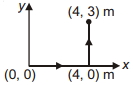
A force $\vec{F}=(3 \vec{i}+4 \vec{j}) \;N$ acts on a particle moving in $x-y$ plane. Starting from origin, the particle first goes along $x$-axis to the point $(4,0) \,m$ and then parallel to the $y$-axis to the point $(4,3) \,m$. The total work done by the force on the particle is ............. $J$
  • A
    $+12$
  • B
    $-6$
  • C
    $-12$
  • $+24$

Answer

Correct option: D.
$+24$
d
(d)

$\vec{F}=3 \hat{i}+4 \hat{j}$

Displacement vector $(\vec{x})=4 \hat{i}+3 \hat{j}$

$\vec{F} \cdot \vec{x}=(3 i+4 \hat{j}) \cdot(4 \hat{i}+3 \hat{j})$

$=12+12=24 \,J$

Need a full question paper?

Generate a complete, print-ready paper with questions like this in minutes — across 16+ boards, with answer keys.

Start Generating Free

Similar questions

Four identical rods of same material are joined end to end to form a square. If the temperature difference between the ends of a diagonal is ${100^o}C$, then the temperature difference between the ends of other diagonal will be ........ $^oC$
A ball is projected with a velocity, $10 ms ^{-1}$, at an angle of $60^{\circ}$ with the vertical direction. Its speed at the highest point of its trajectory will be$............... ms ^{-1}$
A constant power is supplied to a rotating disc. Angular velocity $\left( \omega  \right)$ of disc varies with number of rotations $(n)$ made by the disc as
$A$ man weighing $80\, kg$ is standing at the centre of a flat boat and he is $20\, m$ from the shore. He walks $8\, m$ on the boat towards the shore and then halts. The boat weight $200\, kg$. ........ $m$ far is he from the shore at the end of this time.
Where will it be profitable to purchase $1$ kilogram sugar
An adiabatic process occurs at constant
A students measures the distance traversed in free fall of a body, the initially at rest, in a given time. He uses this data to estimate $g$ , the acceleration due to gravity . If the maximum percentage errors in measurement of the distance and the time are $e_1$ and $e_2$ respectively, the percentage error in the estimation of $g$ is 
Find ratio of acceleration and angular acceleration of com ? If for the below diagram $m =2 \,kg$ and $r =10\, cm$
The period of oscillation of a simple pendulum in the experiment is recorded as $2.63\, s, 2.56 s, 2.42\, s, 2.71\, s$ and $2.80 \,s$ respectively. The average absolute error is ......... $s$
When we rub our palms they gets heated but to a maximum temperature because