MCQ
A frame of reference that is accelerated with respect to an inertial frame of reference is called a non-inertial frame of reference. A coordinate system fixed on a circular disc rotating about a fixed axis with a constant angular velocity $\omega$ is an example of a non-intertial fiame of reference. The relationship between the force $\vec{F}_{\text {rot }}$ experienced by a particle of nass in moving on the rotating disc and the force $\vec{F}_{\text {in }}$ experienced by the particle in an inertial frame of reference is

$\vec{F}_{\text {rot }}=\vec{F}_{\text {in }}+2 m\left(\vec{v}_{\text {rot }} \times \vec{\omega}\right)+m(\vec{\omega} \times \vec{r}) \times \vec{\omega},$

where $\vec{v}_{\text {rot }}$ is the velocity of the particle in the rotating frame of reference and $\bar{r}$ is the position vector of the particle with respect to the centre of the disc.

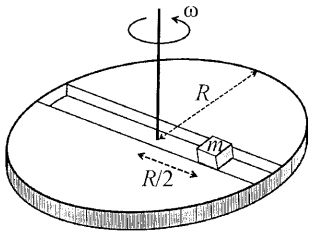
Now consider a smooth slot along a diameter of a disc of radius $R$ rotating counter-clockwise with a constant angular speed $\omega$ about its vertical axis through its center. We assign a coordinate system with the origin at the center of the disc, the $x$-axis along the slot, the $y$-axis perpendicular to the slot and the $z$-axis along the rotation axis $(\vec{\omega}=\omega \hat{k})$. A sm a $1$ block of mass $m$ is gently placed in the slot at $\vec{r}=(R / 2) \hat{i}$ at $t=0$ and is constrained to move only along the slot.

(Image)

($1$) The distance $r$ of the block at time $t$ is

($A$) $\frac{R}{4}\left(e^{\omega t}+e^{-\omega t}\right)$   ($B$) $\frac{R}{2} \cos \omega t$   ($C$) $\frac{R}{4}\left(e^{2 \omega t}+e^{-2 \omega t}\right)$

($D$) $\frac{F}{2} \cos 2 \omega t$

($2$) The net reaction of the disc on the block is

($A$) $\frac{1}{2} m \omega^2 R\left(e^{2 \omega t}-e^{-2 \omega t}\right) \hat{j}+m g \hat{k}$

($B$) $\frac{1}{2} m \omega^2 R\left(e^{\omega t}-e^{-a t t}\right) j+m g k$

($C$) $-m \omega^2 R \cos \omega t \hat{j}-m g \hat{k}$

($D$) $m \omega^2 R \sin \omega t \hat{j}-m g \hat{k}$

Give the answer quetioin ($1$) ($2$)
  • $A,B$
  • B
    $A,C$
  • C
    $A,D$
  • D
    $A,B,C$

Answer

Correct option: A.
$A,B$
a
$1.$ $\text { Force on the block along slat }=m r \omega^2=m v \frac{d v}{d r}$

$\therefore \int_o^v V d v=\int_{R / 2}^r \omega^2 r d r \Rightarrow V=\omega \sqrt{r^2-\frac{R^2}{4}}=\frac{d r}{d t}$

$\therefore \int_{R / 2}^r \frac{d r}{\sqrt{r^2-\frac{R^2}{4}}}=\int_o^t \omega d t$

On solving we get

$r+\sqrt{r^2-\frac{R^2}{4}}=\frac{R}{2} e^{w t}$

or $r^2-\frac{R^2}{4}=\frac{R^2}{4} e^{2 w t}+r^2-2 r \frac{R}{2} e^{w t}$

$\therefore r=\frac{R}{4}\left(e^{w t}+e^{-w t}\right)$

Need a full question paper?

Generate a complete, print-ready paper with questions like this in minutes — across 16+ boards, with answer keys.

Start Generating Free

Similar questions

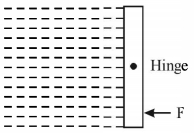
A square gate of size $1\,m \times 1\,m$ is hinged at its mid-point. A fluid of density $\rho$ fills the space to the left of the gate. The force F required to hold the gate stationary is
Which of the following statement is true about magnetic moments of atoms of different elements
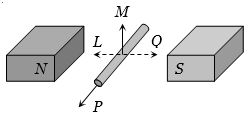
An electric potential difference will be induced between the ends of the conductor shown in the diagram, when the conductor moves in the direction
$L,\, C$ and $R$ denote inductance, capacitance and resistance respectively. Pick out the combination which does not have the dimensions of frequency
Two thin lenses of focal lengths ${f_1}$ and ${f_2}$ are in contact and coaxial. The combination is equivalent to a single lens of power
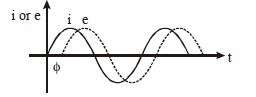
When an ac source of $e.m.f.\ e = E_0 sin(100t)$ is connected across a circuit, the phase difference between the $e.m.f.\ e$ and the current $i$ in the circuit is observed to be $\frac{\pi }{4}$ as shown in the diagram. If the circuit consists possibly only of $ RC$ or $ RL $ or $ LC$ in series, find the relationship between the two elements
If a cube of ice is placed in gravity free space, then when the ice melts.
A pure semiconductor behaves slightly as a conductor at
At any instant, two elements $X _1$ and $X _2$ have same number of radioactive atoms. If the decay constant of $X _1$ and $X _2$ are $10 \lambda$ and $\lambda$ respectively. then the time when the ratio of their atoms becomes $\frac{1}{e}$ respectively will be
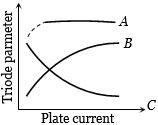
The figure represents variation of triode parameter ($\pi$ or $r_p$ or gm) with the plate current. The correct variation of $\mu$and rp are given, respectively by the curves