Question
A pure semiconductor behaves slightly as a conductor at

Answer

(a)At room temperature some covalent bond breaks and semiconductor behaves slightly as a conductor.

Need a full question paper?

Generate a complete, print-ready paper with questions like this in minutes — across 16+ boards, with answer keys.
Start Generating Free

Similar questions

Two identical non-conducting thin hemispherical shells each of radius $R$ are  brought in contact to make a complete sphere . If a total charge $Q$ is uniformly distributed on them, how much minimum force $F$ will  be required to hold them together
A flywheel can rotate in order to store kinetic energy. The flywheel is a uniform disk made of a material with a density $\rho $ and tensile strength $\sigma $ (measured in Pascals), a radius $r$ , and a thickness $h$ . The flywheel is rotating at the maximum possible angular velocity so that it does not break. Which of the following expression correctly gives the maximum kinetic energy per kilogram that can be stored in the flywheel ? Assume that $\alpha $ is a dimensionless constant
Curie's law states that
The Doppler's effect is applicable for
The rest mass of the photon is
A Galileo telescope has an objective of focal length $100\,cm$ and magnifying power $50$. The distance between the two lenses in normal adjustment will be......$cm$
At a point $20\, cm$ from the centre of a uniformly charged dielectric sphere of radius $10\, cm$, the electric field is $100\, V/m$. The electric field at $3\, cm$ from the centre of the sphere will be.......$V/m$
A conducting metal circular-wire-loop of radius $r$ is placed perpendicular to a magnetic field which varies with time as $B = {B_0}{e^{\frac{{ - t}}{\tau }}}$ , where $B_0$ and $\tau $ are constants, at time $t = 0$. If the resistance of the loop is $R$ then the heat generated in the loop after a long time $\left( {t \to \infty } \right)$ is
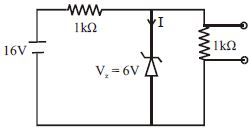
What is value of current $I$ in given circuit..........$mA$
Light is incident normally on a diffraction grating through which the first order diffraction is seen at $32^\circ$. The second order diffraction will be seen at