MCQ
A free neutron decays into a proton, an electron and
  • A
    A neutrino
  • An antineutrino
  • C
    An alpha particle
  • D
    A beta particle

Answer

Correct option: B.
An antineutrino
b
$_0{n^1}{ = _1}{p^1}{ + _{ - 1}}{e^0} + \bar \nu $
Antineutrino is required for conservation of spin.

Need a full question paper?

Generate a complete, print-ready paper with questions like this in minutes — across 16+ boards, with answer keys.

Start Generating Free

Similar questions

It is possible to recognise a person by hearing his voice even if he is hidden behind a wall. This is due to the fact that his voice
$Assertion$ : There are very small sporadic changes in the speed of rotation of the earth
$Reason$ : Shifting of large air masses in the earth's atmosphere produce a change in the moment of inertia of the earth causing its speed of rotation to change.
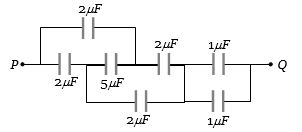
The effective capacitance between the points $P$ and $Q$ of the arrangement shown in the figure is......$\mu F$
In Young's double slit experiment, the distance between the two slits is $0.1 \,mm$ and the wavelength of light used is $4 \times {10^{ - 7}}m$. If the width of the fringe on the screen is $4\, mm$, the distance between screen and slit is
The quantities which have the same dimensions as those of solid angle are:
Calculate the critical angle for glass air surface, if a ray of light which is incident in air on  the glass surface is deviated through $15^o$, when angle of incidence is $45^o$.......$^o$
Which of the following does not give Fehling solution test?
Consider two thermometers $T_1$ and $T_2$ of equal length, which can be used to measure temperature over the range $\theta_1$ to $\theta_2$. $T_1$ contains mercury as the thermometric liquid, while $T_2$ contains bromine. The volumes of the two liquids are the same at the temperature $\theta_1$. The volumetric coefficients of expansion of mercury and bromine are $18 \times 10^{-5} \,K ^{-1}$ and $108 \times 10^{-5} \,K ^{-1}$, respectively. The increase in length of each liquid is the same for the same increase in temperature. If the diameters of the capillary tubes of the two thermometers are $d_1$ and $d_2$, respectively. Then, the ratio of $d_1: d_2$ would be closest to
A body, thrown upwards with some velocity, reaches the maximum height of $20\,m$. Another body with double the mass thrown up, with double initial velocity will reach a maximum height of..........$m$
An automobile of mass $'m'$ accelerates starting from origin and initially at rest, while the engine supplies constant power $P$. The position is given as a function of time by: