MCQ
A frictionless heat engine can be $100 \%$ efficient only if its exhaust temperature is ............
  • A
    Equal to its input temperature
  • B
    Less than its input temperature
  • $0 \,K$
  • D
    $0^{\circ} C$

Answer

Correct option: C.
$0 \,K$
c
(c)

$\because \eta=1-\frac{T_2}{T_1}$

If exhaust temperature zero kelvin then $\eta=100 \%$.

Need a full question paper?

Generate a complete, print-ready paper with questions like this in minutes — across 16+ boards, with answer keys.
Start Generating Free

Similar questions

A projectile is fired from the surface of the earth with a velocity of $5\ m s^{-1}$ and angle $\theta$ with the horizontal. Another projectile fired from another planet with a velocity of $3\ ms^{-1}$ at the same angle follows a trajectory which is identical with the trajectory of the projectile fired from the earth. The value of the acceleration due to gravity on the planet is $($ in $m s^{-1})$ is $($Given $g = 9.8\ m s^{-2})$
The radii of two planets $A$ and $B$ are $R$ and $4 R$ and their densities are $\rho$ and $\rho / 3$ respectively. The ratio of acceleration due to gravity at their surfaces $\left(g_A: g_B\right)$ will be
Wave equations of two particles are given by ${y_1} = a\sin (\omega \,t - kx)$, ${y_2} = a\sin (kx + \omega \,t)$, then
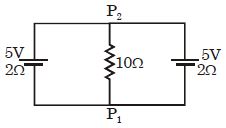
Find the current in the $10\, \Omega$ resistance
A particle moving in a straight line covers half the distance with speed $6 m / s$. The other half is covered in two equal time intervals with speeds $9 m / s$ and $15 m / s$ respectively. The average speed of the particle during the motion is:
A sonometer wire, with a suspended mass of $M = 1\, kg$, is in resonance with a given tuning fork. The apparatus is taken to the moon where the acceleration due to gravity is $(1/6)$ that on earth. To obtain resonance on the moon, the value of $M$ should be ......... $kg$
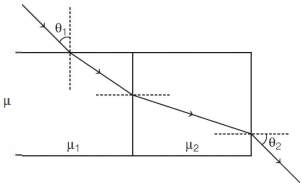
In the figure given below, a ray of light travelling in a medium of refractive index $\mu$ passes through two different connected rectangular blocks of refractive indices $\mu_1$ and $\mu_2\left(\mu_2 > \mu_1\right)$ The angle of incidence $\theta_1$ is increased slightly. Then, the angle $\theta_2$ is
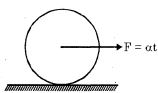
A sphere of mass $m$ and radius $R$ is kept on arough horizontal surface and pulled with a horizontal force $F = \alpha\ t$ where $\alpha$  is a constant and $t$ is time. The coefficient of static friction is $μ_s$ and coefficient of kinetic friction is $μ_k$ . Which of the following graph correctly shows the variation of acceleration of sphere with time ?
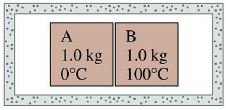
Objects $A$ and $B$ that are initially separated from each other and well isolated from their surroundings are then brought into thermal contact. Initially $T_A= 0^oC$ and $T_B = 100^oC$. The specific heat of $A$ is less than the specific heat of $B$. After some time, the system comes to an equilibrium state. The final temperatures are :
In a transistor in $CE$  configuration, the ratio of power gain to voltage gain is