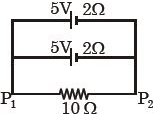
Find the current in the $10\, \Omega$ resistance
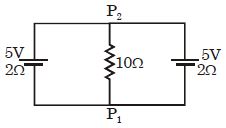
  • A$0.27\, A \,P_2$ to $P_1$
  • B$0.03 \,A \,P_2$ to $P_1$
  • C$0.45\, A \,P_2$ to $P_1$
  • D$0.27\, A\, P_1$ to $P_2$
Diffcult
art

Download our app
and get started for free

Experience the future of education. Simply download our apps or reach out to us for more information. Let's shape the future of learning together!No signup needed.*

Similar Questions

  • 1
    In the given figure each plate of capacitance $C$ has partial value of charge
    View Solution
  • 2
    Two identical cells, when connected either in parallel or in series gives same current in an external resistance $5\,\Omega$. The internal resistance of each cell will be $.............\,\Omega$.
    View Solution
  • 3
    The $V-i$ graph for a conductor at temperature ${T_1}$ and ${T_2}$ are as shown in the figure. $({T_2} - {T_1})$ is proportional to
    View Solution
  • 4
    Find the charge on the capacitor $C$ in the following circuit ............. $\mu C$
    View Solution
  • 5
    As shown in the figure, a network of resistors is connected to a battery of $2\,V$ with an internal resistance of $3\,\Omega$. The currents through the resistors $R_4$ and $R_5$ are $I_4$ and $I_5$ respectively. The values of $I_4$ and $I_5$ are :
    View Solution
  • 6
    Two cells, $e.m.f.$ of each is $E$ and internal resistance $r$ are connected in parallel between the resistance $R$. The maximum energy given to the resistor will be, only when
    View Solution
  • 7
    In the given circuit the cells have zero internal resistance. The currents (in Amperes) passing through resistance $R_1$ and $R_2$ respectively, are
    View Solution
  • 8
    The resistances of the four arms $P, Q, R$ and $S$ in a Wheatstone's bridge are $10\,ohm$, $30\,ohm$, $30\,ohm$ and $90\,ohm$, respectively. The e.m.f. and internal resistance of the cell are $7\,volt$ and $5\,ohm$ respectively. If the galvanometer resistance is $50\,ohm$, the current drawn from the cell will be ............... $A$
    View Solution
  • 9
    Consider a block of conducting material ofresistivity '$\rho$' shown in the figure. Current '$I$' enters at '$A$' and leaves from '$D$'. We apply superp osition principle to find voltage '$\Delta  V$ ' developed between '$B$' and '$C$'. The calculation is done in the following steps:
    $(i)$ Take current '$I$' entering from '$A$' and assume it to spread over a hemispherical surface in the block.
    $(ii)$ Calculatefield $E(r)$ at distance '$r$' from $A$ by using Ohm's law $E = \rho  j$, where j is the current per unit area at '$r$'.
    $(iii)$ From the '$r$' dependence of $E(r)$, obtain the potential $V(r)$ at $r$.
    $(iv)$ Repeat $(i), (ii)$ and $(iii)$ for current '$I$' leaving '$D$' and superpose results for '$A$' and '$D$'.

    For current entering at $A$, the electric field at a distance '$r$'
    from $A$ is

    View Solution
  • 10
    $A$ Wheatstone's bridge is balanced with a resistance of $625\, \Omega$ in the third arm, where $P, Q$ and $S$ are in the $1^{st}, 2^{nd}$ and $4^{th}$ arm respectively. If $P$ and $Q$ are interchanged, the resistance in the third arm has to be increased by $51\,\Omega$ to secure balance. The unknown resistance in the fourth arm is ............. $\Omega$
    View Solution