Question
A function f(x) is said to be continuous in an open interval (a, b), if it is continuous at every point in this interval.
A function f(x) is said to be continuous in the closed interval [a, b), if f(x) is continuous in (a, b) and $\lim\limits_{\text{x}\rightarrow0}\text{f}(\text{a}+\text{h})=\text{f}(\text{a})$ and $\lim\limits_{\text{x}\rightarrow0}\text{f}(\text{b}-\text{h})=\text{f}(\text{b})$
If function $\text{f}(\text{x})=\begin{cases}\frac{\sin(\text{a}+1)\text{x}+\sin\text{x}}{\text{x}}&,\text{x}<0\\\text{c}&,\text{x}=0\\\frac{\sqrt{\text{x}+\text{bx}^2}-\sqrt{\text{x}}}{\text{bx}^{\frac{3}{2}}}&,\text{x}>0\end{cases}$ is continuous at x = 0, then answer the following questions.
  1. The value of a is:
  1. $-\frac{3}{2}$
  2. $0$
  3. $\frac{1}{2}$
  4. $-\frac{1}{2}$
  1. The value of b is:
  1. 1
  2. -1
  3. 0
  4. Any real number.
  1. The value of c is:
  1. $1$
  2. $\frac{1}{2}$
  3. $-1$
  4. $-\frac{1}{2}$
  1. The value of a + c is:
  1. 1
  2. 0
  3. -1
  4. -2
  1. The value of c - a is:
  1. 1
  2. 0
  3. -1
  4. 2

Answer

$\text{L.H.L.}(\text{at x})=\lim\limits_{\text{x}\rightarrow0}\frac{\sin(\text{a}+1)\text{x}+\sin\text{x}}{\text{x}}\Big(\frac{0}{0}\text{ form}\Big)$
Using L' Hospital rule, we get
$\text{L.H.L.} (\text{at x} = 0)$
$=\lim\limits_{\text{x}\rightarrow0}(\text{a}+1)\cos(\text{a}+1)\text{x}+\cos\text{x}=\text{a}+2$
$\text{R.H.L.} (\text{at x} = 0)=\lim\limits_{\text{x}\rightarrow0}\frac{\sqrt{\text{x}+\text{bx}^2}-\sqrt{\text{x}}}{\text{bx}^\frac{3}{2}}=\lim\limits_{\text{x}\rightarrow0}\frac{\sqrt{1+\text{bx}}-1}{\text{bx}}$
$=\lim\limits_{\text{x}\rightarrow0}\frac{1}{\sqrt{1+\text{bx}}+1}=\frac{1}{2}$
Since,f(x) is continuous at x = 0.
$\therefore$ From (i) and (ii), we get
$\text{a}+2=\text{c}=\frac{1}{2}\Rightarrow\text{a}=-\frac{3}{2},\text{c}=\frac{1}{2}$
Also, value of b does not affect the continuity of f(x), so b can be any real number.
  1. (a) $-\frac{3}{2}$
  1. (d) Any real number.
  1. (b) $\frac{1}{2}$
  1. (c) -1
Solution:

$\text{a}+\text{c}=-\frac{3}{2}+\frac{1}{2}=-1$
  1. (d) 2
Solution:

$\text{c}-\text{a}=\frac{1}{2}+\frac{3}{2}=2$

Need a full question paper?

Generate a complete, print-ready paper with questions like this in minutes — across 16+ boards, with answer keys.

Start Generating Free

Similar questions

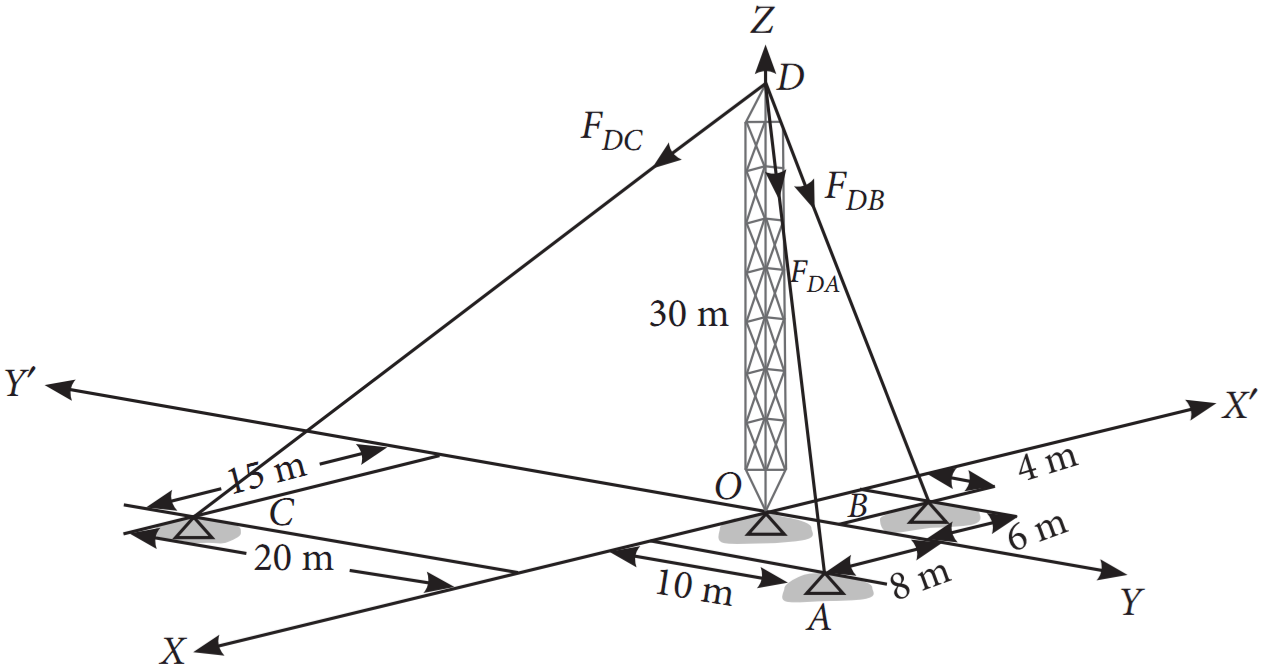
Consider the following diagram, where the forces in the cable are given. Based on the above information, answer the following questions.
  1. The equation of line along the cable AD is:
  1. $\frac{\text{x}}{5}=\frac{\text{y}}{4}=\frac{\text{z}-30}{15}$
  2. $\frac{\text{x}}{4}=\frac{\text{y}}{5}=\frac{\text{z}-30}{15}$
  3. $\frac{\text{x}}{5}=\frac{\text{y}}{4}=\frac{30-\text{z}}{15}$
  4. $\frac{\text{x}}{4}=\frac{\text{y}}{5}=\frac{30-\text{z}}{15}$
  1. The length of cable DC is:
  1. $4\sqrt{61}\text{m}$
  2. $5\sqrt{61}\text{m}$
  3. $6\sqrt{61}\text{m}$
  4. $7\sqrt{61}\text{m}$
  1. The vector DB is:
  1. $-6\hat{\text{i}}+4\hat{\text{j}}-30\hat{\text{k}}$
  2. $6\hat{\text{i}}-4\hat{\text{j}}+30\hat{\text{k}}$
  3. $6\hat{\text{i}}+4\hat{\text{j}}+30\hat{\text{k}}$
  4. None of these
  1. The sum of vectors along the cables is:
  1. $17\hat{\text{i}}+6\hat{\text{j}}+90\hat{\text{k}}$
  2. $17\hat{\text{i}}-6\hat{\text{j}}-90\hat{\text{k}}$
  3. $17\hat{\text{i}}+6\hat{\text{j}}-90\hat{\text{k}}$
  4. None of these
  1. The sum of distances of points A, B and C from the origin, i.e., OA + OB + OC is:
  1. $\sqrt{164}+\sqrt{52}+\sqrt{625}$
  2. $\sqrt{52}+\sqrt{625}+\sqrt{48}$
  3. $\sqrt{164}+\sqrt{625}+\sqrt{49}$
  4. None of these
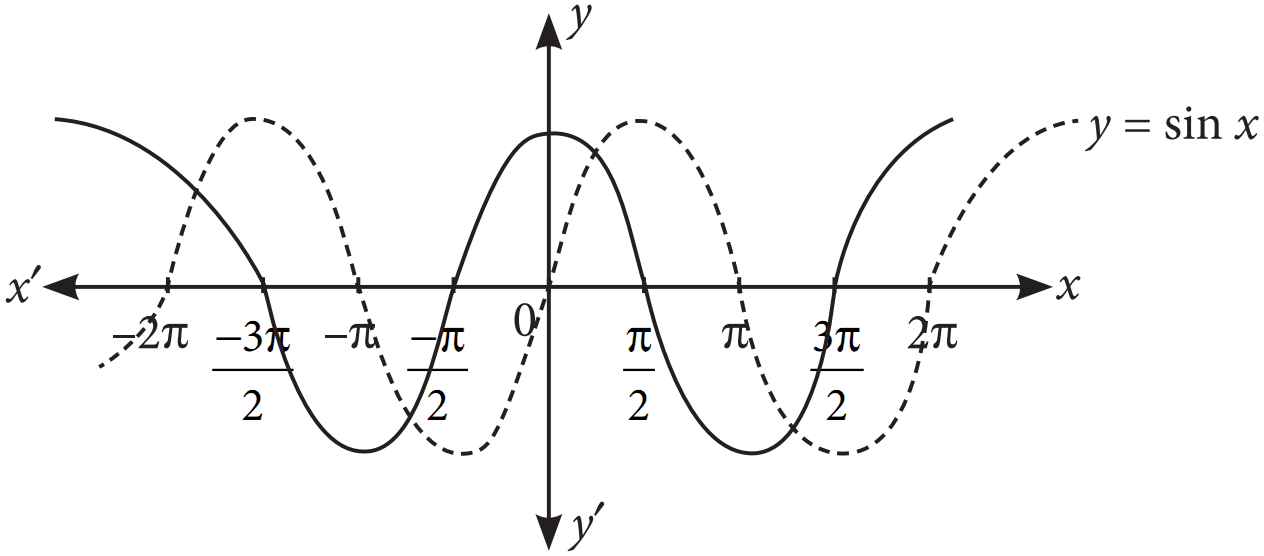
In a classroom, teacher explains the properties of a particular curve by saying that this particular curve has beautiful up and downs. It starts at 1 and heads down until $\pi$ radian, and then heads up again and closely related to sine function and both follow each other, exactly $\frac{\pi}{2}$ radians apart as shown in figure.

Based on the above information, answer the following questions.
  1. Name the curve, about which teacher explained in the classroom.
  1. Cosine
  2. Sine
  3. Tangent
  4. Cotangent
  1. Area of curve explained in the passage from 0 to $\frac{\pi}{2}$ is.
  1. $\frac{1}{3}\text{ sq.unit}$
  2. $\frac{1}{2}\text{ sq.unit}$
  3. ${1}\text{ sq.unit}$
  4. ${2}\text{ sq.units}$
  1. Area of curve discussed in classroom from $\frac{\pi}{2}$ to $\frac{3\pi}{2}$ is.
  1. -2 sq. units
  2. 2 sq. units
  3. 3 sq. units
  4. -3 sq. units
  1. Area of curve discussed in classroom from $\frac{3\pi}{2}$ to $2\pi$ is.
  1. 1 sq. unit
  2. 2 sq. units
  3. 3 sq. units
  4. 4 sq. units
  1. Area of explained curve from 0 to $2\pi$ is.
  1. 1 sq. unit
  2. 2 sq. units
  3. 3 sq. units
  4. 4 sq. units
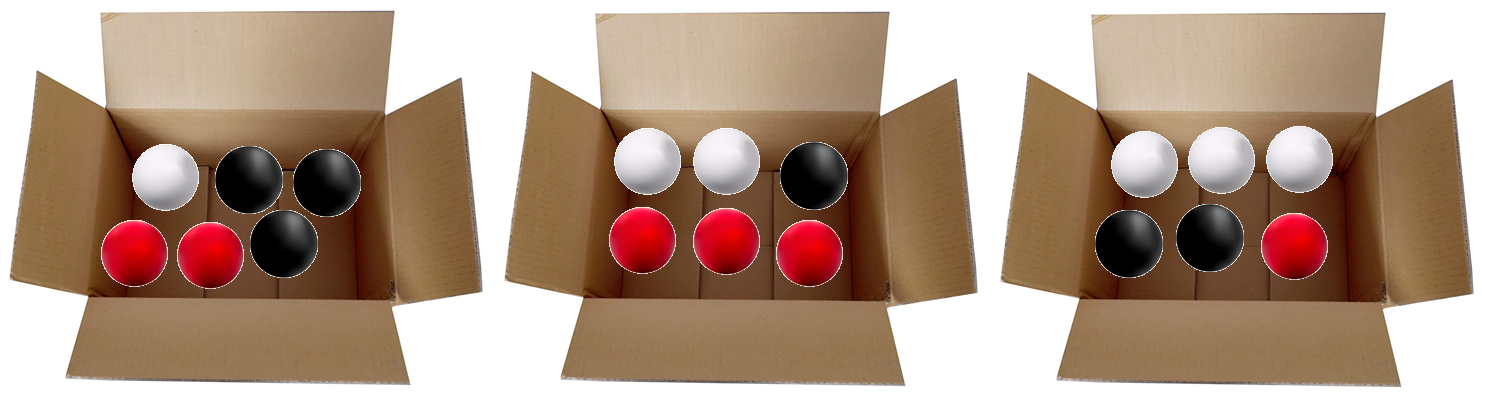
Box I contains $1$ white, $3$ black and $2$ red balls. Box II contains $2$ white, $1$ black and $3$ red balls. Box III contains $3$ white, $2$ black and $1$ red balls. One box is chosen at random and two balls are drawn with replacement.


If $E_1, E_2, E_3$ be the events that the balls drawn from box $I,$ box $II$ and box $III$ respectively and $E$ be the event that balls drawn are one white and one red, then answer the following questions.
  1. Probability of occurrence of event $E$ given that the balls drawn are from box I, is:
  1. $\frac{1}{9}$
  2. $\frac{2}{6}$
  3. $\frac{3}{5}$
  4. $\frac{1}{7}$
  1. Probability of occurrence of event $E$, given that the balls drawn are from box II, is:
  1. $\frac{1}{3}$
  2. $\frac{1}{4}$
  3. $\frac{3}{4}$
  4. $\frac{3}{5}$
  1. Probability of occurrence of event $E,$ given that balls drawn are from box III, is:
  1. $\frac{1}{12}$
  2. $\frac{3}{11}$
  3. $\frac{1}{6}$
  4. $\frac{4}{11}$
  1. The value of $\displaystyle{\sum^3_{\text{i}=1}}\text{P(E}|\text{E}_\text{i})$ is equal to.
  1. $\frac{5}{18}$
  2. $\frac{1}{2}$
  3. $\frac{1}{18}$
  4. $\frac{11}{18}$
  1. The probability that the balls drawn are from box II, given that event $E$ has already occurred, is:
  1. $\frac{1}{11}$
  2. $\frac{6}{11}$
  3. $\frac{5}{11}$
  4. None of these
In a college hostel accommodating 1000 students, one of the hostellers came in carrying Corona virus, and the hostel was isolated. The rate at which the virus spreads is assumed to be proportional to the product of the number of infected students and remaining students. There are 50 infected students after 4 days.

Based on the above information, answer the following questions.
  1. If n(I) denote the number of students infected by Corona virus at any time I, then maximum value of n(I) is:
  1. 50
  2. 100
  3. 500
  4. 1000
  1. $\frac{\text{dn}}{\text{dt}}$ is proporuona to:
  1. n(1000 - n)
  2. n(100 + n)
  3. n(100 - n)
  4. n(100 + n)
  1. The value of n(4) is:
  1. 1
  2. 50
  3. 100
  4. 1000
  1. The most general solution of differential equation formed in given situation is:
  1. $\frac{1}{1000}\log\Big(\frac{1000-\text{n}}{\text{n}}\Big)=\lambda\text{t}+\text{c}$
  2. $\log\Big(\frac{\text{n}}{100-\text{n}}\Big)=\lambda\text{t}+\text{c}$
  3. $\frac{1}{1000}\log\Big(\frac{\text{n}}{1000-\text{n}}\Big)=\lambda\text{t}+\text{c}$
  4. None of these.
  1. The value of n at any time is given by:
  1. $\text{n(t)}=\frac{1000}{1+999\text{e}^{-0.9906\text{t}}}$
  2. $\text{n(t)}=\frac{1000}{1-999\text{e}^{-0.9906\text{t}}}$
  3. $\text{n(t)}=\frac{100}{1-999\text{e}^{-0.9906\text{t}}}$
  4. $\text{n(t)}=\frac{100}{1+999\text{e}^{-0.9906\text{t}}}$
A tin can manufacturer designs a cylindrical tin can for a company making sanitizer and disinfectors. The tin can is made to hold 3 litres of sanitizer or disinfector. The cost of material used to manufacture the tin can is $₹ 100 / \mathrm{m}^2$.

Image

(i) If $\mathrm{r} \mathrm{cm}$ be the radius and $\mathrm{h} \mathrm{cm}$ be the height of the cylindrical tin can, then express the surface area as a function of radius (r)

(ii) Find the radius of the can that will minimize the cost of tin used for making can?

(iii) Find the height that will minimize the cost of tin used for making can ?

OR

Find the minimum cost of material used to manufacture the tin can.

Three slogans on chart papers are to be placed on a school bulletin board at the points A, Band C displaying A (Hub of Learning), B (Creating a better world for tomorrow) and C (Education comes first). The coordinates of these points are (1, 4, 2), (3, -3, -2) and (-2, 2, 6) respectively.

Based on the above information, answer the following questions.
  1. Let $\vec{\text{a}},\vec{\text{b}}$ and $\vec{\text{c}}$ be the position vectors of points A, B and C respectively, then $\vec{\text{a}}+\vec{\text{b}}+\vec{\text{c}}$ is equal to:
  1. $2\hat{\text{i}}+3\hat{\text{j}}+6\hat{\text{k}}$
  2. $2\hat{\text{i}}-3\hat{\text{j}}-6\hat{\text{k}}$
  3. $2\hat{\text{i}}+8\hat{\text{j}}+3\hat{\text{k}}$
  4. $2(7\hat{\text{i}}+8\hat{\text{j}}+3\hat{\text{k}})$
  1. Which of the following is not true?
  1. $\overline{\text{AB}}+\overline{\text{BC}}+\overline{\text{CA}}=\vec{0}$
  2. $\overline{\text{AB}}+\overline{\text{BC}}-\overline{\text{AC}}=\vec{0}$
  3. $\overline{\text{AB}}+\overline{\text{BC}}-\overline{\text{CA}}=\vec{0}$
  4. $\overline{\text{AB}}-\overline{\text{CB}}+\overline{\text{CA}}=\vec{0}$
  1. Area of $\triangle\text{ABC}$ is:
  1. 19 sq. units
  2. $\sqrt{1937}\text{sq}.\text{units}$
  3. $\frac{1}{2}\sqrt{1937}\text{sq}.\text{units}$
  4. $\sqrt{1837}\text{sq}.\text{units}$
  1. Suppose, if the given slogans are to be placed on a straight line, then the value of $|\vec{\text{a}}\times\vec{\text{b}}+\vec{\text{b}}\times\vec{\text{c}}+\vec{\text{c}}\times\vec{\text{a}}|$ will be equal to:
  1. -1
  2. -2
  3. 2
  4. 0
  1. If $\vec{\text{a}}=2\hat{\text{i}}+3\hat{\text{j}}+6\hat{\text{k}},$ then unit vector in the direction of vector $\vec{\text{a}}$ is:
  1. $\frac{2}{7}\hat{\text{i}}-\frac{3}{7}\hat{\text{j}}-\frac{6}{7}\hat{\text{k}}$
  2. $\frac{2}{7}\hat{\text{i}}+\frac{3}{7}\hat{\text{j}}+\frac{6}{7}\hat{\text{k}}$
  3. $\frac{3}{7}\hat{\text{i}}+\frac{2}{7}\hat{\text{j}}+\frac{6}{7}\hat{\text{k}}$
  4. None of these
A football match is organised between students of class XII of two schools, say school A and school B. For which a team from each school is chosen. Remaining students of class XII of school A and Bare respectively sitting
on the plane represented by the equation$ \vec{\text{r}}.(\hat{\text{i}}+\hat{\text{j}}+\hat{2\text{k}})=5$ and $ \vec{\text{r}}.(\hat{2\text{i}}-\hat{\text{j}}+\hat{\text{k}})=6$ to cheer up the team of their respective schools.
Based on the above information, answer the following questions.

  1. The cartesian equation of the plane on which students of school A are seated is:
  1. 2x - y + z = 8
  2. 2x + y + z = 8
  3. x + y + 2z = 5
  4. x + y + z = 5
  1. The magnitude of the normal to the plane on which students of school Bare seated, is:
  1. $\sqrt{5}$
  2. $\sqrt{6}$
  3. $\sqrt{3}$
  4. $\sqrt{2}$
  1. The intercept form of the equation of the plane on which students of school Bare seated is:
  1. $\frac{\text{x}}{6}+\frac{\text{y}}{6}+\frac{\text{z}}{6}=1$
  2. $\frac{\text{x}}{3}+\frac{\text{y}}{(-6)}+\frac{\text{z}}{6}=1$
  3. $\frac{\text{x}}{3}+\frac{\text{y}}{6}+\frac{\text{z}}{6}=1$
  4. $\frac{\text{x}}{3}+\frac{\text{y}}{6}+\frac{\text{z}}{3}=1$
  1. Which of the following is a student of school B?
  1. Mohit sitting at (1, 2, 1)
  2. Ravi sitting at (0, 1, 2)
  3. Khushi sitting at (3, 1, 1)
  4. Shewta sitting at (2, -1, 2)
  1. The distance of the plane, on which students of school Bare seated, from the origin is:
  1. 6 units
  2. $\frac{1}{\sqrt{6}}\text{ units}$
  3. $\frac{5}{\sqrt{6}}\text{ units}$
  4. $\sqrt{6}\text{ units}$
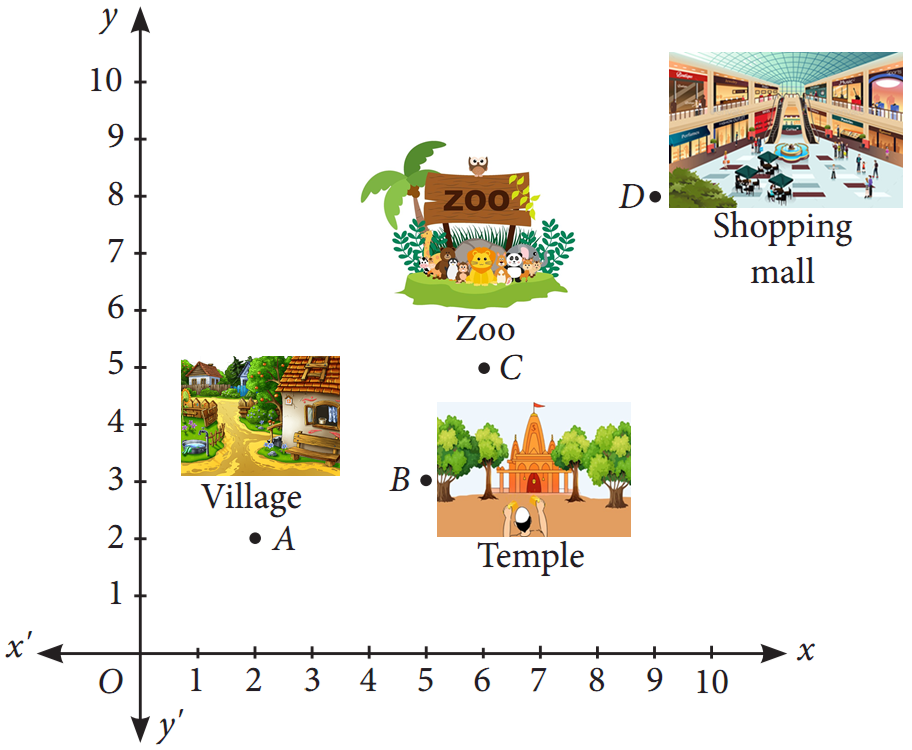
Ishaan left from his village on weekend. First, he travelled up to temple. After this, he left for the zoo. After this, he left for shopping in a mall. The positions of Jshaan at different places is given in the following graph.

Based on the above information, answer the following questions.
  1. Position vector of B is:
  1. $3\hat{\text{i}}+5\hat{\text{j}}$
  2. $5\hat{\text{i}}+3\hat{\text{j}}$
  3. $-5\hat{\text{i}}-3\hat{\text{j}}$
  4. $-5\hat{\text{i}}+3\hat{\text{j}}$
  1. Position vector of D is:
  1. $5\hat{\text{i}}+3\hat{\text{j}}$
  2. $3\hat{\text{i}}+5\hat{\text{j}}$
  3. $8\hat{\text{i}}+9\hat{\text{j}}$
  4. $9\hat{\text{i}}+8\hat{\text{j}}$
  1. Find the vector $\overline{\text{BC}}$ in terms of $\hat{\text{i}},\hat{\text{j}}.$
  1. $\hat{\text{i}}-2\hat{\text{j}}$
  2. $\hat{\text{i}}+2\hat{\text{j}}$
  3. $2\hat{\text{i}}+\hat{\text{j}}$
  4. $2\hat{\text{i}}-\hat{\text{j}}$
  1. Length of vector $\overline{\text{AB}}$ is:
  1. $\sqrt{67}\text{ units}$
  2. $\sqrt{85}\text{ units}$
  3. 90 units
  4. 100 units
  1. If $\vec{\text{M}}=4\hat{\text{j}}+3\hat{\text{k}},$ then its unit vector is:
  1. $\frac{4}{5}\hat{\text{j}}+\frac{3}{5}\hat{\text{k}}$
  2. $\frac{4}{5}\hat{\text{j}}-\frac{3}{5}\hat{\text{k}}$
  3. $-\frac{4}{5}\hat{\text{j}}+\frac{3}{5}\hat{\text{k}}$
  4. $-\frac{4}{5}\hat{\text{j}}-\frac{3}{5}\hat{\text{k}}$
In a murder investigation, a corpse was found by a detective at exactly $8$ p.m. Being alert, the detective measured the body temperature and found it to be $70^\circ F$ Two hours later, the detective measured the body temperature again and found it to be $60^\circ F,$ where the room temperature is $50^\circ F$ Also, it is given the body temperature at the time of death was normal, i.e., $98.6^\circ F.$
Let T be the temperature of the body at any time t and initial time is taken to be $8$ p.m.

Based on the above information, answer the following questions.
  1. By Newton's law of cooling, $\frac{\text{dT}}{\text{dt}}$ is proportional to:
  1. $T - 60$
  2. $T - 50$
  3. $T - 70$
  4. $T - 98.6$
  1. When $t = 0$, then body temperature is equal to:
  1. $50^\circ F$
  2. $60^\circ F$
  3. $70^\circ F$
  4. $98.6^\circ F$
  1. When $t = 2$, then body temperature is equal to:
  1. $50^\circ F$
  2. $60^\circ F$
  3. $70^\circ F$
  4. $98.6^\circ F$
  1. The value of T at any time t is:
  1. $50+20\Big(\frac{1}{2}\Big)^\text{t}$
  2. $50+20\Big(\frac{1}{2}\Big)^\text{t-1}$
  3. $50+20\Big(\frac{1}{2}\Big)^\frac{\text{t}}{2}$
  4. None of these
  1. If it is given that $\log_\text{e} (2.43) = 0.88789$ and $\log_\text{e} (0.5) = -0.69315,$ then the time at which the murder occur is:
  1. $7:30$ p.m.
  2. $5:30$ p.m.
  3. $6:00$ p.m.
  4. $5:00$ p.m.
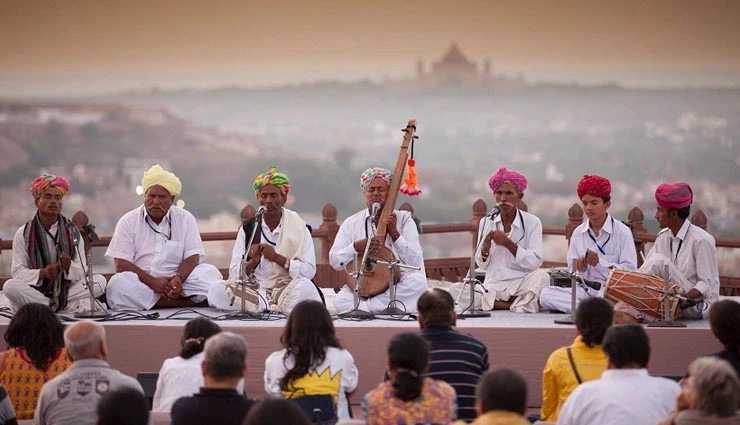
One day, a sangeet mahotsav is to be organised in an open area of Rajasthan. ln recent years, it has rained only $6$ days each year. Also, it is given that when it actually rains, the weatherman correctly forecasts rain 80% of the time. When it doesn't rain, he incorrectly forecasts rain $20\%$ of the time.

If leap year is considered, then answer the following questions.
  1. The probability that it rains on chosen day is:
  1. $\frac{1}{366}$
  2. $\frac{1}{73}$
  3. $\frac{1}{60}$
  4. $\frac{1}{61}$
  1. The probability that it does not rain on chosen day is:
  1. $\frac{1}{366}$
  2. $\frac{5}{366}$
  3. $\frac{360}{366}$
  4. None of these.
  1. The probability that the weatherman predicts correctly is:
  1. $\frac{5}{6}$
  2. $\frac{7}{8}$
  3. $\frac{4}{5}$
  4. $\frac{1}{5}$
  1. The probability that it will rain on the chosen day, if weatherman predict rain for that day, is:
  1. $0.0625$
  2. $0.0725$
  3. $0.0825$
  4. $0.0925$
  1. The probability that it will not rain on the chosen day, if weatherman predict rain for that day, is:
  1. $0.94$
  2. $0.84$
  3. $0.74$
  4. $0.64$