MCQ
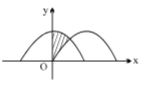
A function $y = f (x)$ satisfies the differential equation $\frac{{dy}}{{dx}} - y = \cos x - \sin x$ with initial condition that $y$ is bounded when $x \rightarrow \infty .$ The area enclosed by $y = f (x), y = \cos x$ and the $y-$ axis is
  • $\sqrt 2 \; - \;1$
  • B
    $\sqrt 2$
  • C
    $1$
  • D
    $\frac{1}{{\sqrt 2 }}$

Answer

Correct option: A.
$\sqrt 2 \; - \;1$
a
$I.F. = e^{-x}$
$ye^{-x} = \int {{e^{ - x}}(\cos x - \sin x)\,dx} $  put $- x = t$ 
$= - \int {{e^t}(\cos t + \sin t)\,dt} $ 
$= - e^t sin t + c$ 
$y e^{-x} = e^{-x} sin x + c$ 
since $y$ is bounded when $x \rightarrow \infty \Rightarrow c = 0$ 
$y = \sin x$ 
Area $= \int\limits_0^{\frac{\pi }{4}} {(\cos x - \sin x)\,dx} = \sqrt 2 \; - \;1$

Need a full question paper?

Generate a complete, print-ready paper with questions like this in minutes — across 16+ boards, with answer keys.

Start Generating Free

Similar questions

Evaluate: $\int \frac{\cos x}{\left(\cos \frac{x}{2}+\sin \frac{x}{2}\right)^3} d x$
$A B C D$ is a rhombus whose diagonals intersects at $E$. Then $\overrightarrow{E A}+\overrightarrow{E B}+\overrightarrow{E C}+\overrightarrow{E D}$ equals to
The equation of the plane parallel to the lines x - 1 = 2y - 5 = 2z and 3x = 4y - 11 = 3z -4 and passing through the point (2, 3, 3) is:
If $[t]$ denotes the greatest integer $\leq t$, then number of points, at which the function $f ( x )=4|2 x +3|+$ $9\left[x+\frac{1}{2}\right]-12[x+20]$ is not differentiable in the open interval $(-20,20)$, is$.....$
Find value of $x$ in equation $\left[\begin{array}{c}x+y+z \\ x+z \\ y+z\end{array}\right]=\left[\begin{array}{l}9 \\ 5 \\ 7\end{array}\right]$
If $y = y ( x ), x \in\left(0, \frac{\pi}{2}\right)$ be the solution curve of the differential equation $\left(\sin ^{2} 2 x\right) \frac{d y}{d x}+\left(8 \sin ^{2} 2 x+2 \sin 4 x\right) y=$$2 e ^{-4 x }(2 \sin 2 x +\cos 2 x )$, with $y \left(\frac{\pi}{4}\right)= e ^{-\pi}$, then $y \left(\frac{\pi}{6}\right)$ is equal to.
If $A = \left[ {\begin{array}{*{20}{c}}
  1&0&0 \\ 
  2&1&0 \\ 
  { - 3}&2&1 
\end{array}} \right]\,$ and $B = \left[ {\begin{array}{*{20}{c}}
  1&0&0 \\ 
  { - 2}&1&0 \\ 
  7&{ - 2}&1 
\end{array}} \right]$ then $AB$ equals
The area of the region bounded by the parabola $(y-2)^{2}=(x-1)$, the tangent to it at the point whose ordinate is $3$ and the $\mathrm{x}$-axis is :
Let $\text{U}=\sin^{-1}\Big(\frac{2\text{x}}{1+\text{x}^2}\Big)$ and $\text{V}=\tan^{-1}\Big(\frac{2\text{x}}{1-\text{x}^2}\Big),$ then $\frac{\text{dU}}{\text{dV}}=$
If $3\sin^{-1}\Big(\frac{2\text{x}}{1+\text{x}^2}\Big)-4\cos^{-1}\Big(\frac{1-\text{x}^2}{1+\text{x}^2}\Big)+2\tan^{-1}\Big(\frac{2\text{x}}{1-\text{x}^2}\Big)=\frac{\pi}{3}$ is equal to: