MCQ 11 Mark
Area bounded by the curve $y = \log x\,,$ $x - $ axis and the ordinates $x = 1,\,\,x = 2$ is
- A
$\log 4\,\,sq. \,unit$
- B
$(\log 4 + 1)\,\,sq. \,unit$
- ✓
$(\log 4 - 1)\,\,sq. \,unit$
- D
AnswerCorrect option: C. $(\log 4 - 1)\,\,sq. \,unit$
c
(c) Given curve $y = \log x$ and $x = 1$, $x = 2$.
Hence required area $= \int_1^2 {\,\log \,x\,dx} = (x\,\log x - x)_1^2$
$= 2\log 2 - 1 = (\log 4 - 1)\,\,sq. \,unit$.
View full question & answer→MCQ 21 Mark
Area bounded by the curve $y = x{e^{{x^2}}},$ $x - $axis and the ordinates $x = 0,\,\,x = a$
- A
$\frac{{{e^{{a^2}}} + 1}}{2}\,\,sq. \,unit$
- ✓
$\frac{{{e^{{a^2}}} - 1}}{2}\,\,sq. \,unit$
- C
${e^{{a^2}}} + 1\,\,sq. \,unit$
- D
${e^{{a^2}}} - 1\,\,sq. \,unit$
AnswerCorrect option: B. $\frac{{{e^{{a^2}}} - 1}}{2}\,\,sq. \,unit$
b
(b) Required area is $\int_0^a {y\,\,dx = \int_0^a {x{e^{{x^2}}}dx} } $
We put ${x^2} = t \Rightarrow dx = \frac{{dt}}{{2x}}$ as
$x = 0 \Rightarrow t = 0$ and $x = a \Rightarrow t = {a^2}$,
then it reduces to
$\frac{1}{2}\int_0^{{a^2}} {{e^t}dt = \frac{1}{2}[{e^t}]_0^{{a^2}} = \frac{{{e^{{a^2}}} - 1}}{2}}\,\,sq. \,unit$.
View full question & answer→MCQ 31 Mark
Area bounded by $y = x\sin x$ and $x - $ axis between $x = 0$ and $x = 2\pi ,$ is
- A
$0$
- B
$2\pi \,\, sq. \,unit$
- C
$\pi \,\, sq. \,unit$
- ✓
$4\pi \,\, sq. \,unit$
AnswerCorrect option: D. $4\pi \,\, sq. \,unit$
d
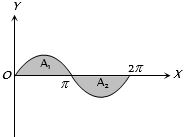
(d) Required area is ${A_1} + {A_2}$
$= \int_0^\pi {y\,\,dx + \left| {\int_\pi ^{2\pi } {y\,dx} } \right| = 4\pi \,sq.} \,unit$
View full question & answer→MCQ 41 Mark
If area bounded by the curves ${y^2} = 4\,ax$ and $y = mx$ is ${a^2}/3,$, then the value of $m$ is
- ✓
$2$
- B
$ - 2$
- C
$\frac{1}{2}$
- D
Answera
(a) The two curves ${y^2} = 4ax$ and $y = mx$ intersect at
$\left( {\frac{{4a}}{{{m^2}}},\frac{{4a}}{m}} \right)$ and the area enclosed by the two curves is given by
$\int_0^{4a/{m^2}} {(\sqrt {4ax} - mx)} \,dx$.
$\therefore \,\,\,\int_0^{4a/{m^2}} {(\sqrt {4ax} - mx)} \,dx = \frac{{{a^2}}}{3}$
==> $\frac{8}{3}\frac{{{a^2}}}{{{m^3}}} = \frac{{{a^2}}}{3} $
$\Rightarrow {m^3} = 8 \Rightarrow m = 2$.
View full question & answer→MCQ 51 Mark
Area bounded by parabola ${y^2} = x$ and straight line $2y = x$ is
- ✓
$\frac{4}{3}$
- B
$1$
- C
$\frac{2}{3}$
- D
$\frac{1}{3}$
AnswerCorrect option: A. $\frac{4}{3}$
a
(a) ${y^2} = x$ and $2y = x $
$\Rightarrow {y^2} = 2y \Rightarrow y = 0,\,2$
$\therefore \,$ Required area $ = \int_0^2 {({y^2} - 2y)dy = \left( {\frac{{{y^3}}}{3} - {y^2}} \right)_0^2}$
$={ \frac{4}{3}} \,\, sq. \,unit$.
View full question & answer→MCQ 61 Mark
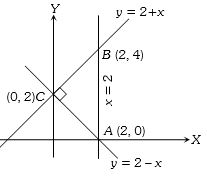
Area bounded by lines $y = 2 + x,$ $y = 2 - x$ and $x = 2$ is
Answerb
(b) Obviously, triangle $ACB$ is right angled at $C$.
$\therefore$ Required area $ = \frac{1}{2} \times AC \times BC$
$ = \frac{1}{2} \times 2\sqrt 2 \times 2\sqrt 2 = 4\,\, sq. \,unit$.
View full question & answer→MCQ 71 Mark
If a curve $y = a\sqrt x + bx$ passes through the point $(1, 2)$ and the area bounded by the curve, line $x = 4$ and $x-$ axis is $8$ sq. unit, then
- ✓
$a = 3,\,b = - 1$
- B
$a = 3,\,b = 1$
- C
$a = - 3,\,b = 1$
- D
$a = - 3,\,b = - 1$
AnswerCorrect option: A. $a = 3,\,b = - 1$
a
(a) Given curve $y = a\sqrt x + bx$.
This curve passes through $(1, 2)$,
$\therefore 2 = a + b$ ...$(i)$
and area bounded by this curve and line $x = 4$ and $x-$ axis is $8$ sq. unit,
then $\int_{\,0}^{\,4} {(a\sqrt x + bx)\,} dx = 8$
==> $\frac{{2a}}{3}[{x^{3/2}}]_0^4 + \frac{b}{2}[{x^2}]_0^4 = 8$,
==> $\frac{{2a}}{3}.8 + 8b = 8$
==> $2a + 3b = 3$ ...$(ii)$
From equation $(i)$ and $(ii),$ we get
$a = 3,\,b = - 1$.
View full question & answer→MCQ 81 Mark
If the area above the $x -$ axis, bounded by the curves $y = {2^{kx}}$ and $x = 0$ and $x = 2$ is $\frac{3}{{\ln 2}},$ then the value of $k$ is
- A
$\frac{1}{2}$
- ✓
$1$
- C
$ - 1$
- D
$2$
Answerb
(b) $\int_{\,0}^{\,2} {{2^{kx}}dx = \frac{3}{{\log 2}} \Rightarrow {2^{2k}} - 1 = 3k} $.
Now check from options, only $(b)$ satisfies the above condition.
View full question & answer→MCQ 91 Mark
Area bounded by the curve $xy - 3x - 2y - 10 = 0,$ $x -$ axis and the lines $x = 3,x = 4$ is
- A
$16\log 2 - 13$
- B
$16\log 2 - 3$
- ✓
$16\log 2 + 3$
- D
AnswerCorrect option: C. $16\log 2 + 3$
c
(c) Given curve is $y(x - 2) = 3x + 10 $
$\Rightarrow y = \frac{{3x + 10}}{{x - 2}}$
Required area is $\int_3^4 {\,\,y\,dx = \int_3^4 {\frac{{3x + 10}}{{x - 2}}\,\,dx} } $
$= [3x + 16\log (x - 2)]_3^4 = 3 + 16\log 2$ sq. unit.
View full question & answer→MCQ 101 Mark
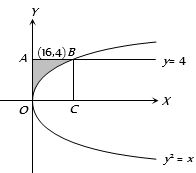
The area bounded by curve ${y^2} = x,$ line $y = 4$ and $y -$ axis is
- A
$\frac{{16}}{3}$
- ✓
$\frac{{64}}{3}$
- C
$7\sqrt 2 $
- D
AnswerCorrect option: B. $\frac{{64}}{3}$
b
(b) Required area = area of $OABC\, -$ area of $OBC$
$ = 16 \times 4 - \int_0^{16} {\sqrt x } dx = 64 - \left[ {\frac{{{x^{3/2}}}}{{3/2}}} \right]_0^{16} = \frac{{64}}{3}.$
View full question & answer→MCQ 111 Mark
The area bounded by the straight lines $x = 0,x = 2$ and the curves $y = {2^x},y = 2x - {x^2}$ is
- A
$\frac{4}{3} - \frac{1}{{\log 2}}$
- B
$\frac{3}{{\log 2}} + \frac{4}{3}$
- C
$\frac{4}{{\log 2}} - 1$
- ✓
$\frac{3}{{\log 2}} - \frac{4}{3}$
AnswerCorrect option: D. $\frac{3}{{\log 2}} - \frac{4}{3}$
d
(d) Required area =$\int_0^2 {[{2^x} - (2x - {x^2})]\,dx} $
$ = \left[ {\frac{{{2^x}}}{{\log 2}} - {x^2} + \frac{{{x^3}}}{3}} \right]_0^2$
$ = \frac{4}{{\log 2}} - 4 + \frac{8}{3} - \frac{1}{{\log 2}}$
$ = \frac{3}{{\log 2}} - \frac{4}{3}$.
View full question & answer→MCQ 121 Mark
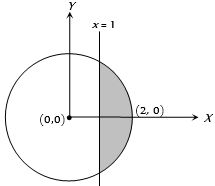
The area of smaller part between the circle ${x^2} + {y^2} = 4$ and the line $x = 1$ is
- A
$\frac{{4\pi }}{3} - \sqrt 3 $
- ✓
$\frac{{8\pi }}{3} - \sqrt 3 $
- C
$\frac{{4\pi }}{3} + \sqrt 3 $
- D
$\frac{{5\pi }}{3} + \sqrt 3 $
AnswerCorrect option: B. $\frac{{8\pi }}{3} - \sqrt 3 $
b
(b) Area of smaller part $ = 2\,\int_1^2 {\sqrt {4 - {x^2}} } \,dx$
$ = 2\,\left[ {\frac{x}{2}\sqrt {4 - {x^2}} + 2{{\sin }^{ - 1}}\frac{x}{2}} \right]_1^2$
$ = 2\,\left[ {2.\frac{\pi }{2} - \left[ {\frac{{\sqrt 3 }}{2} - 2.\frac{\pi }{6}} \right]} \right]$
$ = 2\,\left[ {\pi - \left[ {\frac{{\sqrt 3 }}{2} - \frac{\pi }{3}} \right]} \right]$
$ = \frac{{8\pi }}{3} - \sqrt 3 $.
View full question & answer→MCQ 131 Mark
The area between the curve $y = {\sin ^2}x,$ $x - $ axis and the ordinates $x = 0$ and $x = \frac{\pi }{2}$ is
- A
$\frac{\pi }{2}$
- ✓
$\frac{\pi }{4}$
- C
$\frac{\pi }{8}$
- D
$\pi $
AnswerCorrect option: B. $\frac{\pi }{4}$
b
(b) Required area $A = \int_0^{\pi /2} {{{\sin }^2}x.\,dx} = \int_0^{\pi /2} {\left( {\frac{{1 - \cos 2x}}{2}} \right)} \,dxa$
$ = \frac{1}{2}[x]_0^{\pi /2} - \frac{1}{4}[\sin 2x]_0^{\pi /2} = \frac{\pi }{4}$.
View full question & answer→MCQ 141 Mark
The area of the triangle formed by the tangent to the hyperbola $xy = {a^2}$ and co-ordinate axes is
- A
${a^2}$
- ✓
$2{a^2}$
- C
$3{a^2}$
- D
$4{a^2}$
AnswerCorrect option: B. $2{a^2}$
b
(b) Given $xy = {a^2}$ or $y = \frac{{{a^2}}}{x}$ .....$(i)$
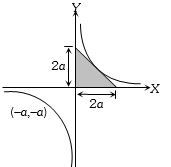
There are two points on the curve $(a, a),(- a,- a)$
The equation of the line at $(a,a)$ is,
$y - a = {\left( {\frac{{dy}}{{dx}}} \right)_{(a,\,a)}}(x - a)$
$ = {\left( {\frac{{ - {a^2}}}{{{x^2}}}} \right)_{(a,\,a)}}(x - a)$
$\Rightarrow$ $y - a = - (x - a)$
therefore, equation of the tangent at $(a,a)$ is $x + y = 2\,a$.
The interception of line $x + y = 2a$ with $x-$ axis is $2a$ and with $y-$ axis is $2a.$
$\therefore $ Required area $= \frac{1}{2} \times 2a \times 2a = 2{a^2}$.
View full question & answer→MCQ 151 Mark
The area bounded by the curve $y = 4x - {x^2}$ and the $x - $ axis, is
- A
$\frac{{30}}{7}\,\, sq. \,unit$
- B
$\frac{{31}}{7}\,\, sq. \,unit$
- ✓
$\frac{{32}}{3}\,\, sq. \,unit$
- D
$\frac{{34}}{3}\,\, sq. \,unit$
AnswerCorrect option: C. $\frac{{32}}{3}\,\, sq. \,unit$
c
(c) We have $y = 4x - {x^2}$ and $y = 0$;
$\therefore $ $x = 0$, $4$
Required area $ = \int_0^4 {(4x - {x^2})dx = \left[ {\frac{{4{x^2}}}{2} - \frac{{{x^3}}}{3}} \right]_0^4} $
$ = 32 - \frac{{64}}{3} = \frac{{32}}{3}\,\, sq. \,unit$
View full question & answer→MCQ 161 Mark
The area between the curve $y = 4 + 3x - {x^2}$ and $x -$ axis is
- ✓
$125/6$
- B
$125/3$
- C
$125/2$
- D
AnswerCorrect option: A. $125/6$
a
(a) Solving $y = 0$ and $y = 4 + 3x - {x^2},$
we get $x = - 1,\,4$.
Curve does not intersect $x -$ axis between $x = - 1$ and $x = 4$.
$\therefore$ Area $ = \int_{ - 1}^4 {(4 + 3x - {x^2})dx = \frac{{125}}{6}} $.
View full question & answer→MCQ 171 Mark
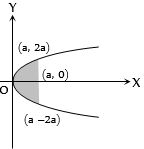
Area bounded by the parabola ${y^2} = 4ax$ and its latus rectum is
- A
$\frac{2}{3}{a^2}\,\, sq. \,unit$
- B
$\frac{4}{3}{a^2}\,\, sq. \,unit$
- ✓
$\frac{8}{3}{a^2}\,\, sq. \,unit$
- D
$\frac{3}{8}{a^2}\,\, sq. \,unit$
AnswerCorrect option: C. $\frac{8}{3}{a^2}\,\, sq. \,unit$
c
(c) Area = $2\int_0^a {\,\,y\,dx = 2\int_0^a {\sqrt {4ax} } \,\,dx} $
$2 \times 2\sqrt a \times \frac{2}{3}\left| {{x^{3/2}}} \right|_0^a $
$= \frac{8}{3}{a^2}\,\, sq. \,unit$
View full question & answer→MCQ 181 Mark
Area of the ellipse $\frac{{{x^2}}}{{{a^2}}} + \frac{{{y^2}}}{{{b^2}}} = 1$ is
- ✓
$\pi \,ab\,\,\, sq. \,unit$
- B
$\frac{1}{2}\pi \,ab\,\,\, sq. \,unit$
- C
$\frac{1}{4}\pi \,ab\,\,\, sq. \,unit$
- D
AnswerCorrect option: A. $\pi \,ab\,\,\, sq. \,unit$
a
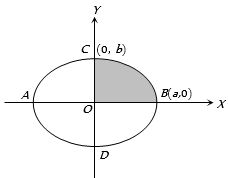
(a) Since the given equation contains only even powers of $x$ and only even powers of $y$,
the curve is symmetrical about $y -$ axis as well as $x - $ axis.
$\therefore$ Whole area of given ellipse
$ = 4({\rm{area\,\, }}\,{\rm{of}}\,BCO) = 4 \times \int_0^a {y\,dx = 4\int_0^a {\frac{b}{a}\sqrt {{a^2} - {x^2}} } dx} $
$ = 4ab\int_0^{\pi /2} {\left( {\frac{{1 + \cos 2\theta }}{2}} \right)\,d\theta } $, {Putting
$x = a\sin \theta $}
$ = 2ab\left( {\int_0^{\pi /2} {\,\,d\theta + \int_0^{\pi /2} {\,\,\,\cos 2\theta \,d\theta } } } \right)$
$ = [\theta ]_0^{\pi /2} + \left[ {\frac{{\sin 2\theta }}{2}} \right]_0^{\pi /2} = \pi ab\,\,\, sq. \,unit$
View full question & answer→MCQ 191 Mark
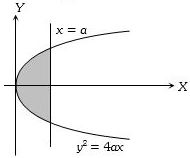
The area between the curve ${y^2} = 4ax,$ $x -$ axis and the ordinates $x = 0$ and $x = a$ is
- A
$\frac{4}{3}{a^2}$
- ✓
$\frac{8}{3}{a^2}$
- C
$\frac{2}{3}{a^2}$
- D
$\frac{5}{3}{a^2}$
AnswerCorrect option: B. $\frac{8}{3}{a^2}$
b
(b) Required area $ = 2\int_0^a {\sqrt {4ax} dx} $
$ = 4\sqrt a \times \frac{2}{3}[{x^{3/2}}]_0^a = \frac{{8\sqrt a }}{3}.a\sqrt a = \frac{8}{3}{a^2}$.
View full question & answer→MCQ 201 Mark
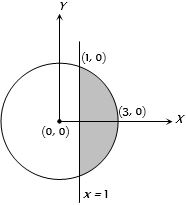
The area of the smaller segment cut off from the circle ${x^2} + {y^2} = 9$ by $x = 1$ is
- A
$\frac{1}{2}(9{\sec ^{ - 1}}3 - \sqrt 8 )$
- ✓
$9{\sec ^{ - 1}}(3) - \sqrt 8 $
- C
$\sqrt 8 - 9{\sec ^{ - 1}}(3)$
- D
AnswerCorrect option: B. $9{\sec ^{ - 1}}(3) - \sqrt 8 $
b
(b) Area of smaller part $I = 2\int_1^3 {\sqrt {9 - {x^2}} \,dx} $
$ = 2.\frac{1}{2}\left[ {x\sqrt {9 - {x^2}} + 9{{\sin }^{ - 1}}\frac{x}{3}} \right]_1^3 $
$= \left[ {9\frac{\pi }{2} - \sqrt 8 - 9{{\sin }^{ - 1}}\left( {\frac{1}{3}} \right)} \right]$
$ = \left[ {9\left( {\frac{\pi }{2} - {{\sin }^{ - 1}}\left( {\frac{1}{3}} \right)} \right) - \sqrt 8 } \right]$
$ = \left[ {9{{\cos }^{ - 1}}\left( {\frac{1}{3}} \right) - \sqrt 8 } \right]$
$= [9{\sec ^{ - 1}}(3) - \sqrt 8 ]$.
View full question & answer→MCQ 211 Mark
The area bounded by the curves ${y^2} = 8x$ and $y = x$ is
- A
$\frac{{128}}{3}\,\, sq. \,unit$
- ✓
$\frac{{32}}{3}\,\, sq. \,unit$
- C
$\frac{{64}}{3}\,\, sq. \,unit$
- D
$32\,\, sq. \,unit$
AnswerCorrect option: B. $\frac{{32}}{3}\,\, sq. \,unit$
b
(b) ${y^2} = 8x$ and $y = x $
$\Rightarrow {x^2} = 8x \Rightarrow x = 0$,8
$\therefore$ Required area =$\int_0^8 {(2\sqrt 2 \sqrt x - x)dx} $
$ = \left[ {\frac{{4\sqrt 2 }}{3}{x^{3/2}} - \frac{{{x^2}}}{2}} \right]_0^8 $
$= \frac{{128}}{3} - \frac{{64}}{2} = \frac{{32}}{3}\,\, sq. \,unit$
View full question & answer→MCQ 221 Mark
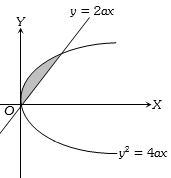
The area enclosed by the parabola ${y^2} = 4ax$ and the straight line $y = 2ax,$ is
- A
$\frac{{{a^2}}}{3}\,\, sq. \,unit$
- B
$\frac{1}{{3{a^2}}}\,\, sq. \,unit$
- ✓
$\frac{1}{{3a}}\,\, sq. \,unit$
- D
$\frac{2}{{3a}}\,\, sq. \,unit$
AnswerCorrect option: C. $\frac{1}{{3a}}\,\, sq. \,unit$
c
(c) The points of intersection of the parabola
${y^2} = 4ax$ and the chord $y = 2ax$ is obtained by solving these equations simultaneously.
${y^2} = 4ax,y = 2ax \Rightarrow {(2ax)^2} = 4ax$
==> $x[4{a^2}x - 4a] = 0$
$ \Rightarrow 4ax[ax - 1] = 0$
==> $x = 0$ or $x = \frac{1}{a}$
Also $x = 0 \Rightarrow y = 0$ and $x = \frac{1}{a}$
==>$y = \pm 2$
Hence the required points are $(0,0)$ and $\left[ {\frac{1}{a},2} \right]$.
Now required area $ = \int_0^{1/a} {[\sqrt {4ax} - 2ax} ]dx = \frac{1}{{3a}}\,\, sq. \,unit$.
View full question & answer→MCQ 231 Mark
The area of the region bounded by the curve $y = x|x|$, $x-$ axis and the ordinates $x = 1,\,\,x = - 1$ is given by
- A
$Zero$
- B
$\frac{1}{3}$
- ✓
$\frac{2}{3}$
- D
$1$
AnswerCorrect option: C. $\frac{2}{3}$
c
(c) Required area $ = \int_{ - 1}^1 {x|x|dx} $
$ = \int_{ - 1}^0 { - {x^2}dx + \int_0^1 {{x^2}dx} } $
$=\left( {\frac{{ - {x^3}}}{3}} \right)_{ - 1}^0$$ + \left( {\frac{{{x^3}}}{3}} \right)_0^1$
$ = \left| {\,\frac{{ - 1}}{3}\,} \right| + \left| {\,\frac{1}{3}\,} \right| = \frac{2}{3}$.
View full question & answer→MCQ 241 Mark
If $A$ is the area of the region bounded by the curve $y = \sqrt {3x + 4} $, $x$ axis and the line $x = - 1$ and $x = 4$ and $B$ is that area bounded by curve ${y^2} = 3x + 4$, $x -$ axis and the lines $x = - 1$ and $x = 4$ then $A:B$ is equal to
Answera
(a) In both cases area will be same, hence ratio $A:B$ is $1 : 1.$
View full question & answer→MCQ 251 Mark
The area of the region bounded by the curve $9{x^2} + 4{y^2} - 36 = 0$ is
- A
$9\pi $
- B
$4\pi $
- C
$36\pi $
- ✓
$6\pi $
AnswerCorrect option: D. $6\pi $
d
(d) $9{x^2} + 4{y^2} = 36$
==> $\frac{{{x^2}}}{4} + \frac{{{y^2}}}{9} = 1$,
which is equation of an ellipse.
Remember area enclosed by ellipse is $\pi \,ab$
$i.e.,$ $\pi \;2.3 = 6\pi $.
View full question & answer→MCQ 261 Mark
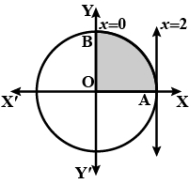
Area lying in the first quadrant and bounded by the circle $x^{2}+y^{2}=4$ and the lines $x=0$ and $x=2$ is
- ✓
$\pi $
- B
$\frac{\pi}{2}$
- C
$\frac{\pi}{3}$
- D
$\frac{\pi}{4}$
AnswerCorrect option: A. $\pi $
a
The area bounded by the circle and the lines, $x=0$ and $x=2,$ in the first quadrant is represented as shaded region in the plot.
$\therefore$ Area $O A B=\int_{0}^{2} y d x$
$=\int_{0}^{2} \sqrt{4-x^{2}} d x$
$=\left[\frac{x}{2} \sqrt{4-x^{2}}+\frac{4}{2} \sin ^{-1} \frac{x}{2}\right]_{0}^{2}$
$=2\left(\frac{\pi}{2}\right)=\pi $ sq. units
Thus, the correct answer $A.$
View full question & answer→MCQ 271 Mark
The area enclosed between the curves $y = {x^3}$ and $y = \sqrt x $ is, (in square units)
- A
$\frac{5}{3}$
- B
$\frac{5}{4}$
- ✓
$\frac{5}{{12}}$
- D
$\frac{{12}}{5}$
AnswerCorrect option: C. $\frac{5}{{12}}$
c
(c) Given curves are, $y = {x^3}$ and $y = \sqrt x $
On solving, we get $x = 0,x = 1$
Therefore, required area $= \int_0^1 {({x^3} - \sqrt x )} \,dx$
$ = \left[ {\frac{{{x^4}}}{4} - \frac{{2x\sqrt x }}{3}} \right]_0^1 $
$= \left[ {\frac{1}{4} - \frac{2}{3}} \right] = \frac{5}{{12}}$,
(Area can not be negative).
View full question & answer→MCQ 281 Mark
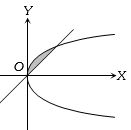
The area between the parabola $y = {x^2}$ and the line $y = x$ is
- ✓
$\frac{1}{6}\,\, sq. \,unit$
- B
$\frac{1}{3}\,\, sq. \,unit$
- C
$\frac{1}{2}\,\, sq. \,unit$
- D
AnswerCorrect option: A. $\frac{1}{6}\,\, sq. \,unit$
a
(a) Given curves are $y = {x^2}$ and $y = x$
On solving, we get $x = 0$, $x = 1$
Therefore, required area $A = \int_0^1 {({x^2} - x)} dx$
$ = \left[ {\frac{{{x^3}}}{3} - \frac{{{x^2}}}{2}} \right]_0^1$
$ = \frac{1}{3} - \frac{1}{2} = \frac{1}{6}\,\, sq. \,unit$.
View full question & answer→MCQ 291 Mark
The area enclosed by the parabolas $y = {x^2} - 1$ and $y = 1 - {x^2}$ is
Answerd
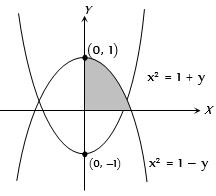
(d) Given parabolas are ${x^2} = 1 + y$, ${x^2} = 1 - y$
$\therefore$ Required area $ = 4\int_0^1 {(1 - {x^2})\,dx} $
$ = 4\left[ {x - \frac{{{x^3}}}{3}} \right]_0^1 = \frac{8}{3}$.
View full question & answer→MCQ 301 Mark
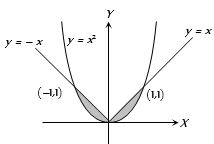
The area of the region bounded by the curves $y = {x^2}$ and $y = \,|x|$ is
Answerb
(b) Required area $= 2$ (shaded area in first quadrant)
$=2\int_0^1 {(x - {x^2})\,dx = 2 \times \frac{1}{6} = \frac{1}{3}} $.
View full question & answer→MCQ 311 Mark
The area bounded by curves $y = \cos x$ and $y = \sin x$ and ordinates $x = 0$ and $x = \frac{\pi }{4}$ is
- A
$\sqrt 2 $
- B
$\sqrt 2 + 1$
- ✓
$\sqrt 2 - 1$
- D
$\sqrt 2 (\sqrt 2 - 1)$
AnswerCorrect option: C. $\sqrt 2 - 1$
c
(c) Given equations of curves $y = \cos x$ and $y = \sin x$ and ordinates $x = 0$ to $x = \frac{\pi }{4}.$
We know that area bounded by the curves
$ = \int_{{x_1}}^{{x_2}} {ydx = \int_0^{\pi /4} {\cos xdx - \int_0^{\pi /4} {\,\,\sin x\,dx} } } $
$ = [\sin x]_0^{\pi /4} - [ - \cos x]_0^{\pi /4}$
$ = \left( {\sin \frac{\pi }{4} - \sin 0} \right) + \left( {\cos \frac{\pi }{4} - \cos 0} \right) $
$= \left( {\frac{1}{{\sqrt 2 }} - 0} \right) + \left( {\frac{1}{{\sqrt 2 }} - 1} \right)$
$ = \sqrt 2 - 1$.
View full question & answer→MCQ 321 Mark
The area in the first quadrant between ${x^2} + {y^2} = {\pi ^2}$ and $y = \sin x$ is
- ✓
$\frac{{({\pi ^3} - 8)}}{4}$
- B
$\frac{{{\pi ^3}}}{4}$
- C
$\frac{{({\pi ^3} - 16)}}{4}$
- D
$\frac{{({\pi ^3} - 8)}}{2}$
AnswerCorrect option: A. $\frac{{({\pi ^3} - 8)}}{4}$
a
(a) Area of the circle in first quadrant is $\frac{{\pi ({\pi ^2})}}{4}$
$i.e.,$ $\frac{{{\pi ^3}}}{4}$.
Also area bounded by curve $y = \sin x$ and $x -$ axis is $2$ sq. unit.
Hence required area is $\frac{{{\pi ^3}}}{4} - 2 = \frac{{{\pi ^3} - 8}}{4}$.
View full question & answer→MCQ 331 Mark
The area bounded by the curves ${y^2} - x = 0$ and $y - {x^2} = 0$ is
- A
$\frac{7}{3}$
- ✓
$\frac{1}{3}$
- C
$\frac{5}{3}$
- D
$1$
AnswerCorrect option: B. $\frac{1}{3}$
b
(b)$\int_0^1 {(\sqrt x - {x^2})dx = \left( {\frac{{{x^{3/2}}}}{{3/2}} - \frac{{{x^3}}}{3}} \right)_0^1 = \frac{1}{3}} $.
View full question & answer→MCQ 341 Mark
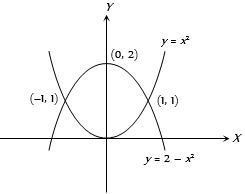
Area bounded by curves $y = {x^2}$ and $y = 2 - {x^2}$ is
Answera
(a) $y = {x^2}$.....$(i)$
$y = 2 - {x^2}$.....$(ii)$
$\therefore $ By equation $(i)$ and $(ii),$ we get, $x = \pm 1$
$\therefore $ $y = \pm 1$
$\therefore $ Required area $ = 2\left[ {\int_0^1 {(2 - {x^2})dx - \int_0^1 {{x^2}dx} } } \right]$
$ = 2\,\left[ {2x - \frac{{2{x^3}}}{3}} \right]_0^1 = 4\left[ {x - \frac{{{x^3}}}{3}} \right]_0^1 = 4\left( {\frac{2}{3}} \right) = \frac{8}{3}$.
View full question & answer→MCQ 351 Mark
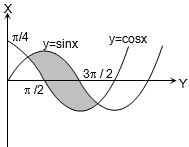
The sine and cosine curves intersects infinitely many times giving bounded regions of equal areas. The area of one of such region is
- A
$\sqrt 2 $
- ✓
$2\sqrt 2 $
- C
$3\sqrt 2 $
- D
$4\sqrt 2 $
AnswerCorrect option: B. $2\sqrt 2 $
b
(b) Point of intersection of $y=sinx$ and $y = \cos x$ are $\frac{\pi }{4},\frac{{5\pi }}{4}$.
Since, $\sin x \ge \cos x$ on the interval $\left[ {\frac{\pi }{4},\frac{{5\pi }}{4}} \right]$
$\therefore $ Area of one such region $ = \int_{\pi /4}^{5\pi /4} {(\sin x - \cos x)\;dx} $
$ = 2\sqrt 2 sq.\;unit$
View full question & answer→MCQ 361 Mark
The area of the region bounded by the lines $x=1, x=2$, and the curves $x\left(y-e^x\right)=\sin x$ and $2 x y=2 \sin x+x^3$ is
- A
$e^2-e-\frac{1}{6}$
- ✓
$e^2-e-\frac{7}{6}$
- C
$e^2-e+\frac{1}{6}$
- D
$e^2-e+\frac{7}{6}$
AnswerCorrect option: B. $e^2-e-\frac{7}{6}$
b
(b)
The area of region bounded by the curves
$x\left(y-e^x\right)=\sin x$ or $y=\frac{\sin x}{x}+e^x$ and
$2 x y=2 \sin x+x^3$
or $\quad y=\frac{\sin x}{x}+\frac{x^2}{2}$
between lines $x=1$ and $x=2$ is
$A=\int \limits_1^2\left\{\left(\frac{\sin x}{x}+e^x\right)-\left(\frac{\sin x}{x}+\frac{x^2}{2}\right)\right\} d x$
$=\int \limits_1^2\left(e^x-\frac{x^2}{2}\right) d x=\left|\left[e^x-\frac{x^3}{6}\right]_1^2\right|=e^2-e-\frac{7}{6}$
View full question & answer→MCQ 371 Mark
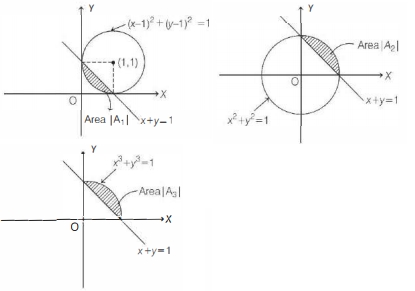
Let $A_1, A_2$ and $A_3$ be the regions on $R^2$ defined by
$A_1=\left\{(x, y): x \geq 0, y \geq 0,2 x+2 y-x^2-y^2>1>x+y\right\}$
$A_2=\left\{(x, y): x \geq 0, y \geq 0, x+y>1>x^2+y^2\right\}$
$A_3=\left\{(x, y): x \geq 0, y \geq 0, x+y>1>x^3+y^3\right\}$
Denote by $\left|A_1\right|,\left|A_2\right|$ and $\left|A_3\right|$ the areas of the regions $A_1, A_2$ and $A_3$ respectively. Then,
- A
$\left|A_1\right|>\left|A_2\right|>\left|A_3\right|$
- B
$\left|A_1\right|>\left|A_3\right|>\left|A_2\right|$
- ✓
$\left|A_1\right|=\left|A_2\right|<\left|A_3\right|$
- D
$\left|A_1\right|=\left|A_3\right|>\left|A_2\right|$
AnswerCorrect option: C. $\left|A_1\right|=\left|A_2\right|<\left|A_3\right|$
c
(c)
Area of region defincd by
$A_1=\left\{\begin{array}{r}\left.(x, y): x \geq 0, y \geq 0,2 x+2 y-x^2\right\} \\ -y^2>1>x+y\end{array}\right\}$
Similarly, $\left|A_2\right|$ is the area of region definced by
$\left.A_2= \forall (x, y) \leq x \geq 0, y \geq 0, x+y>1>x^2+y^2\right\}$
Here, $\left|A_1\right|=\left|A_2\right|$
and area $\left|A_3\right|$ is the area of refion defined by
$A_3=\left\{(x, y): x \geq 0, y \geq 0, x+y>1>x^3+y^3\right\}$
then $\left|A_3\right|>\left|A_2\right|=\left|A_1\right|$
View full question & answer→MCQ 381 Mark
The maximum possible area bounded by the parabola $y=x^2+x+10$ and a chord of the parabola of length $1$ is
- A
$\frac{1}{12}$
- ✓
$\frac{1}{6}$
- C
$\frac{1}{3}$
- D
$\frac{1}{2}$
AnswerCorrect option: B. $\frac{1}{6}$
b
(b)
We have,
$y=x^2+x+10$
$x^2+x+\frac{1}{4}=y-10+\frac{1}{4}$
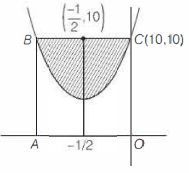
$\left(x+\frac{1}{2}\right)^2=\left(y-\frac{39}{4}\right)$
Latusrectum of parabola is $1 .$
$\therefore$ Length of chord is also
$1$
Area is maximum when chord is latusrectum.
Area of shaded region $=$
Area of rectangle $O A B C-2 \int \limits_{-1 / 2}^0$ parabola
$=10-2 \int \limits_{\frac{-1}{2}}^0\left(x^2+x+10\right) d x$
$=10-2\left[\frac{x^3}{3}+\frac{x^2}{2}+10\right]_{-1}^2$
$=10-2\left[\frac{-1}{24}+\frac{1}{8}-\frac{10}{2}\right]=\frac{1}{6}$
View full question & answer→MCQ 391 Mark
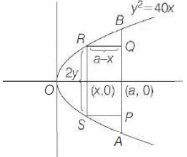
Let $A B$ be the la tusrectum of the parabola $y^2=4a x$ in the $X Y$-plane. Let $T$ be the region bounded by the finite arc $A B$ of the parabola and the line segment $A B$. A rectangle $P Q R S$ of maximum possible area is inscribed in $T$ with $P, Q$ on line $A B$, and $R, S$ on arc $A B$. Then, area $(P Q R S)$ area $(T)$ equals
- A
$\frac{1}{2}$
- B
$-\frac{1}{3}$
- C
$\frac{1}{\sqrt{2}}$
- ✓
$\frac{1}{\sqrt{3}}$
AnswerCorrect option: D. $\frac{1}{\sqrt{3}}$
d
(d)
Area of region $O B A O$
$=\operatorname{area}(T)=2 \int_0^a \sqrt{4 e x} d x$
$=4 \sqrt{a}\left[\frac{2}{3} x^{3 / 2}\right]_0^a=4 \sqrt{a}\left[\frac{2}{8} a^{3 / 2}-0\right]=\frac{8}{3} a^2$
Area of rectangle $=(P Q R S)$
$=R S \times R Q=2 y(a-x)$
$\quad A=2 y\left(a-\frac{y^2}{4 a}\right) \quad\left[\because x=\frac{y^2}{4 a}\right]$
$\frac{d A}{d y}=2 a-\frac{3 y^2}{2 a}$
For maxima or minima $\frac{d A}{d y}=0$
$2 a-\frac{3 y^2}{2 a}=0 \Rightarrow y=\frac{2 a}{\sqrt{3}}$
$\therefore$ Area of rectangle
$P Q R S=2 \times \frac{2 a}{\sqrt{3}}\left(a-\frac{a}{3}\right)=\frac{8 a^2}{3 \sqrt{3}}$
$\frac{\text { Arca of rectangle } P Q R S}{\text { Area of rectangle }(T)}$
$=\frac{8 a^2 / 3 \sqrt{3}}{8 a^2 / 3}=\frac{1}{\sqrt{3}}$
View full question & answer→MCQ 401 Mark
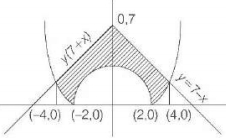
The area bounded by the curves $y=\frac{1}{4}\left|4-x^2\right|$ and $y=7-|x|$ is
Answerb
(b)
We have,
$y=\frac{1}{4}\left|4-x^2\right| \text { and } y=7-|x|$
Graph of given curves
Area of shaded region
$=2\left[\int \limits_0^4(7-x) d x-\int \limits_0^4 \frac{1}{4}\left|4-x^2\right| d x\right]$
$=2\left[\int \limits_0^4(7-x) d x-\frac{1}{4}\left[\int \limits_0^2\left(4-x^2\right) d x\right.\right.$
$\quad\quad\quad\quad\quad\quad\quad\quad\quad\quad\quad\left.\left.+\int \limits_2^4\left(x^2-4\right) d x\right]\right]$
$=2\left[\left[7 x-\frac{x^2}{2}\right]_0^4-\frac{1}{4}\left[4 x-\frac{x^3}{3}\right]_0^2\right.$
$\quad\quad\quad\quad\quad\quad\quad\quad\quad\left.-\frac{1}{4}\left[\frac{x^3}{3}-4 x\right]_2^4\right]$
View full question & answer→MCQ 411 Mark
The parabola $y^2=4 x+1$ divides the disc $x^2+y^2 \leq 1$ into two regions with areas $A_1$ and $A_2$. Then, $\left|A_1-A_2\right|$ equals
- A
$\frac{1}{3}$
- ✓
$\frac{2}{3}$
- C
$\frac{\pi}{4}$
- D
$\frac{\pi}{3}$
AnswerCorrect option: B. $\frac{2}{3}$
b
(b)
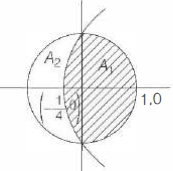
We have, parabola $y^2=4 x+1$ and circle $x^2+y^2 \leq 1$
Area of shaded region,
$A_1=2\left(\int \limits_{-1 / 4}^0 \sqrt{4 x+1} d x+\int_0^1 \sqrt{1-x^2} d x\right)$
$\Rightarrow \quad A_1=2\left[\frac{2}{3}(4 x+1)^{3 / 2}\right]_{-1 / 4}^0+2 \times \frac{\pi}{2}$
$\Rightarrow \quad A_1=\frac{1}{3}+\frac{\pi}{2}$
$\begin{aligned} A_2 =\text { Area of circle }-A_1 \\ =\pi-\left(\frac{1}{3}+\frac{\pi}{2}\right)=\frac{\pi}{2}-\frac{1}{3} \\ \therefore\left|A_1-A_2\right| =\left|\frac{1}{3}+\frac{\pi}{2}-\frac{\pi}{2}+\frac{1}{3}\right|=\frac{2}{3} \end{aligned}$
View full question & answer→MCQ 421 Mark
Let $A_1, A_2, A_3$ be regions in the $X Y$-plane defined by
$A_1=\left\{(x, y): x^2+2 y^2 \leq 1\right\}$
$A_2=\left\{(x, y):\left|x^3\right|+2 \sqrt{2} \mid y^3 \leq 1\right\}$
$A_3=\{(x, y): \max (|x|, \sqrt{2}|y|) \leq 1\}$ Then,
- A
$A_1 \supset A_2 \supset A_3$
- B
$A_3 \supset A_1 \supset A_2$
- C
$A_2 \supset A_3 \supset A_1$
- ✓
$A_3 \supset A_2 \supset A_1$
AnswerCorrect option: D. $A_3 \supset A_2 \supset A_1$
d
(d)
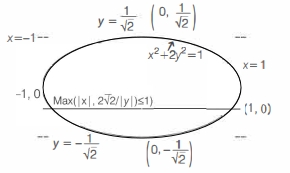
Given, $A_1=\left\{(x, y): x^2+2 y^2 \leq 1\right\}$
$A_2=\left\{(x, y):\left.\left|x^3+2 \sqrt{2}\right| y\right|^3 \leq 1\right\}$
$A_3=\{(x, y): \max (|x|, \sqrt{2}|y| \leq 1)\}$
Graph of $A_1, A_2$ and $A_3$ are
Clearly from graph $A_1 \subset A_2 \subset A_3$
View full question & answer→MCQ 431 Mark
The area of the region bounded by the curve $y=\left|x^3-4 x^2+3 x\right|$ and the $X$-axis, $0 \leq x \leq 3$, is
- A
$\frac{37}{6}$
- B
$\frac{9}{4}$
- ✓
$\frac{37}{12}$
- D
$0$
AnswerCorrect option: C. $\frac{37}{12}$
c
(c)
We have, $y=\left|x^3-4 x^2+3 x\right|$
Area of region bounded by $y \leq f(x), X$-axis and $0 \leq x \leq 3$ is $\int_0^3\left|x^3-4 x^2+3 x\right| d x$
$\int_0^1\left(x^3-4 x^2+3 x\right)-\int_1^3\left(x^3-4 x^2+3 x\right) d x$
$=\left[\frac{x^4}{4}-\frac{2 x^3}{3}+\frac{3 x^2}{2}\right]_0^1-\left[\frac{x^4}{4}-\frac{4 x^3}{3}+\frac{\left.3 x^2\right]^3}{2}\right\rfloor_1$
$\left.=\left[\left(\frac{1}{4}-\frac{4}{3}+\frac{3}{2}\right)-(0)\right\rfloor\right]$
View full question & answer→MCQ 441 Mark
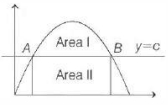
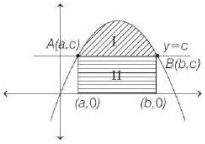
The figure shows a portion of the graph $y=2 x-4 x^3$.The line $y=c$ is such that the areas of the regions marked $I$ and $II$ are equal. If $a, b$ are the $x$-coordinates of $A, B$ respectively, then $a+b$ equals
- ✓
$\frac{2}{\sqrt{7}}$
- B
$\frac{3}{\sqrt{7}}$
- C
$\frac{4}{\sqrt{7}}$
- D
$\frac{5}{\sqrt{7}}$
AnswerCorrect option: A. $\frac{2}{\sqrt{7}}$
a
(a)
We have, $y=2 x-4 x^3$
Given, area of $I$ region = area of $II$ region
$\therefore \quad \int \limits_a^b\left(2 x-4 x^3\right) d x=2(b-a) c$
${\left[x^2-x^4\right\}_a=2(b-a) c }$
$\Rightarrow \quad\left(b^2-b^4\right)-\left(a^2-a^4\right)=2(b-a) c$
$\Rightarrow \quad\left(b^2-a^2\right)-\left(b^4-a^4\right)=2(b-a) c$
$\Rightarrow \quad\left(b^2-a^2\right)\left(1-\left(b^2+a^2\right)\right)=2(b-a) c$
$\Rightarrow \quad(b+a)\left(1-b^2-a^2\right)=2 c$
$\Rightarrow \quad(b+a)\left(1-(b+a)^2+2 a b\right)=2 c$
$\quad\left[\because c=2 x-4 x^3\right]$
$\Rightarrow \quad c=2 x-4 x^3$
$\therefore \quad$ Let $a, b$ and $\alpha$ are roots.
$\therefore a+b+\alpha=0, a b+(a+b) \alpha=-\frac{1}{2}$
$a b \alpha=-\frac{c}{4}$
$a+b=-\alpha, a b=\alpha^2-\frac{1}{2}, a b=\frac{-c}{4 \alpha}$
$1-\alpha^2+2\left(\alpha^2-\frac{1}{2}\right)=-8 \alpha\left(\alpha^2-\frac{1}{2}\right)$
$\Rightarrow \quad 1-\alpha^2+2 \alpha^2-1=8 \alpha^2-4$
$\Rightarrow \quad \alpha^2=4 \Rightarrow \alpha=\frac{2}{\sqrt{7}}$
View full question & answer→MCQ 451 Mark
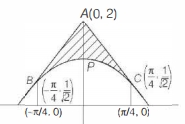
The area bounded by the curve $y=\cos x$, the line joining $(-\pi / 4, \cos (-\pi / 4))$ and $(0,2)$ and the line joining $(\pi / 4, \cos (\pi / 4))$ and $(0,2)$ is
- ✓
$\left(\frac{4+\sqrt{2}}{8}\right) \pi-\sqrt{2}$
- B
$\left(\frac{4+\sqrt{2}}{8}\right) \pi+\sqrt{2}$
- C
$\left(\frac{4+\sqrt{2}}{4}\right) \pi-\sqrt{2}$
- D
$\left(\frac{4+\sqrt{2}}{4}\right) \pi+\sqrt{2}$
AnswerCorrect option: A. $\left(\frac{4+\sqrt{2}}{8}\right) \pi-\sqrt{2}$
a
(a)
Given, $y=\cos x$
Equation of line joining
$\left(\frac{-\pi}{4}, \cos \left(\frac{-\pi}{4}\right)\right)$ and $(0,2)$ is
$y-2 =\frac{2-1 / \sqrt{2}}{0+\pi / 4}(x-0)$
$\Rightarrow \quad y-2 =(8-2 \sqrt{2}) x$
$\Rightarrow \quad y =\frac{(8-2 \sqrt{2})}{\pi} x+2$
Equation of line joining $\left(\frac{\pi}{4}, \cos \frac{\pi}{4}\right)$ and $(0,2)$ is
$y-2 =\frac{2-\frac{1}{\sqrt{2}}}{0-\frac{\pi}{4}}(x-0)$
$\Rightarrow \quad y =\left(\frac{-8+2 \sqrt{2}}{\pi}\right) x+2$
Graph of given curve, $y=\cos x$, and line are
Area of shaded region
$=2 \text { area of curve } A P C A$
$=2 \int \limits_0^{\pi / 4}\left[\frac{(-8+2 \sqrt{2})}{\pi} x+2-\cos x\right] d x$
$=2\left[\frac{-8 x^2}{2 \pi}+\frac{2 \sqrt{2} x^2}{2 \pi}+2 x-\sin x\right]_0^{\pi / 4}$
$=2\left[\frac{-4}{\pi}\left(\frac{\pi}{4}\right)^2+\frac{\sqrt{2}}{\pi}\left(\frac{\pi}{4}\right)^2+\frac{2 \pi}{4}-\frac{1}{\sqrt{2}}\right]$
$=2\left[\frac{\pi}{4}\left(\frac{-4}{4}+\frac{\sqrt{2}}{4}+2\right)-\frac{1}{\sqrt{2}}\right]$
$=\left(\frac{4+\sqrt{2}}{8}\right) \pi-\sqrt{2}$
View full question & answer→MCQ 461 Mark
The value of $\int \limits_0^{2 \pi} \min \left\{|x-\pi|, \cos ^{-1}(\cos x)\right\} d x$ is
- A
$\frac{\pi^2}{4}$
- ✓
$\frac{\pi^2}{2}$
- C
$\frac{\pi^2}{8}$
- D
$\pi^2$
AnswerCorrect option: B. $\frac{\pi^2}{2}$
b
(b) We have,
$\int \limits_0^{2 \pi} \min \left\{|x-\pi|, \cos ^{-1}(\cos x)\right\} d x$
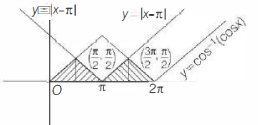
Graph of $y=|x-\pi|$ and $y=\cos ^{-1}(\cos x)$
$\int \limits_0^{2 \pi} \min \left\{|x-\pi|, \cos ^{-1}(\cos x) d x=\right.\text { Area of }$
shaded region.
$=\frac{1}{2} \times \pi \times \frac{\pi}{2}+\frac{1}{2} \times \pi \times \frac{\pi}{2}$
$=\frac{\pi^2}{4}+\frac{\pi^2}{4}=\frac{\pi^2}{2}$
View full question & answer→MCQ 471 Mark
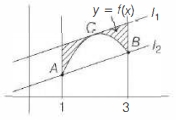
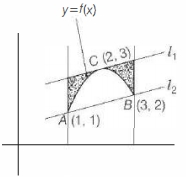
The following figure shows the graph of a continuous function $y=f(x)$ on the interval $[1,3]$. The points $A, B, C$ have coordinates $(1,1),(3,2),(2,3)$ respectively, and the lines $l_1$ and $l_2$ are parallel, with $l_1$ being tangent to the curve at $C$. If the area under the graph of $y=f(x)$ from $x=1$ to $x=3$ is $4$ sq units, then the area of the shaded region is
Answera
(a)
Given,
$A(1,1), B(3,2), C(2,3)$
Slope of line $l_2=\frac{2-1}{3-1}=\frac{1}{2}$
Line $l_1$ is parallel to $b_2$
$\therefore$ Equation of line $l_1$ is
$\begin{aligned}\Rightarrow & y-3 &=\frac{1}{2}(x-2) \\\Rightarrow & y &=\frac{x}{2}+2 \end{aligned}$
Area of shaded region
$\begin{array}{l}=\int \limits_1^3\left(\text { line } l_1-\text { curve } f(x)\right) d x \\ =\int \limits_1^3\left(\frac{x}{2}+2\right) d x-4 \\=\left[\frac{x^2}{4}+2 x\right]_1^3-4 \\ =\left(\frac{9}{4}+6\right)-\left(\frac{1}{4}+2\right)-4 \\=\frac{9}{4}+6-\frac{1}{4}-2-4=2\end{array}$
View full question & answer→MCQ 481 Mark
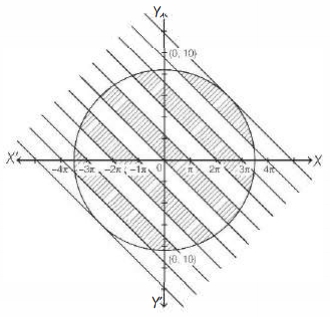
Consider the regions $A=\left\{(x, y) \mid x^2+y^2 \leq 100\right\}$ and $R=\{(x, y) \mid \sin (x+y)>0\}$ in the plane. Then, the area of the region $A \cap B$ is $....\pi$
Answerd
(d)
We have,
$\begin{array}{l}A=\left\{(x, y): x^2+y^2 \leq 100\right\} \\B=\{(x, y): \sin (x+y) > 0 \end{array}$
$\sin (x+y) > 0$
$\therefore \quad x+y \in(0, \pi) \cup(2 \pi, 3 \pi)$
$\quad x+y=c$ equation of line
Required area = shaded region
$\frac{1}{2}$ area of circle $=\frac{1}{2} \pi(10)^2=50 \pi$
View full question & answer→MCQ 491 Mark
The area bounded by the parabolas $y=x^2$ and $y=1-x^2$ equals
- A
$\frac{\sqrt{2}}{3}$
- ✓
$\frac{2 \sqrt{2}}{3}$
- C
$\frac{1}{3}$
- D
$\frac{2}{3}$
AnswerCorrect option: B. $\frac{2 \sqrt{2}}{3}$
b
(b)
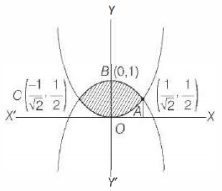
We have, $y=x^2$ and $y=1-x^2$
Intersection point of $y=x^2$ and $y=1-x^2$ is $A\left(\frac{1}{\sqrt{2}}, \frac{1}{2}\right)$ and $C\left(\frac{-1}{\sqrt{2}}, \frac{1}{2}\right)$
Area of shaded region
$=2 \int \limits_0^{1 / \sqrt{2}}\left[\left(1-x^2\right)-\left(x^2\right)\right] d x$
$=2 \int \limits_0^{1 / \sqrt{2}}\left(1-2 x^2\right) d x$
$=2\left[x-\frac{2 x^3}{3}\right]_0^{1 / \sqrt{2}}$
$=2\left[\frac{1}{\sqrt{2}}-\frac{1}{3 \sqrt{2}}\right]$
$=\frac{2}{\sqrt{2}}\left[\frac{3-1}{3}\right]=\frac{2 \sqrt{2}}{3}$ sq units
View full question & answer→MCQ 501 Mark
The area of the region bounded by $y=|| x-3|-4|-5$ and the $X$-axis is
- A
$24.5$
- B
$37$
- ✓
$49$
- D
$35 \sqrt{2}$
Answerc
(c)
We have, $y=\| x-3|-4|-5$
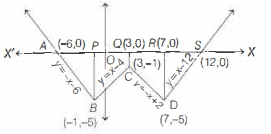
$y=\left\{\begin{array}{cc}-x-6, & x<-1 \\x-4, & -1 \leq x<3 \\-x+2, & 3 \leq x<7 \\x-12, & x \geq 7\end{array}\right.$
The graph of function are
Area of region bounded by
$y=|| x-3|-4|-5$ and $X$-axis
$=$ Area of $\triangle A P B+$ Area of trapezium
$B P Q C+$ Area of trapezium $Q C D R+$ Area
of $\triangle R S D$
$=\frac{1}{2} \times 5 \times 5+\frac{1}{2} \times 4 \times(5+1)$
$+\frac{1}{2} \times 4 \times(5+1)+\frac{1}{2} \times 5 \times 5$
$=49$
View full question & answer→