MCQ
$ A _{( g )} \rightleftharpoons B _{( g )}+\frac{ C }{2}(g)$ The correct relationship between $K_P, \alpha$ and equilibrium pressure $P$ is
  • A
    $K_P=\frac{\alpha^{1 / 2} P ^{1 / 2}}{(2+\alpha)^{1 / 2}}$
  • B
    $K_P=\frac{\alpha^{3 / 2} P^{1 / 2}}{(2+\alpha)^{1 / 2}(1-\alpha)}$
  • C
    $K_P=\frac{\alpha^{1 / 2} P^{3 / 2}}{(2+\alpha)^{3 / 2}}$
  • D
    $K _{ P }=\frac{\alpha^{1 / 2} P ^{1 / 2}}{(2+\alpha)^{3 / 2}}$

Answer

$A_{(g)} \rightleftharpoons B_{(g)}+\frac{c}{2}(g)$
$t=t_{cq} \quad(1-\alpha) \alpha \frac{\alpha}{2}$
$P_{B}=\frac{\alpha}{\left(1+\frac{\alpha}{2}\right)} \cdot P, P_{A}=\frac{(1-\alpha)}{\left(1+\frac{\alpha}{2}\right)} \cdot P, P_{C}=\frac{\frac{\alpha}{2}}{\left(1+\frac{\alpha}{2}\right)} \cdot P$
$K_{P}=\frac{P_{B} \cdot P_{C}^{\frac{1}{2}}}{P_{A}}$
$=\frac{(\alpha)^{\frac{3}{2}}(P)^{\frac{1}{2}}}{(1-\alpha)(2+\alpha)^{\frac{1}{2}}}$

Need a full question paper?

Generate a complete, print-ready paper with questions like this in minutes — across 16+ boards, with answer keys.

Start Generating Free

Similar questions

Consider th following four reactions:

$(I)$ $\begin{array}{*{20}{c}}
  {{C_6}{H_5} - CH - Cl} \\ 
  {\,\,|} \\ 
  {\,\,\,\,\,\,\,\,\,C{H_3}} 
\end{array}\xrightarrow[{5\% \,\,water}]{{95\% \,\,\,acetone}}\begin{array}{*{20}{c}}
  {{C_6}{H_5} - CH - OH} \\ 
  | \\ 
  {\,\,\,\,\,\,C{H_3}} 
\end{array}$

$(II)$ $\begin{array}{*{20}{c}}
  {{C_6}{H_5} - CH - Cl} \\ 
  {\,\,|} \\ 
  {\,\,\,\,\,\,C{H_3}} 
\end{array}\xrightarrow[{10\% \,\,water}]{{90\% \,\,\,acetone}}\begin{array}{*{20}{c}}
  {{C_6}{H_5} - CH - OH} \\ 
  | \\ 
  {\,\,\,\,\,\,C{H_3}} 
\end{array}$

$(III)$ $\begin{array}{*{20}{c}}
  {{C_6}{H_5} - CH - Cl} \\ 
  {\,\,|} \\ 
  {\,\,\,\,\,\,C{H_3}} 
\end{array}\xrightarrow[{20\% \,\,water}]{{80\% \,\,\,acetone}}\begin{array}{*{20}{c}}
  {{C_6}{H_5} - CH - OH} \\ 
  | \\ 
  {\,\,\,\,\,\,C{H_3}} 
\end{array}$

$(IV)$ $\begin{array}{*{20}{c}}
  {{C_6}{H_5} - CH - Cl} \\ 
  {\,\,|} \\ 
  {\,\,\,\,\,\,C{H_3}} 
\end{array}\xrightarrow{{100\% \,water}}\begin{array}{*{20}{c}}
  {{C_6}{H_5} - CH - OH} \\ 
  | \\ 
  {\,\,\,\,\,\,C{H_3}} 
\end{array}$

Arrange these reactions in decreasing order of greater proportion of inverted product and select correct answer from the codes given below :
Among the properties $(a) $ reducing $ (b) $ oxidising $(c)$  complexing, the set of properties shown by $C{N^ - }$ ion towards metal species is
Calculate the enthalpy for the following reaction using the given bond energies $(KJ/mole)$ :-

$(C-H= 414; H-O = 463; H-Cl=431;$$ C-Cl=326, C-O=335)$

$CH_3-OH(g) + HCl(g) \rightarrow CH_3-Cl(g) + H_2O(g)$


The equivalent conductance of monobasic acid at infinite dilution is $348\, ohm^{-1}\, cm^2\, eq^{-1}$ . If the resistivity of the solution containing $15\, g$ acid (mol. wt. $49$ ) in $1$ $litre$ is $18.5\, ohm\, cm$ . What is the degree of dissociation of acid? .............. $\%$
For the compounds $CH_3Cl, CH_3Br, CH_3I$ and $CH_3F$, the correct order of increasing $C-$ halogen bond length is
Which of the following have maximum electron gain enthalpy
Solid $Ba(NO_3)_2$ is gradually dissolved in a $1.0 \times 10^{-4}\, M$  $N_2CO_3$ solution. At what concentration of $Ba^{2+}$ will aprecipitate begin to form? ($K_{sp}$  for $BaCO_3 = 5 .1 \times 10^{-9}$)
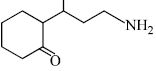
Reductive amination of $A$ forms :

$A$ :

Total number of electrons in $“Cu”$ atom having $m_l = 0$
Which of the following has the least energy