Question
A galvanometer can be converted into voltmeter of given range by connecting a suitable resistance R, in series with the galvanometer, whose value is given by,
$\text{R}_\text{s}=\frac{\text{V}}{\text{I}_\text{g}}-\text{G}$
where Vis the voltage to be measured, lg is the current for full scale deflection of galvanometer and G is the resistance of galvanometer.
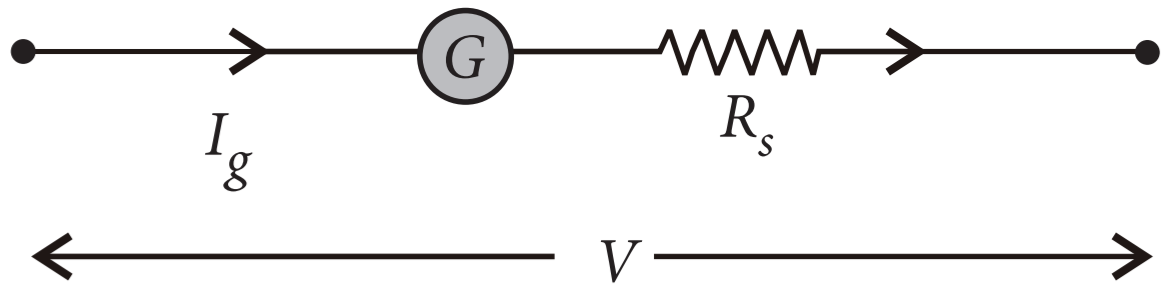
Series resistor(R,) increases range of voltmeter and the effective resistance of galvanometer. It also protects the galvanometer from damage due to large current. Voltmeter is a high resistance instrument and it is always connected in parallel with the circuit element across which potential difference is to be measured. An ideal voltmeter has infinite resistance. In order to increase the range of voltmeter n times the value of resistance to be connected in series with galvanometer is $R_s = (n - 1)G.$
  1. 10mA current can pass through a galvanometer of resistance $25\Omega$ What resistance in series should be connected through it, so that it is converted into a voltmeter of 100V?
  1. $0.975\Omega$
  2. $99.75\Omega$
  3. $975\Omega$
  4. $9975\Omega$
  1. There are 3 voltmeter A, B, C having the same range but their resistance are $15000\Omega,10000\Omega$, and $5000\Omega$ respectively. 'Tile best voltmeter amongst them is the one whose resistance is
  1. $5000\Omega$
  2. $10000\Omega$
  3. $15000\Omega$
  4. all are equally good.
  1. A milliammeter of range 0 to 25mA and resistance of $10\Omega$ is to be converted into a voltmeter with a range of 0 to 25V. 'Tile resistance that should be connected in series will be:
  1. $930\Omega$
  2. $960\Omega$
  3. $990\Omega$
  4. $1010\Omega$
  1. To convert a moving coil galvanometer (MCG) into a voltmeter:
  1. A high resistance R is connected in parallel with MCG.
  2. A low resistance R is connected in parallel with MCG.
  3. A low resistance R is connected in series with MCG.
  4. A high resistance R is connected in series with MCG.
  1. To increase the current sensitivity of a moving coil galvanometer, we should decrease:
  1. Zero.
  2. Low.
  3. High.
  4. Infinity.

Answer

  1. (d) $9975\Omega$
Explanation:

A galvanometer can be converted into a voltmeter of given range by connecting a suitable high resistance R in series of galvanometer, which is given by,

$\text{R}=\frac{\text{V}}{\text{I}_\text{g}}-\text{G}=\frac{100}{10\times10^{-3}}-25=10000-25=9975\Omega$
  1. (c) $15000\Omega$
Explanation:

An ideal voltmeter should have a very high resistance.
  1. (c) $990\Omega$
Explanation:

Resistance of voltmeter $=\frac{25}{25\times10^{-3}}=1000\Omega$

$\therefore\text{X}=1000-10=990\Omega$
  1. (d) A high resistance R is connected in series with MCG.
Explanation:

To convert a moving coil galvanometer into a voltmeter, it is connected with a high resistance in series. The voltmeter is connected in parallel to measure the potential difference. As the resistance is high, the voltmeter itself does not consume current.
  1. (d) Infinity.
Explanation:

The resistance of an ideal voltmeter is infinity.

Need a full question paper?

Generate a complete, print-ready paper with questions like this in minutes — across 16+ boards, with answer keys.

Start Generating Free

Similar questions

Find the acceleration due to gravity of the moon at a point 1000km above the moon's surface. The mass of the moon is $7.4 \times 10^{22}kg$ and its radius is 1740km.
A fat person is standing on a light plank floating on a calm lake. The person walks from one end to the other on the plank. His friend sitting on the shore watches him and finds that the person hardly moves any distance because the plank moves backward about the same distance as the person moves on the plank. Explain.
For the past some time, Aarti had been observing some erratic body movement, unsteadiness and lack of coordination in the activities of her sister Radha, who also used to complain of severe headache occasionally. Aarti suggested to her parents to get a medical check-up of Radha. The doctor thoroughly examined Radha and diagnosed that she has a brain tumour.
  1. What, according to you, are the values displayed by Aarti?
  2. How can radioisotopes help a doctor to diagnose brain tumour?
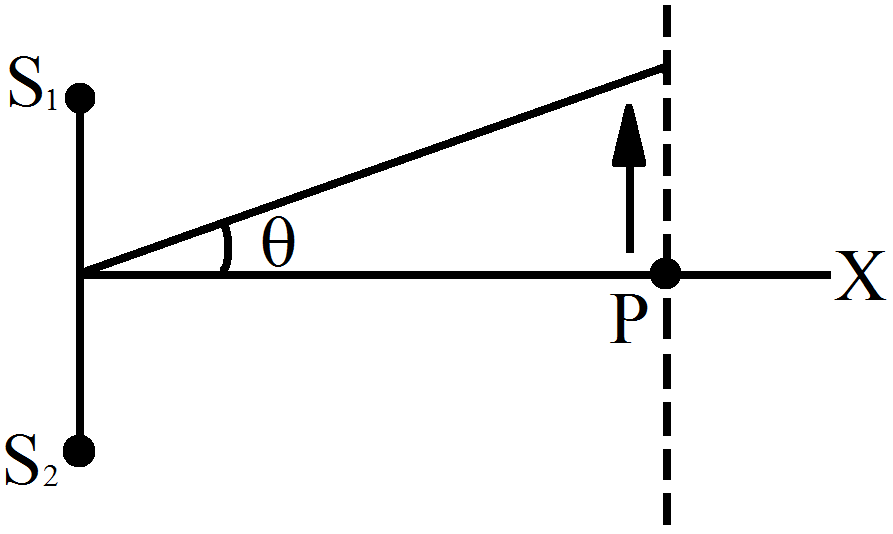
Two speakers $S_1$ and $S_2$, driven by the same amplifier, are placed at y = 1.0m and y = -1.0m figure, The speakers vibrate in phase at 600Hz. A man stands at a point on the X-axis at a very large distance from the origin and starts moving parallel to the Y-axis. The speed of sound in air is 330m/s.
  1. At what angle $\theta$ will the intensity of sound drop to a minimum for the first time?
  2. At what angle will he hear a maximum of sound intensity for the first time?
  3. If he continues to walk along the line, how many more maxima can he hear?
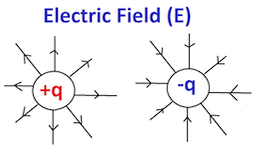
Electric field intensity at any point is the strength of the electric field at that point. It is also defined as the force experienced by unit positive charge placed at that point. Electric Field Intensity is a vector quantity. It is denoted by E. When placed within the electric field, the test charge will experience an electric force - either attractive or repulsive.
Image
(i) The Electric field at a point is
(a) discontinuous only if there is a negative charge at that point
(b) always continuous
(c) continuous if there is charge at that point
(d) continuous if there is no charge at that point

(ii) A charge is distributed uniformly over a ring of radius a. Obtain an expression for the electric intensity E at a point on the axis of the ring. Hence the points at large distances from the ring, it behaves like a point charge is:
(a) $E =\frac{1}{4 \pi \varepsilon_0} \cdot \frac{q}{x}$
(b) $E =\frac{1}{2 \pi \varepsilon_0} \cdot \frac{Q}{x^2}$
(c) $E =\frac{1}{4 \pi \varepsilon_0} \cdot \frac{q}{x^4}$
(d) $E =\frac{1}{4 \pi \varepsilon_0} \cdot \frac{Q}{x^2}$

(iii) Force acting on an electron in a uniform electric field of $5 \times 10^4 N / C$ is:
(a) $8 \times 10^{-15} N$
(b) $-7 \times 10^{-15} N$
(c) $-8 \times 10^{-15} N$
(d) $7 \times 10^{-15} N$

(iv) At a particular point, the electric field depends upon:
(a) source charge Q only
(b) both Q and q
(c) test charge $q_0$ only
(d) neither Q nor q

OR

Four charges of the same magnitude and same sign are placed at the corners of a square, of each side 0.1 m. then electric field intensity at the centre of the square is:
(a) $0.01 N / C$
(b) $0.25 N / C$
(c) zero
(d) $0.1 N / C$

Suppose you are running fast in a field when you suddendly find a snake in front of you. You stop quickly. Which force is responsible for your deceleration?
A uniform magnetic field of 1.5 T exists in a cylindrical region of radius10.0 cm, its direction parallel to the axis along east to west. A wire carrying current of 7.0 A in the north to south direction passes through this region. What is the magnitude and direction of the force on the wire if,
  1. The wire intersects the axis,
  2. The wire is turned from N-S to northeast-northwest direction,
  3. The wire in the N-S direction is lowered from the axis by a distance of 6.0 cm?
Suppose you are inside the water in a swimming pool near an edge. A friend is standing on the edge. Do you find your friend taller or shorter than his usual height?

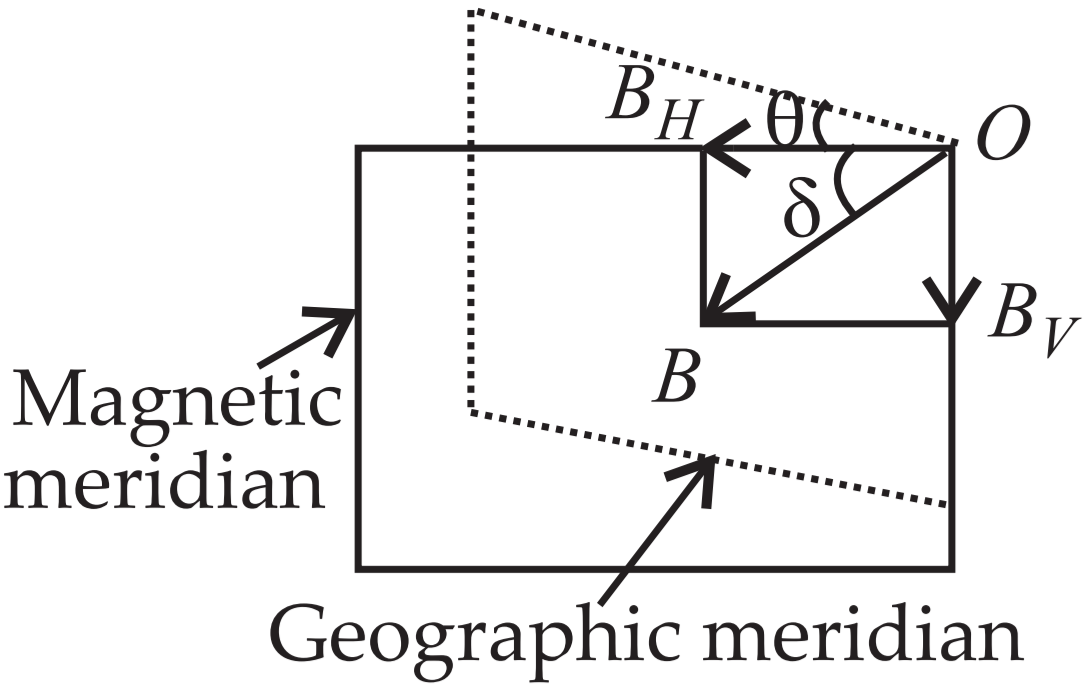
'Tile earth's magnetic field at a point on its surface is usually characterised by three quantities: (a) declination (bl inclination or dip and (cl horizontal component of the field. These are known as the elements of the earth's magnetic field. At a place, angle between geographic meridian and magnetic meridian is defined as magnetic declination, whereas angle made by the earth's magnetic field with the horizontal in magnetic meridian is known as magnetic dip.
  1. In a certain place, the horizontal component of magnetic field is $\frac{1}{\sqrt{3}}$ times the vertical component. 'Tile angle of dip at this place is:
  1. $\text{Zero}$
  2. $\frac{\pi}{3}$
  3. $\frac{\pi}{2}$
  4. $\frac{\pi}{6}$
  1. The angle between the true geographic north and the north shown by a compass needle is called as:
  1. Inclination.
  2. Magnetic declination.
  3. Angle of meridian.
  4. Magnetic pole.
  1. Tile angles of dip at the poles and the equator respectively are
  1. 30º, 30º
  2. 0º, 90º
  3. 45º, 90º
  4. 90º, 0º
  1. A compass needle which is allowed to move in a horizontal plane is taken to a geomagnetic pole. It
  1. Will become rigid showing no movement.
  2. Will stay in any position.
  3. Will stay in north-south direction only.
  4. Will stay in east-west direction only.
  1. Select the correct statement from the following.
  1. The magnetic dip is zero at the centre of the earth.
  2. Magnetic dip decreases as we move away from the equator towards the magnetic pole.
  3. Magnetic dip increases as we move away from the equator towards the magnetic pole.
  4. Magnetic dip does not vary from place to place.
Derive the formula for the magnetic field produced at a point on the axis of a current carrying circular loop.