Question
'Tile earth's magnetic field at a point on its surface is usually characterised by three quantities: (a) declination (bl inclination or dip and (cl horizontal component of the field. These are known as the elements of the earth's magnetic field. At a place, angle between geographic meridian and magnetic meridian is defined as magnetic declination, whereas angle made by the earth's magnetic field with the horizontal in magnetic meridian is known as magnetic dip.
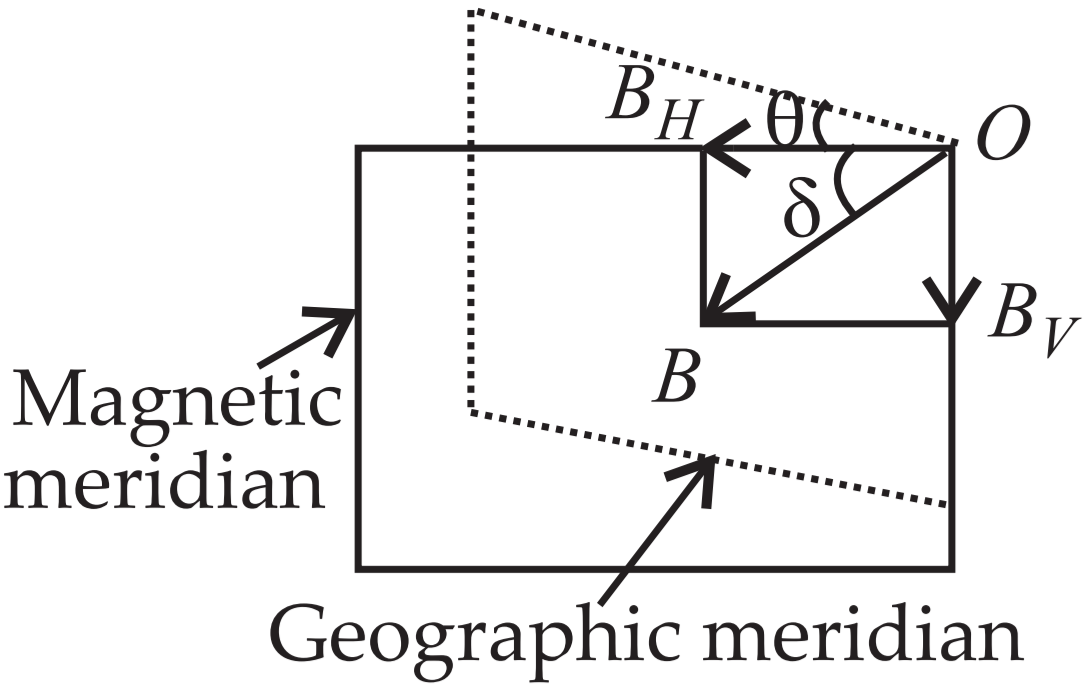
- In a certain place, the horizontal component of magnetic field is $\frac{1}{\sqrt{3}}$ times the vertical component. 'Tile angle of dip at this place is:
- $\text{Zero}$
- $\frac{\pi}{3}$
- $\frac{\pi}{2}$
- $\frac{\pi}{6}$
- The angle between the true geographic north and the north shown by a compass needle is called as:
- Inclination.
- Magnetic declination.
- Angle of meridian.
- Magnetic pole.
- Tile angles of dip at the poles and the equator respectively are
- 30º, 30º
- 0º, 90º
- 45º, 90º
- 90º, 0º
- A compass needle which is allowed to move in a horizontal plane is taken to a geomagnetic pole. It
- Will become rigid showing no movement.
- Will stay in any position.
- Will stay in north-south direction only.
- Will stay in east-west direction only.
- Select the correct statement from the following.
- The magnetic dip is zero at the centre of the earth.
- Magnetic dip decreases as we move away from the equator towards the magnetic pole.
- Magnetic dip increases as we move away from the equator towards the magnetic pole.
- Magnetic dip does not vary from place to place.