MCQ
A galvanometer gives full scale deflection with $0.006$ A current. By connecting it to a $4990 \ \Omega$ resistance, it can be converted into a voltmeter of range $0-30 \ V$. If connected to a $\frac{2 n }{249} \Omega$ resistance, it becomes an ammeter of range $0-1.5 \ A$. The value of $n$ is:
  • A
    $2$
  • B
    $3$
  • C
    $4$
  • $5$

Answer

Correct option: D.
$5$
d
$\frac{6}{1000}(G+4990)=30 $

$\Rightarrow G+4990=\frac{30,000}{6}=5000 $

$\Rightarrow G=10 $

$\frac{6}{1000} \times 10=\left(1.5-\frac{6}{1000}\right) S $

$\Rightarrow S =\frac{60}{1494}=\frac{2 n}{249} $

$\Rightarrow=\frac{249 \times 30}{1494}=\frac{2490}{498}=5$

Need a full question paper?

Generate a complete, print-ready paper with questions like this in minutes — across 16+ boards, with answer keys.

Start Generating Free

Similar questions

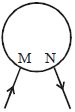
A uniform wire of resistance $20\,ohm$ having resistance $1\Omega /m$ is bent in the adjoining form of a circle as shown in the figure. If the equivalent resistance between $M$ and $N$ is $1.8 \,\Omega $, then the length of the shorter section is ................ $m$
Certain neutron stars are believed to be rotating at about $1\,rev/\sec $. If such a star has a radius of $ 20\, km$, the acceleration of an object on the equator of the star will be
The amplitude and the time period in a $S.H.M.$ is $0.5 \,cm$ and $0.4 \,sec$ respectively. If the initial phase is $\pi /2$ radian, then the equation of $S.H.M.$ will be
The length of a wire is $1.0\, m$ and the area of cross-section is $1.0 \times {10^{ - 2}}\,c{m^2}$. If the work done for increase in length by $0.2\, cm$ is $0.4\, joule$, then Young's modulus of the material of the wire is
From the following combinations of physical constants (expressed through their usual symbols) the only combination, that would have the same value in different systems of units, is
A ground to ground projectile is at point $A$ at $t=\frac{T}{3}$, is at point $B$ at $t=\frac{5 T}{6}$ and reaches the ground at $t=T$. The difference in heights between points $A$ and $B$ is
What is the magnitude of a point charge due to which the electric field $30\,cm$ away has the magnitude $2\,newton/coulomb$ $[1/4\pi {\varepsilon _0} = 9 \times {10^9}\,N{m^2}/{C^2}]$
If the resistivity of a potentiometer wire be $\rho $ and area of cross-section be $A$, then what will be potential gradient along the wire
Two spherical balls having equal masses with radius of $5\, {cm}$ each are thrown upwards along the same vertical direction at an interval of $3\, {s}$ with the same initial velocity of $35 \,{m} / {s}$, then these balls collide at a height of $\ldots \ldots \ldots . {m}$. (Take ${g}=10 \,{m} / {s}^{2}$ )
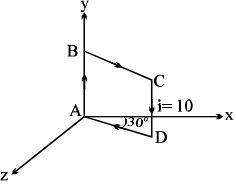
Figure shows a square current carrying loop $ABCD$ of side $10\,\, cm$ and current $i = 10\,A$. The magnetic moment $\vec M$ of the loop is