The length of a wire is $1.0\, m$ and the area of cross-section is $1.0 \times {10^{ - 2}}\,c{m^2}$. If the work done for increase in length by $0.2\, cm$ is $0.4\, joule$, then Young's modulus of the material of the wire is
Medium
Download our app for free and get started
(c) $W = \frac{1}{2}\frac{{YA{l^2}}}{L}$ $⇒$ $0.4 = \frac{1}{2} \times \frac{{Y \times {1^{ - 6}} \times {{(0.2 \times {{10}^{ - 2}})}^2}}}{1}$
$ Y$$ = 2 \times {10^{11}}N/{m^2}$

Download our appand get started for free
Experience the future of education. Simply download our apps or reach out to us for more information. Let's shape the future of learning together!No signup needed.*
Similar Questions
- 1A suspended long metal wire is stretched a small distance $x$ by a load $W$ in newton suspended at the other end. Select the best answer out of the followingView Solution
- 2A force is applied to a steel wire ' $A$ ', rigidly clamped at one end. As a result elongation in the wire is $0.2\,mm$. If same force is applied to another steel wire ' $B$ ' of double the length and a diameter $2.4$ times that of the wire ' $A$ ', the elongation in the wire ' $B$ ' will be $............\times 10^{-2}\,mm$ (wires having uniform circular cross sections)View Solution
- 3A uniform copper rod of length $50 \,cm$ and diameter $3.0 \,mm$ is kept on a frictionless horizontal surface at $20^{\circ} C$. The coefficient of linear expansion of copper is $2.0 \times 10^{-5} \,K ^{-1}$ and Young's modulus is $1.2 \times 10^{11} \,N / m ^2$. The copper rod is heated to $100^{\circ} C$, then the tension developed in the copper rod is .......... $\times 10^3 \,N$View Solution
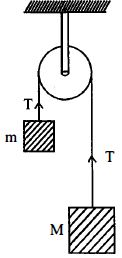
- 4Two blocks of masses $m$ and $M$ are connected by means of a metal wire of cross-sectional area $A$ passing over a frictionless fixed pulley as shown in the figure. The system is then released. If $M = 2\, m$, then the stress produced in the wire isView Solution
- 5Choose the correct relationship between Poisson ratio $(\sigma)$. bulk modulus $( K )$ and modulus of rigidity $(\eta)$ of a given solid object:View Solution
- 6Young's moduli of the material of wires $A$ and $B$ are in the ratio of $1: 4$, while its area of cross sections are in the ratio of $1: 3$. If the same amount of load is applied to both the wires, the amount of elongation produced in the wires $A$ and $B$ will be in the ratio ofView Solution
[Assume length of wires $A$ and $B$ are same]
- 7On applying a stress of $20 \times {10^8}N/{m^2}$ the length of a perfectly elastic wire is doubled. Its Young’s modulus will beView Solution
- 8One end of a slack wire (Young's modulus $Y$, length $L$ and cross-sectional area $A$ ) is clamped to a rigid wall and the other end to a block (mass $m$ ), which rests on a smooth horizontal plane. The block is set in motion with a speed $v$. What is the maximum distance, then the block will travel after the wire becomes taut?View Solution
- 9$A$ current of $(2.5 \pm 0.05)$ $A$ flows through a wire and develops a potential difference of $(10 \pm 0.1)$ $\mathrm{volt}.$ Resistance of the wire in $\mathrm{ohm},$ isView Solution
- 10A steel wire $1.5\,m$ long and of radius $1\,mm$ is attached with a load $3\,kg$ at one end the other end of the wire is fixed it is whirled in a vertical circle with a frequency $2\,Hz$ . Find the elongation of the wire when the weight is at the lowest position $(Y = 2 \times 10^{11}\,N/m^2$ and $g = 10\,m/s^2)$View Solution