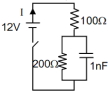
A galvanometer of resistance, $G,$ is connected in a circuit. Now a resistance $R$ is connected in series of galvanometer. To keep the main current in the circuit unchanged, the resistance to be put in parallel with the series combination of $G$ and $R$ is
Medium


Download our appand get started for free
Experience the future of education. Simply download our apps or reach out to us for more information. Let's shape the future of learning together!No signup needed.*
Similar Questions
- 1In a region $10^{19}$ $\alpha -$ particels and $10^{19}$ protons per second move to the left, while $10^{19}$ electrons moves to the right per second. The current isView Solution
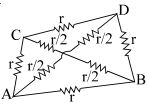
- 2The figure shows a tetrahedron, each side of which has a resistance $r$ Choose the correct statement $(s)$ related to the resistance between any two points.View Solution
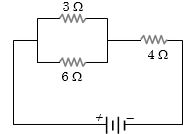
- 3In the figure, current through the $3\,\Omega $ resistor is $0.8\, ampere$, then potential drop through $4\,\Omega $ resistor is ........... $V$View Solution
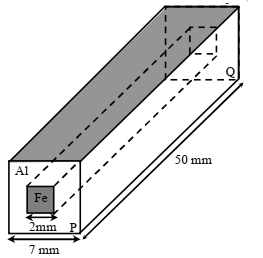
- 4In an aluminium $(A1)$ bar of square cross section, a square hole is drilled and is filled with iron ( $Fe$ ) as shown in the figure. The electrical resistivities of $A 1$ and $Fe$ are $2.7 \times 10^{-8} \ \Omega m$ and $1.0 \times 10^{-7} \ \Omega m$, respectively. The electrical resistance between the two faces $P$ and $Q$ of the composite bar isView Solution
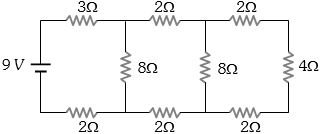
- 5View SolutionIn the circuit shown in the figure, the current through
- 6What amount of heat will be generated in a coil of resistance $R$ due to a charge $q$ passing through it if the current in the coil decreases to zero uniformly during a time interval $\Delta t$View Solution
- 7A $10 \,m$ long potentiometer wire is connected to a battery having a steady voltage. A Leclanche cell is balanced at $4 \,m$ length of the wire. If the length is kept the same, but its cross-section is doubled, the null point will be obtained at ........... $m$View Solution
- 8A resistor dissipates $192\, {J}$ of energy in $1\, {s}$ when a current of $4\, {A}$ is passed through it. Now, when the current is doubled, the amount of thermal energy dissipated in $5 \,{s}$ in $.....\,J.$View Solution
- 9ln a balanced wheat stone bridge, current in the galvanometer is zero. It remains zero when:View Solution
$[1]$ battery emf is increased
$[2]$ all resistances are increased by $10\,ohms$
$[3]$ all resistances are made five times
$[4]$ the battery and the galvanometer are interchanged
- 10Find the charge in steady state of the capacitor. (in $nC)$View Solution