MCQ
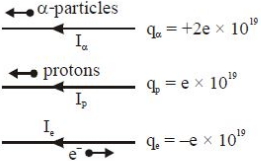
In a region $10^{19}$ $\alpha -$ particels and $10^{19}$ protons per second move to the left, while $10^{19}$ electrons moves to the right per second. The current is
  • A
    $3.2\,A$ towards left
  • B
    $3.2\,A$ towards right
  • $6.4\,A$ towards left
  • D
    $6.4\,A$ towards right

Answer

Correct option: C.
$6.4\,A$ towards left
c
Current due to protons and $\alpha$ -particles is towards left and as ${e^ - }$ have $-$ ive charge, so current due to electrons is also towards left

$\therefore $ total current $\mathrm{I}=(2 \mathrm{e}+\mathrm{e}+\mathrm{e}) \times 10^{19}$

${=4 \times 1.6 \times 10^{-19} \times 10^{19}} $

${=6.4 \mathrm{\,A}}$

Need a full question paper?

Generate a complete, print-ready paper with questions like this in minutes — across 16+ boards, with answer keys.

Start Generating Free

Similar questions

A uniform rod of length $l$ is being rotated in a horizontal plane with a constant angular speed about an axis passing through one of its ends. If the tension generated in the rod due to rotation is $T(x)$ at a distance $x$ from the axis, then which of the following graphs depicts it most closely?
If maximum velocity with which an electron can be emitted from a photo cell is $4 \times {10^8}\,cm/\sec $, the stopping potential is ................ $volt$ (mass of electron $= 9 \times 10^{-31} \,kg$)
The temperature at which the speed of sound in air becomes double of its value at ${0^o}C$ is  ...... $K$
A uniform rope of mass $M$ and length $L$ is fixed at its upper end vertically from a rigid support. Then the tension in the rope at the distance $l$ from the rigid support is $x$
A drum of radius $R$ and mass $M$, rolls down without slipping along an inclined plane  of angle $\theta$. The frictional force
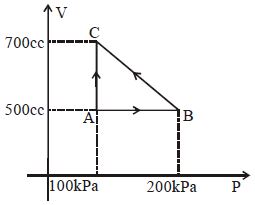
A gas taken through cyclic process $ABCA$ is shown in figure. If $2.4\,cal.$ of heat is given in the process, what is value of $J$ ...... $J/cal$ (mechanical equivalent of heat)?
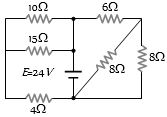
Find the equivalent resistance across the terminals of source of $e.m.f$. $24\, V$ for the circuit shown in figure .............. $\Omega$
An eye specialist prescribes spectacles having a combination of convex lens of focal length $40\, cm$ in contact with a concave lens of focal length $25\, cm$. The power of this lens combination in diopters is
A body of mass $1000 \ kg$ is moving horizontally with a velocity $6\ m / s$. If $200 \ kg$ extra mass is added, the final velocity $($ in $m / s )$ is:
A thin prism having refracting angle $10^o $ is made of glass of refractive index $1.42.$ This prism is combined with another thin prism of glass of refractive index $1. 7.$ This combination produces dispersion without deviation. The refracting angle of second prism should be....$^o$