MCQ
A gas at $NTP$ is suddenly compressed to one-fourth of its original volume. If $\gamma $ is supposed to be $\frac{3}{2}$, then the final pressure is........ atmosphere
  • A
    $4$
  • B
    $1.5$
  • $8$
  • D
    $0.25$

Answer

Correct option: C.
$8$
c
(c) $P{V^\gamma } = {\rm{constant}} \Rightarrow \frac{{{P_2}}}{{{P_1}}} = {\left( {\frac{{{V_1}}}{{{V_2}}}} \right)^\gamma }$$ \Rightarrow \frac{{{P_2}}}{1} = {\left( {\frac{{{V_1}}}{{{V_1}/4}}} \right)^{3/2}} = 8$
==> ${P_2} = 8\;atm$.

Need a full question paper?

Generate a complete, print-ready paper with questions like this in minutes — across 16+ boards, with answer keys.
Start Generating Free

Similar questions

Instantaneous temperature difference between cooling body and the surroundings obeying Newton's law of cooling is $\theta$. Which of the following represents the variation of $\ln \theta$ with time $t$ ?
Each side of a box made of metal sheet in cubic shape is $'a'$ at room temperature $'T'$, the coefficient of linear expansion of the metal sheet is $^{\prime} \alpha^{\prime}$. The metal sheet is heated uniformly, by a small temperature $\Delta T$, so that its new temperature is $T +\Delta T$. Calculate the increase in the volume of the metal box.
An object of mass $M$ is at rest on smooth horizontal surface. Objects of different masses collide head on elastically to the object of mass $M$ . All colliding objects are having fixed same kinetic energy and in each case mass $M$ is supposed to be at rest initially. In this experiment the kinetic energy transferred to stationary mass $(M)$ depend on linear momentum of incoming colliding mass then energy transferred to $M$ in a collision is
A wheel of mass $10\, kg$ has a moment of inertia of $160\, kg-m^2$ about its own axis, the radius of gyration will be ....... $m$
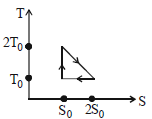
The temperature-entropy diagram of a reversible engine cycle is given in the figure. Its efficiency is
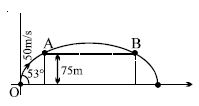
At $t = 0$ a projectile is fired from a point $O$(taken as origin) on the ground with a speed of $50\,\, m/s$ at an angle of $53^o$ with the horizontal. It just passes two points $A \& B$ each at height $75 \,\,m$ above horizontal as shown. The horizontal separation between the points $A$ and $B$ is ........ $m$
Different points in earth are at slightly different distances from the sun and hence experience different forces due to gravitation. For a rigid body, we know that if various forces act at various points in it, the resultant motion is as if a net force acts on the c.m. (centre of mass) causing translation and a net torque at the c.m. causing rotation around an axis through the c.m. For the earthsun system (approximating the earth as a uniform density sphere).
Which of the following relations is true for two unit vectors $\hat{ A }$ and $\hat{ B }$ making an angle $\theta$ to each other$?$
Four modifications are suggested in the lens formula to include the effect of the thickness t of the lens. Which one is likely to be correct?
In a cyclic process, the internal energy of the gas