MCQ
A gas expands under constant pressure $P$ from volume ${V_1}$ to ${V_2}$. The work done by the gas is
  • $P({V_2} - {V_1})$
  • B
    $P({V_1} - {V_2})$
  • C
    $P(V_1^\gamma - V_2^\gamma )$
  • D
    $P\frac{{{V_1}{V_2}}}{{{V_2} - {V_1}}}$

Answer

Correct option: A.
$P({V_2} - {V_1})$
a
(a) Work done $ = P\Delta V = P({V_2} - {V_1})$

Need a full question paper?

Generate a complete, print-ready paper with questions like this in minutes — across 16+ boards, with answer keys.
Start Generating Free

Similar questions

If the linear momentum is increased by $50\%$, the kinetic energy will increase by ............. $\%$
A simple pendulum of length $L$ and mass (bob) $M$ is oscillating in a plane about a vertical line between angular limits $ - \varphi $ and $ + \varphi $. For an angular displacement $\theta (|\theta | < \varphi )$, the tension in the string and the velocity of the bob are $T$ and $ v$ respectively. The following relations hold good under the above conditions
Motion of a particle in $x - y$ plane is described by a set of following equations $x=4 \sin \left(\frac{\pi}{2}-\omega t\right) m$ and $y=4 \sin (\omega t) m$. The path of particle will be 
The displacement of a particle is given by $x = (t - 2)^2$ where $x$ is in metres and $t$ in seconds. The distance covered by the particle in first $4$ seconds is:
Which of the following graphs represents the graphical relation between momentum $(p)$ and kinetic energy $(K)$ for a body in motion?
The molecular kinetic energy of a liquid is:
A particle moves under the effect of a force $F = Cx$ from $x = 0$ to $x = {x_1}$. The work done in the process is
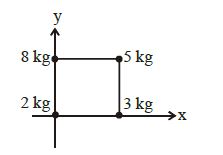
Four bodies of masses $2, 3, 5$ and $8\,kg$ are placed at the four corners of a square of side $2\,m$ as shown. The position of $CM$ will be
Two resistors $R$ and $2R$ are connected in series in an electric circuit. The thermal energy developed in $R$ and $2R$ are in the ratio:
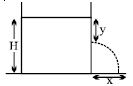
Acylindrical vessel is filled with a liquid up to height H.A small hole is made in the vessel at a distance $y$ below the liquid surface as shown in figure. The liquid emerging from the hole strike the ground at distance $x$