Question
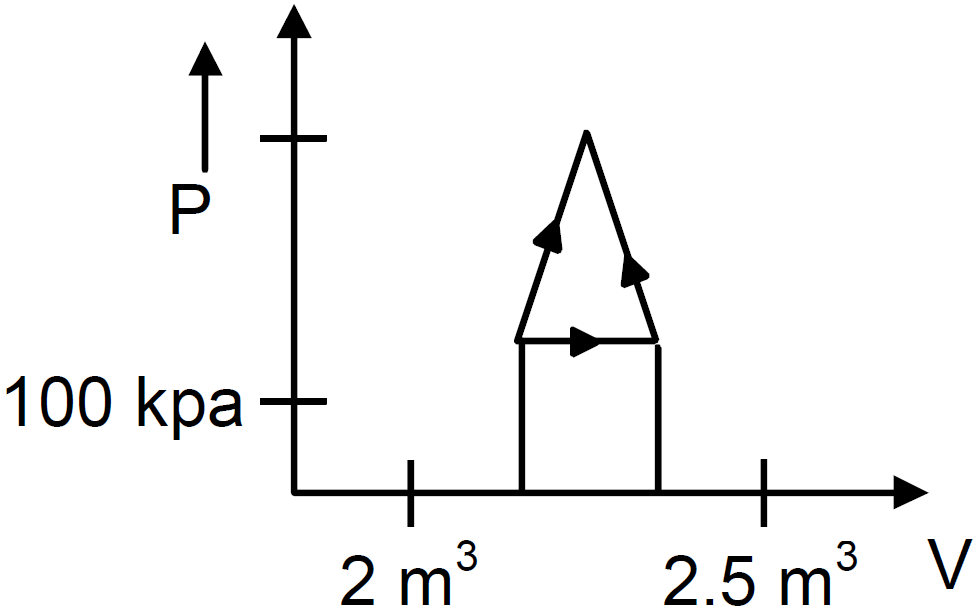
A gas is initially at a pressure of $100kPa$ and its volume is $2.0m^3$. Its pressure is kept constant and the volume is changed from $2.0m^3$ to $2.5m^3$​​​​​​​. Its volume is now kept constant and the pressure is increased from $100kPa$ to $200kPa$. The gas is brought back to its initial state, the pressure varying linearly with its volume.
  1. Whether the heat is supplied to or extracted from the gas in the complete cycle?
  2. How much heat was supplied or extracted?
Answer


  1. $\text{P}_1 = 100\text{KPa}$
$\text{V}_1=2\text{m}^3$
$\Delta\text{V}_1=0.5\text{m}^3$
$\Delta\text{P}_1 = 100\text{KPa}$
From the graph, We find that area under AC is greater than area under than AB.
So, we see that heat is extracted from the system.
  1. Amount of heat = Area under ABC.
$=\frac{1}{2}\times\frac{5}{10}\times10^5=25000\text{J}$

Need a full question paper?

Generate a complete, print-ready paper with questions like this in minutes — across 16+ boards, with answer keys.

Start Generating Free

Similar questions

A bullet of mass 25g is fired horizontally into a ballistic pendulum of mass 5.0kg and gets embedded in it. If the centre of the pendulum rises by a distance of 10cm, find the speed of the bullet.
A particle having mass 10g oscillates according to the equation $\text{x}=(2.0\text{cm})\sin\big[(100\text{s}^{-1})\text{t}+\frac{\pi}{6}\big].$ Find (a) the amplitude, the time period and the spring constant (b) the position, the velocity and the acceleration at t = 0.
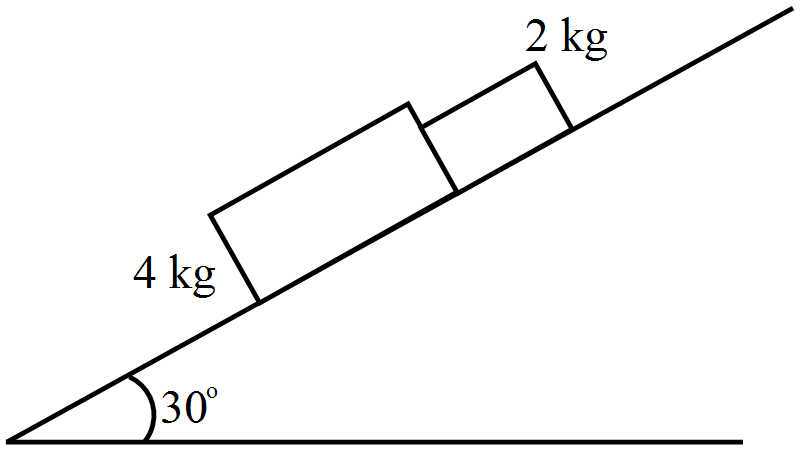
Figure shows two blocks in contact sliding down an inclined surface of inclination $30°$. The friction coefficient between the block of mass $2.0kg$ and the incline is $\mu_1,$ and that between the block of mass $4.0kg$ and the incline is $\mu_2.$ Calculate the acceleration of the 2.0kg block if:
  1. $\mu_1=0.20$ and $\mu_2=0.30$
  2. $\mu_1=0.30$ and $\mu_2=0.20$ Take $\text{g}=10\text{m/s}^2.$

Stationary waves are set up by the superposition of two waves given by $\text{y}_1=0.05\sin(5\pi\text{t}-\text{x})$ and $\text{y}_2=0.05\sin(5\pi\text{t}),$ where x and y are in metre and t in sec. Calculate the displacement of a particle at a distance of x = 1m.
(i) Whatement is position vector $\cos ^2 \alpha+\cos ^2 \beta+\cos ^2 \gamma=1$(ii) Explain the displacvector
An aircraft is flying at a height of 3400m above the ground. If the angle subtended at a ground observation point by the aircraft positions 10.0s apart is 30°, what is the speed of the aircraft?
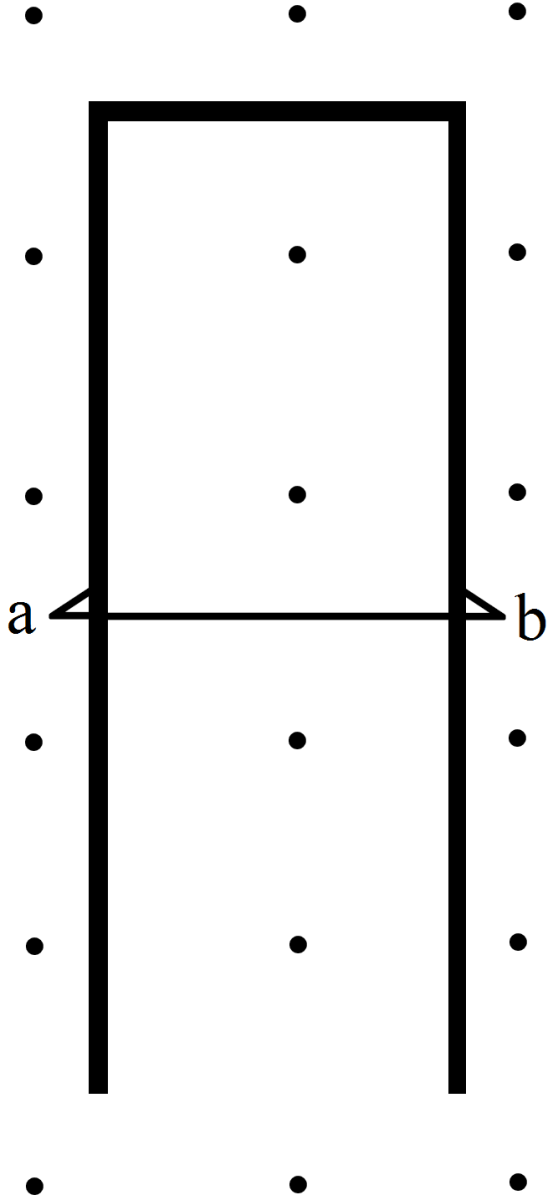
A conducting wire ab of length l, resistance r and mass m starts sliding at $t = 0$ down a smooth, vertical, thick pair of connected rails as shown in figure. A uniform magnetic field B exists in the space in a direction perpendicular to the plane of the rails.
  1. Write the induced emf in the loop at an instant t when the speed of the wire is v.
  2. What would be the magnitude and direction of the induced current in the wire?
  3. Find the downward acceleration of the wire at this instant.
  4. After sufficient time, the wire starts moving with a constant velocity. Find this velocity $v_m$​​​​​​​.
  5. Find the velocity of the wire as a function of time.
  6. Find the displacement of the wire as a function of time.
  7. Show that the rate of heat developed in the wire is equal to the rate at which the gravitational potential energy is decreased after steady state is reached.
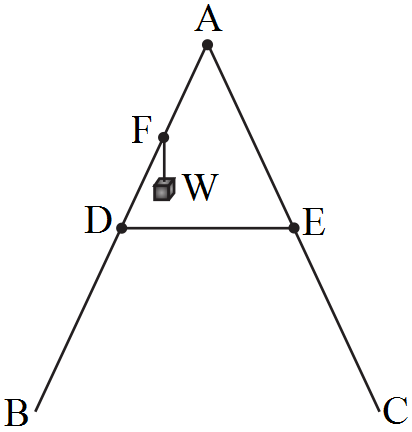
As shown in the two sides of a step ladder BA and CA are 1.6m long and hinged at A. A rope DE, 0.5m is tied half way up. A weight 40kg is suspended from a point F, 1.2m from B along the ladder BA. Assuming the floor to be frictionless and neglecting the weight of the ladder, find the tension in the rope and forces exerted by the floor on the ladder. (Take $g = 9.8m/s^2$​​​​​​​) (Hint: Consider the equilibrium of each side of the ladder separately).
 
A small block of superdense material has a mass of $3 \times 10^{24}kg$. It is situated at a height h (much smaller than the earth's radius) from where it falls on the earth's surface. Find its speed when its height from the earth's surface has reduced to $\frac{\text{h}}{2}.$ The mass of the earth is $6 \times 10^{24}kg$.
Two wires, one of steel and the other of aluminium, each $2 m$ long and of diameter $2.0 mm$ , are joined end to end to form a composite wire of length $4.0 m$ . What tension in the wire will produce a total extension of $0.90 mm$ ? Y for steel $=2 \times 10^{11} \mathrm{Nm}^{-2} ; Y$ for aluminium $=7 \times 10^{11} \mathrm{Nm}^{-2}$