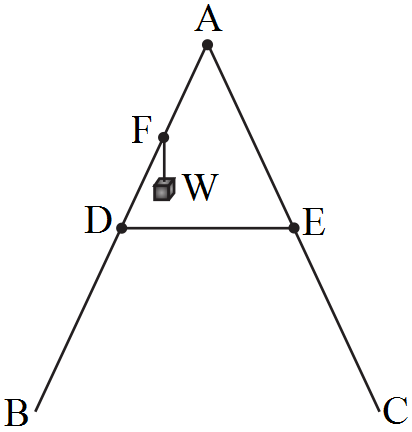
As shown in the two sides of a step ladder BA and CA are 1.6m long and hinged at A. A rope DE, 0.5m is tied half way up. A weight 40kg is suspended from a point F, 1.2m from B along the ladder BA. Assuming the floor to be frictionless and neglecting the weight of the ladder, find the tension in the rope and forces exerted by the floor on the ladder. (Take $g = 9.8m/s^2$) (Hint: Consider the equilibrium of each side of the ladder separately).
Exercise
Download our app for free and get started
The given situation can be shown as:
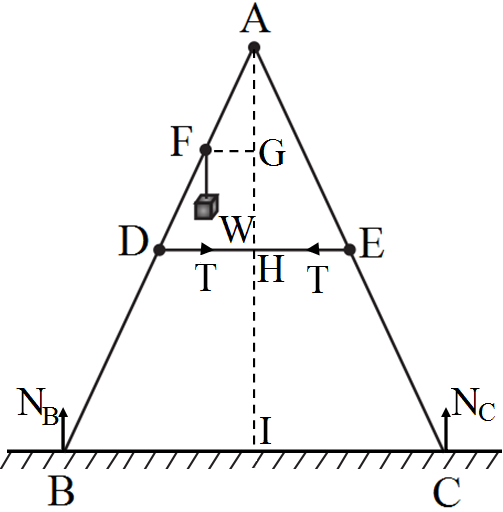
$N _{ B }=$ Force exerted on the ladder by the floor point
$B N _{ C }=$ Force exerted on the ladder by the floor point
$C T=$ Tension in the rope
$B A=C A=1.6 m D E=0.5 m B F=1.2 m$ Mass of the weight,
$m =40 kg$ Draw a perpendicular from A on the floor BC .
This intersects DE at mid-point $H . \Delta ABI$ and $\triangle AIC$ are similar
$\therefore BI = IC$
Hence, I is the midpoint of $B C$. $D E \| B C B C$
$=2 \times D E=1 m A F=B A-B F=0.4 m \ldots \ldots$ (i)
$D$ is the mid-point of $A B$.
Hence, we can write, $AD =\left(\frac{1}{2}\right) \times BA =0.8 m \ldots (ii)$
Using equations (i) and (ii),
we get, $FE =0.4 m$ Hence, F is the mid-point of AD .
$FG \| DH$ and F is the mid-point of AD .
Hence, G will also be the mid-point of $AH . \triangle AFG$ and $\triangle ADH$ are similar
$\therefore \frac{ FG }{ DH }=\frac{ AF }{ AD } \frac{ FG }{ DH }=\frac{0.4}{0.8}=\frac{1}{2}=\left(\frac{1}{2}\right) \times 0.25=0.125 m \ln \Delta ADH , AH =\left( AD ^2- DH ^2\right)^{1 / 2}=\left(0.8^2-0.25^2\right)^{1 / 2}=$
0.76 m For translational equilibrium of the ladder,
the upward force should be equal to the downward force.
$N _{ C }+ N _{ B }$ $= mg =392$.....(iii)
For rotational equilibrium of the ladder, the net moment about A is,
$- N _{ B } \times BI + mg \times FG + N _{ C } \times$
$Cl + T \times AG - T \times AG =0- N _{ B } \times 0.5+40 \times 9.8 \times 0.125+ N _{ C } \times 0.5$
$=0\left(N_{ C }- N _{ B }\right) \times 0.5=49 N_{ C }- N _{ B }=98 \ldots..(iv)$
Adding equations (iii) and (iv),
we get, $N_C=245 N N_B=147 N$
For rotational equilibrium of the side AB , consider the moment about
$A .- N _{ B } \times BI + mg \times FG + T \times AG $
$=0-245 \times 0.5+40 \times 9.8 \times 0.125+ T \times 0.76=0 T$
$=96.7 N$
$N _{ B }=$ Force exerted on the ladder by the floor point
$B N _{ C }=$ Force exerted on the ladder by the floor point
$C T=$ Tension in the rope
$B A=C A=1.6 m D E=0.5 m B F=1.2 m$ Mass of the weight,
$m =40 kg$ Draw a perpendicular from A on the floor BC .
This intersects DE at mid-point $H . \Delta ABI$ and $\triangle AIC$ are similar
$\therefore BI = IC$
Hence, I is the midpoint of $B C$. $D E \| B C B C$
$=2 \times D E=1 m A F=B A-B F=0.4 m \ldots \ldots$ (i)
$D$ is the mid-point of $A B$.
Hence, we can write, $AD =\left(\frac{1}{2}\right) \times BA =0.8 m \ldots (ii)$
Using equations (i) and (ii),
we get, $FE =0.4 m$ Hence, F is the mid-point of AD .
$FG \| DH$ and F is the mid-point of AD .
Hence, G will also be the mid-point of $AH . \triangle AFG$ and $\triangle ADH$ are similar
$\therefore \frac{ FG }{ DH }=\frac{ AF }{ AD } \frac{ FG }{ DH }=\frac{0.4}{0.8}=\frac{1}{2}=\left(\frac{1}{2}\right) \times 0.25=0.125 m \ln \Delta ADH , AH =\left( AD ^2- DH ^2\right)^{1 / 2}=\left(0.8^2-0.25^2\right)^{1 / 2}=$
0.76 m For translational equilibrium of the ladder,
the upward force should be equal to the downward force.
$N _{ C }+ N _{ B }$ $= mg =392$.....(iii)
For rotational equilibrium of the ladder, the net moment about A is,
$- N _{ B } \times BI + mg \times FG + N _{ C } \times$
$Cl + T \times AG - T \times AG =0- N _{ B } \times 0.5+40 \times 9.8 \times 0.125+ N _{ C } \times 0.5$
$=0\left(N_{ C }- N _{ B }\right) \times 0.5=49 N_{ C }- N _{ B }=98 \ldots..(iv)$
Adding equations (iii) and (iv),
we get, $N_C=245 N N_B=147 N$
For rotational equilibrium of the side AB , consider the moment about
$A .- N _{ B } \times BI + mg \times FG + T \times AG $
$=0-245 \times 0.5+40 \times 9.8 \times 0.125+ T \times 0.76=0 T$
$=96.7 N$

Download our appand get started for free
Experience the future of education. Simply download our apps or reach out to us for more information. Let's shape the future of learning together!No signup needed.*
Similar Questions
- 1View Solution
- Prove the theorem of perpendicular axes.
- Prove the theorem of parallel axes.
- 2View SolutionTorques of equal magnitude are applied to a hollow cylinder and a solid sphere, both having the same mass and radius. The cylinder is free to rotate about its standard axis of symmetry, and the sphere is free to rotate about an axis passing through its centre. Which of the two will acquire a greater angular speed after a given time.
- 3Separation of Motion of a system of particles into motion of the centre of mass and motion about the centre of mass: Show $\text{L}=\text{L}'+\text{R}\times\text{MV}$ where $\text{L}'=\sum\text{r}'_\text{i}\times\text{p}'_\text{i}$ is the angular momentum of the system about the centre of mass with velocities taken relative to the centre of mass. Remember $\text{r}'_\text{i}=\text{r}_\text{i}-\text{R},$ rest of the notation is the standard notation used in the chapter. Note: $\text{L}'$ and $\text{MR}\times\text{V}$ can be said to be angular momenta, respectively, about and of the centre of mass of the system of particles.View Solution
- 4Separation of Motion of a system of particles into motion of the centre of mass and motion about the centre of mass: Show $\text{K}=\text{K}'+\frac{1}{2}\text{M}\text{V}^2$ where K' is the total kinetic energy of the system of particles, K′ is the total kinetic energy of the system when the particle velocities are taken with respect to the centre of mass and $\frac{\text{MV}^2}{2}$ is the kinetic energy of the translation of the system as a whole (i.e. of the centre of mass motion of the system). The result has been used in $\sec7.14$View Solution
- 5A comet revolves around the sun in a highly elliptical orbit having a minimum distance of $7 \times 10^{10}m$ and a maximum distance of $1.4 \times 10^{13}m$. If its speed while nearest to the Sun is $60km s^{-1}$, find its linear speed when situated farthest from the Sun.View Solution
- 6View SolutionA hoop of radius 2m weighs 100kg. It rolls along a horizontal floor so that its centre of mass has a speed of 20cm/s. How much work has to be done to stop it?
- 7View SolutionShow that a(b × c) is equal in magnitude to the volume of the parallelepiped formed on the three vectors a, b and c.
- 8View SolutionShow that a(b × c) is equal in magnitude to the volume of the parallelepiped formed on the three vectors a, b and c.
- 9Two blocks of masses $400g$ and $200g$ are connected through a light string going over a pulley which is free to rotate about its axis. The pulley has a moment of inertia $1.6 \times 10^{-4}kg-m^2$ and a radius 2.0cm. Find:View Solution
- The kinetic energy of the system as the $400g$ block falls through $50cm$.
- The speed of the blocks at this instant.
- 10The moment of inertia of a solid flywheel about its axis is $0.1kg-m^2$. A tangential force of $2kg/ wt$ is applied round the circumference of the flywheel with the help of a string and mass arrangement as shown in Fig. If the radius of the wheel is $0.1m$, find the acceleration of the mass.View Solution