MCQ
A gas mixture consists of $2.0$ moles of oxygen and $4.0$ moles of neon at temperature $T.$ Neglecting all vibrational modes, calculate the total internal energy of the system. $($Oxygen has two rotational modes.$)$
  • $11RT$
  • B
    $13RT$
  • C
    $15RT$
  • D
    $19RT$

Answer

Correct option: A.
$11RT$

Need a full question paper?

Generate a complete, print-ready paper with questions like this in minutes — across 16+ boards, with answer keys.

Start Generating Free

Similar questions

If it takes $5\,minutes$ to fill a $15\,litre$ bucket from a water tap of diameter $\frac{2}{{\sqrt \pi  }}cm$ then the Reynolds number for the flow is (density of water $= 10^3\,kg/m^3$ ) and viscosity of water $= 10^{-3}\,Pa.s$ ) close to
The wavelength of ultrasonic waves in air is of the order of:
The moment of inertia of semicircular plate of radius $R$ and mass $M$ about axis $AA’$ in its plane passing through its centre is
Which of the following options are correct?
  1. Acceleration due to gravity decreases with increasing altitude.
  2. Acceleration due to gravity increases with increasing depth $($assume the earth to be a sphere of uniform density$).$
  3. Acceleration due to gravity increases with increasing latitude.
  4. Acceleration due to gravity is independent of the mass of the earth.
Which of the following statements can be suitable?
The displacement due to a wave moving in the positive $x-$direction is given by $y = \frac{1}{{(1 + {x^2})}}$ at time $t = 0$ and by $y = \frac{1}{{[1 + {{(x - 1)}^2}]}}$ at $t = 2$ seconds, where $x$ and $y$ are in metres. The velocity of the wave in $m/s$ is
A copper block of mass $5.0\, kg$ is heated to a temperature of $500^{\circ} C$ and is placed on a large ice block. What is the maximum amount of ice (ઇન $kg$) that can melt? [Specific heat of copper: $0.39\, Jg ^{-1 \circ} C ^{-1}$ and latent heat of fusion of water : $335 \,J g ^{-1}$ ]
The persistence of sound in a room after the source of sound is turned off is called reverberation. The measure of reverberation time is the time required for sound intensity to decrease by $60 \,dB$. It is given that the intensity of sound falls off as $I_0 \exp \left(-c_1 \alpha\right)$ where $I_0$ is the initial intensity, $c_1$ is a dimensionless constant with value $1 / 4$. Here, $\alpha$ is a positive constant which depends on the speed of sound, volume of the room, reverberation time, and the effective absorbing area $A_e$. The value of $A_e$ is the product of absorbing coefficient (with value between $0$ and $1,1$ being a perfect absorber) and the area of the room. For a concert hall of volume $600 \,m ^3$, the value of $A_e$ (in $m ^2$ ) required to give a reverberation time of $1 s$ is closest to (speed of sound in air $=340 \,m / s$ )
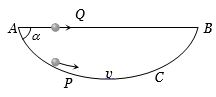
A particle $P$ is sliding down a frictionless hemispherical bowl. It passes the point $A$ at $t = 0$. At this instant of time, the horizontal component of its velocity is $v$. A bead $Q$ of the same mass as $P$ is ejected from $A$ at $t = 0$ along the horizontal string $AB$ (see figure) with the speed $v$. Friction between the bead and the string may be neglected. Let ${t_P}$ and ${t_Q}$ be the respective time taken by $P$ and $Q$ to reach the point $B$. Then
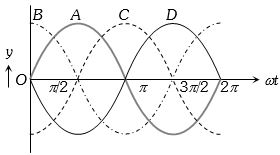
The figure shows four progressive waves $A, B, C$ and $D $ with their phases expressed with respect to the wave $A$. It can be concluded from the figure that