MCQ
A gas (Molar mass $=280\,g\,mol ^{-1}$ ) was burnt in excess $O _{2}$ in a constant volume calorimeter and during combustion the temperature of calorimeter increased from $298.0 K$ to $298.45\,K$. If the heat capacity of calorimeter is $2.5\,kJ\,K ^{-1}$ and enthalpy of combustion of gas is $9\,kJ\,mol ^{-1}$ then amount of gas burnt is $......g$. (Nearest Integer)
  • $35$
  • B
    $34$
  • C
    $33$
  • D
    $32$

Answer

Correct option: A.
$35$
a
Let $x g$ is burnt

$\text { moles }=\frac{ x }{280}$

heat released by $\frac{ x }{280}$ mole $=2.5 \times 0.45\,kJ$

heat released by $1\,mole$ $=\frac{2.5 \times 0.45 \times 280}{ x } kJ$

$\Delta H =\Delta U +\Delta ngRT$

$\Delta H \simeq \Delta U$

$9=\frac{2.5 \times 280 \times 0.45}{ x }$

$x =35\,g$

Need a full question paper?

Generate a complete, print-ready paper with questions like this in minutes — across 16+ boards, with answer keys.

Start Generating Free

Similar questions

Which of the following elements can present both in cation and anion of its salts?
According to Bronsted principle, an aqueous solution of $HN{O_3}$ will contain
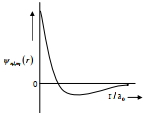
The wave function $\psi_{n / m m}$ is a mathematical function whose value depends upon spherical polar coordinates $(r, \theta, \phi)$ of the electron and characterized by the quantum numbers $n, l$ and $m_l$. Here $r$ is distance from nucleus, $\theta$ is colatitude and $\phi$ is azimuth. In the mathematical functions given in the Table, $\mathrm{Z}$ is atomic number and $a_0$ is Bohr radius.

$column 1$ $column 2$ $column 3$
$(I)$ $1$s orbital $(i)$ $\psi_{n, l, m_l} \propto\left(\frac{Z}{a_0}\right)^{\frac{3}{2}} e^{-\left(\frac{Z r}{a_0}\right)}$ $image$
($II$) $2 \mathrm{~s}$ orbital $(ii)$ One radial node $(Q)$ Probability density at nucleus $\propto \frac{1}{a_0^3}$
$(III)$ $2 p_z$ orbital $(iii)$ $\psi_{n, l m_l} \propto\left(\frac{Z}{a_0}\right)^{\frac{5}{2}} r e^{-\left(\frac{Z r}{2 a_0}\right)} \cos \theta$ $(R)$ Probability density is maximum at nucleus
$(IV)$ $3 \mathrm{~d}_{\mathrm{z}}^2$ orbital $(iv)$ $x y$-plane is a nodal plane $(S)$ Energy needed to excite electron from $n=2$ state to $n=4$ state is $\frac{27}{32}$ times the energy needed to excite electron from $n=2$ state to $n=6$ state

($1$) For the given orbital in Column $1$, the only $CORRECT$ combination for any hydrogen-like species is

$[A] (IV) (iv) (R)$   $[B] (II) (ii) (P)$    $[C] (III) (iii) (P)$    $[D] (I) (ii) (S)$

($2$)  For $\mathrm{He}^{+}$ion, the only INCORRECT combination is

$[A] (II) (ii) (Q)$ $[B] (I) (i) (S)$ $[C] (I) (i) (R)$ $[D] (I) (iii) (R)$

($3$) For hydrogen atom, the only $CORRECT$ combination is

$[A] (I) (iv) (R)$   $[B] (I) (i) (P)$    $[C] (II) (i) (Q)$   $[D] (I) (i) (S)$

Give the answer quetion ($1$) ($2$) and ($3$)
In which of the following reactions, standard reaction entropy change $(\Delta S^o)$ is positive and standard Gibb's energy change $(\Delta G^o)$ decreases sharply with increasing temperature ?
The most common oxidation states of the most electronegative elements in their compounds are :
Product $(B)$ is
Henry Moseley studied characteristic X-ray spectra of elements. The graph which represents his observation correctly is: (Given $v =$ frequency of $X$-ray emitted; $Z =$ atomic number)
Solubility of $AgCl$ will be minimum in
Addition of $Br_2$ to trans- $2$ -butene would give a product which is
The difference between the radii of $3^{\text {rd }}$ and $4^{\text {th }}$ orbits of $Li ^{2+}$ is $\Delta R _{1}$. The difference between the radii of $3^{\text {rd }}$ and $4^{\text {th }}$ orbits of $He ^{+}$ is $\Delta R _{2}$. Ratio $\Delta R _{1}: \Delta R _{2}$ is :
