MCQ
A given system undergoes a change in which the work done by the system equals the decrease in its internal energy. The system must have undergone an
  • A
    lsothermal change
  • Adiabatic change
  • C
    lsobaric change
  • D
    Isochoric change

Answer

Correct option: B.
Adiabatic change
In adiabatic change $Q=$ constant $\Rightarrow \Delta Q=0$
So $(\Delta W=\Delta U(\because \Delta Q=\Delta U+\Delta W)$

Need a full question paper?

Generate a complete, print-ready paper with questions like this in minutes — across 16+ boards, with answer keys.
Start Generating Free

Similar questions

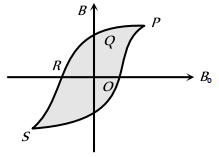
The figure illustrate how $B$, the flux density inside a sample of unmagnetised ferromagnetic material varies with $B$, the magnetic flux density in which the sample is kept. For the sample to be suitable for making a permanent magnetImage
The true value of angle of dip at a place is 60 , the apparent dip in a plane inclined at an angle of 30 with magnetic meridian is
Two trolleys of mass $m$ and $3 m$ are connected by a spring. They were compressed and released once, they move off in opposite direction and comes to rest after covering distances $S_1$ and $S_2$ respectively. Assuming the coefficient of friction to be uniform, the ratio of distances $S_1: S_2$ is
A wire of cross-sectional area $3 mm ^2$ is first stretched between two fixed points at a temperature of $20^{\circ} C$. Determine the tension when the temperature falls to $10^{\circ} C$. Coefficient of linear expansion $\alpha=10^{-5 \circ} C ^{-1}$ and $Y=2 \times 10^{11} N / m ^2$
If $\gamma$ denotes the ratio of two specific heats of a gas, the ratio of slopes of adiabatic and isothermal $P V$ curves at their point of intersection is
If in a photoelectric experiment, the wavelength of incident radiation is reduced from $6000 \mathring A$ to $4000 \mathring A$ then
The grid in a triode valve is used
If in the experiment of Wheatstone's bridge, the positions of cells and galvanometer are interchanged, then balance points will
A block of mass 5 is moving horizontally at a speed of $1.5 m / s$. A perpendicular force of $5 N$ acts on it for $4 sec$. What will be the distance of the block from the point where the force started acting
A steady current $i$ flows in a small square loop of wire of side $L$ in a horizontal plane. The loop is now folded about its middle such that half of it lies in a vertical plane. Let $\overrightarrow {{\mu _1}} $ and $\overrightarrow {{\mu _2}} $ respectively denote the magnetic moments due to the current loop before and after folding. Then