MCQ 11 Mark
During an isothermal expansion of an ideal gas
- A
Its internal energy decreases
- B
Its internal energy does not change
- C
The work done by the gas is equal to the quantity of heat absorbed by it
- ✓
Answer(d) During isothermal change $T=$ constant $\Rightarrow \Delta U=0$ also from FLOT, $\Delta Q=\Delta W$.
View full question & answer→MCQ 21 Mark
An engine is supposed to operate between two reservoirs at temperature $727^{\circ} \mathrm{C}$ and $227^{\circ} \mathrm{C}$. The maximum possible efficiency of such an engine is
- ✓
$1 / 2$
- B
$1 / 4$
- C
$3 / 4$
- D
AnswerCorrect option: A. $1 / 2$
(a) $\quad \eta=\frac{T_1-T_2}{T_1}=\frac{(273+727)-(273+227)}{273+727}=\frac{1000-500}{1000}=\frac{1}{2}$
View full question & answer→MCQ 31 Mark
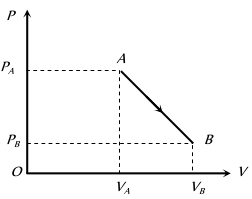
An ideal gas is taken from point $A$ to the point $B$, as shown in the $P$ - $V$ diagram, keeping the temperature constant. The work done in the process is
- A
$\left(P_A-P_B\right)\left(V_B-V_A\right)$
- B
$\frac{1}{2}\left(P_B-P_A\right)\left(V_B+V_A\right)$
- C
$\frac{1}{2}\left(P_B-P_A\right)\left(V_B-V_A\right)$
- ✓
$\frac{1}{2}\left(P_B+P_A\right)\left(V_B-V_A\right)$
AnswerCorrect option: D. $\frac{1}{2}\left(P_B+P_A\right)\left(V_B-V_A\right)$
$W=$ Area bonded by the indicator diagram with $V$axis
$[=\frac{1}{2}\left(P_A+P_B\right)\left(V_B-V_A\right)]$
View full question & answer→MCQ 41 Mark
A Carnot engine whose low temperature reservoir is at $7^{\circ} \mathrm{C}$ has an efficiency of $50 \%$. It is desired to increase the efficiency to $70 \%$. By how many degrees should the temperature of the high temperature reservoir be increased
- A
$840 K$
- B
$280 K$
- C
$560 \mathrm{~K}$
- ✓
$380 \mathrm{~K}$
AnswerCorrect option: D. $380 \mathrm{~K}$
(d)Initially $ \eta=\frac{T_1-T_2}{T_1} \Rightarrow 0.5=\frac{T_1-(273+7)}{T_1} $
$\Rightarrow \quad \frac{1}{2}=\frac{T_1-280}{T_1}\Rightarrow T_1=560\mathrm{~K}$
Finally $\eta_1{ }^{\prime}=\frac{T_1{ }^{\prime}-T_2}{T_1^{\prime}}\Rightarrow 0.7=\frac{T_1^{\prime}-(273+7)}{T_1^{\prime}} \Rightarrow T_1^{\prime}=933 \mathrm{~K}$
$\therefore$ increase in temperature $=933-560=373 \mathrm{~K} \approx 380 \mathrm{~K}$
View full question & answer→MCQ 51 Mark
During an isothermal expansion of an ideal gas
- A
Its internal energy decreases
- ✓
Its internal energy does not change
- C
The work done by the gas is equal to the quantity of heat absorbed by it
- D
AnswerCorrect option: B. Its internal energy does not change
Its internal energy does not change
View full question & answer→MCQ 61 Mark
An engine is supposed to operate between two reservoirs at temperature $727^{\circ} \mathrm{C}$ and $227^{\circ} \mathrm{C}$. The maximum possible efficiency of such an engine is
- ✓
$1 / 2$
- B
$1 / 4$
- C
$3 / 4$
- D
AnswerCorrect option: A. $1 / 2$
(a) $\quad \eta=\frac{T_1-T_2}{T_1}=\frac{(273+727)-(273+227)}{273+727}=\frac{1000-500}{1000}=\frac{1}{2}$
View full question & answer→MCQ 71 Mark
An ideal gas is taken from point $A$ to the point $B$, as shown in the $P$ - $V$ diagram, keeping the temperature constant. The work done in the process is
- A
$\left(P_A-P_B\right)\left(V_B-V_A\right)$
- B
$\frac{1}{2}\left(P_B-P_A\right)\left(V_B+V_A\right)$
- C
$\frac{1}{2}\left(P_B-P_A\right)\left(V_B-V_A\right)$
- ✓
$\frac{1}{2}\left(P_B+P_A\right)\left(V_B-V_A\right)$
AnswerCorrect option: D. $\frac{1}{2}\left(P_B+P_A\right)\left(V_B-V_A\right)$
$W=$ Area bonded by the indicator diagram with $V$axis $[=\frac{1}{2}\left(P_A+P_B\right)\left(V_B-V_A\right)]$
View full question & answer→MCQ 81 Mark
A Carnot engine whose low temperature reservoir is at $7^{\circ} \mathrm{C}$ has an efficiency of $50 \%$. It is desired to increase the efficiency to $70 \%$. By how many degrees should the temperature of the high temperature reservoir be increased
- A
$840 K$
- B
$280 K$
- C
$560 \mathrm{~K}$
- ✓
$380 \mathrm{~K}$
AnswerCorrect option: D. $380 \mathrm{~K}$
(d)Initially$\eta=\frac{T_1-T_2}{T_1} \Rightarrow 0.5=\frac{T_1-(273+7)}{T_1} $
$\Rightarrow \quad \frac{1}{2}=\frac{T_1-280}{T_1}$
$\Rightarrow T_1=560\mathrm{~K}$
Finally $\eta_1{ }^{\prime}=\frac{T_1{ }^{\prime}-T_2}{T_1^{\prime}}$
$\Rightarrow 0.7=\frac{T_1^{\prime}-(273+7)}{T_1^{\prime}}$
$ \Rightarrow T_1^{\prime}=933 \mathrm{~K}$
$\therefore$ increase in temperature $=933-560=373 \mathrm{~K} \approx 380 \mathrm{~K}$
View full question & answer→MCQ 91 Mark
During an isothermal expansion of an ideal gas
- A
Its internal energy decreases
- B
Its internal energy does not change
- C
The work done by the gas is equal to the quantity of heat absorbed by it
- ✓
View full question & answer→MCQ 101 Mark
An engine is supposed to operate between two reservoirs at temperature $727^{\circ} \mathrm{C}$ and $227^{\circ} \mathrm{C}$. The maximum possible efficiency of such an engine is
- ✓
$1 / 2$
- B
$1 / 4$
- C
$3 / 4$
- D
AnswerCorrect option: A. $1 / 2$
(a) $\quad \eta=\frac{T_1-T_2}{T_1}=\frac{(273+727)-(273+227)}{273+727}=\frac{1000-500}{1000}=\frac{1}{2}$
View full question & answer→MCQ 111 Mark
An ideal gas is taken from point $A$ to the point $B$, as shown in the $P$ - $V$ diagram, keeping the temperature constant. The work done in the process is
- A
$\left(P_A-P_B\right)\left(V_B-V_A\right)$
- B
$\frac{1}{2}\left(P_B-P_A\right)\left(V_B+V_A\right)$
- C
$\frac{1}{2}\left(P_B-P_A\right)\left(V_B-V_A\right)$
- ✓
$\frac{1}{2}\left(P_B+P_A\right)\left(V_B-V_A\right)$
AnswerCorrect option: D. $\frac{1}{2}\left(P_B+P_A\right)\left(V_B-V_A\right)$
$W=$ Area bonded by the indicator diagram with $V$axis$[=\frac{1}{2}\left(P_A+P_B\right)\left(V_B-V_A\right)]$
View full question & answer→MCQ 121 Mark
A Carnot engine whose low temperature reservoir is at $7^{\circ} \mathrm{C}$ has an efficiency of $50 \%$. It is desired to increase the efficiency to $70 \%$. By how many degrees should the temperature of the high temperature reservoir be increased
- A
$840 K$
- B
$280 K$
- C
$560 \mathrm{~K}$
- ✓
$380 \mathrm{~K}$
AnswerCorrect option: D. $380 \mathrm{~K}$
(d)Initially$\eta=\frac{T_1-T_2}{T_1} \Rightarrow 0.5=\frac{T_1-(273+7)}{T_1} $
$\Rightarrow \quad \frac{1}{2}=\frac{T_1-280}{T_1}$
$\Rightarrow T_1=560\mathrm{~K}$
Finally $\eta_1{ }^{\prime}=\frac{T_1{ }^{\prime}-T_2}{T_1^{\prime}}$
$\Rightarrow 0.7=\frac{T_1^{\prime}-(273+7)}{T_1^{\prime}}$
$ \Rightarrow T_1^{\prime}=933 \mathrm{~K}$
$\therefore$ increase in temperature $=933-560=373 \mathrm{~K} \approx 380 \mathrm{~K}$
View full question & answer→MCQ 131 Mark
A Carnot engine absorbs an amount $Q$ of heat from a reservoir at an abosolute temperature $T$ and rejects heat to a sink at a temperature of $T / 3$. The amount of heat rejected is
- A
$Q / 4$
- ✓
$Q / 3$
- C
$Q / 2$
- D
$2 Q / 3$
AnswerCorrect option: B. $Q / 3$
$\because \eta=1-\frac{T_2}{T_1}=\frac{W}{Q_1}=\frac{Q_1-Q_2}{Q_1}$
where $Q_1=$ heat absorbed, $Q_2=$ heat rejected
$\Rightarrow 1-\frac{T / 3}{T}=\frac{W}{Q_1} $
$\Rightarrow \frac{2}{3}=\frac{W}{Q_1}=\frac{Q_1-Q_2}{Q_1}$
$\Rightarrow \frac{2}{3}=1-\frac{Q_2}{Q_1} $
$\Rightarrow \frac{Q_2}{Q_1}=\frac{1}{3} $
$\Rightarrow Q_2=\frac{Q_1}{3}=\frac{Q}{3}$
View full question & answer→MCQ 141 Mark
A Carnot engine absorbs an amount $Q$ of heat from a reservoir at an abosolute temperature $T$ and rejects heat to a sink at a temperature of $T / 3$. The amount of heat rejected is
- A
$Q / 4$
- ✓
$Q / 3$
- C
$Q / 2$
- D
$2 Q / 3$
AnswerCorrect option: B. $Q / 3$
$\because \eta=1-\frac{T_2}{T_1}=\frac{W}{Q_1}=\frac{Q_1-Q_2}{Q_1}$
where $Q_1=$ heat absorbed, $Q_2=$ heat rejected
$\Rightarrow 1-\frac{T / 3}{T}=\frac{W}{Q_1} \Rightarrow \frac{2}{3}=\frac{W}{Q_1}=\frac{Q_1-Q_2}{Q_1}$
$\Rightarrow \frac{2}{3}=1-\frac{Q_2}{Q_1} \Rightarrow \frac{Q_2}{Q_1}=\frac{1}{3} \Rightarrow Q_2=\frac{Q_1}{3}=\frac{Q}{3}$
View full question & answer→MCQ 151 Mark
A Carnot engine absorbs an amount $Q$ of heat from a reservoir at an abosolute temperature $T$ and rejects heat to a sink at a temperature of $T / 3$. The amount of heat rejected is
- A
$Q / 4$
- ✓
$Q / 3$
- C
$Q / 2$
- D
$2 Q / 3$
AnswerCorrect option: B. $Q / 3$
$\because \eta=1-\frac{T_2}{T_1}=\frac{W}{Q_1}=\frac{Q_1-Q_2}{Q_1}$
where $Q_1=$ heat absorbed, $Q_2=$ heat rejected
$\Rightarrow 1-\frac{T / 3}{T}=\frac{W}{Q_1} \Rightarrow \frac{2}{3}=\frac{W}{Q_1}=\frac{Q_1-Q_2}{Q_1}$
$\Rightarrow \frac{2}{3}=1-\frac{Q_2}{Q_1} \Rightarrow \frac{Q_2}{Q_1}=\frac{1}{3} \Rightarrow Q_2=\frac{Q_1}{3}=\frac{Q}{3}$
View full question & answer→MCQ 161 Mark
The work done in which of the following processes is zero
Answer(c) $W=P \Delta V=0$(As $\Delta V=0$ )
View full question & answer→MCQ 171 Mark
The work done in which of the following processes is zero
Answer(c) $W=P \Delta V=0$(As $\Delta V=0$ )
View full question & answer→MCQ 181 Mark
The work done in which of the following processes is zero
Answer(c) $W=P \Delta V=0$(As $\Delta V=0$ )
View full question & answer→MCQ 191 Mark
The coefficient of performance of a Carnot refrigerator working between $30^{\circ} \mathrm{C}$ and $0^{\circ} \mathrm{C}$ is
Answer(c) Coefficient of performance$K=\frac{T_2}{T_1-T_2}=\frac{273}{303-273}=\frac{273}{30}=9$
View full question & answer→MCQ 201 Mark
An ideal gas expands in such a manner that its pressure and volume can be related by equation $P V^2=$ constant. During this process, the gas is
- A
- ✓
- C
Neither heated nor cooled
- D
First heated and then cooled
Answer(b) $P V^2=$ constant represents adiabatic equation. So during the expansion of ideal gas internal energy of gas decreases and temperature falls.
View full question & answer→MCQ 211 Mark
The coefficient of performance of a Carnot refrigerator working between $30^{\circ} \mathrm{C}$ and $0^{\circ} \mathrm{C}$ is
AnswerCoefficient of performance$K=\frac{T_2}{T_1-T_2}=\frac{273}{303-273}=\frac{273}{30}=9$
View full question & answer→MCQ 221 Mark
An ideal gas expands in such a manner that its pressure and volume can be related by equation $P V^2=$ constant. During this process, the gas is
- A
- ✓
- C
Neither heated nor cooled
- D
First heated and then cooled
Answer(b) $P V^2=$ constant represents adiabatic equation. So during the expansion of ideal gas internal energy of gas decreases and temperature falls.
View full question & answer→MCQ 231 Mark
The coefficient of performance of a Carnot refrigerator working between $30^{\circ} \mathrm{C}$ and $0^{\circ} \mathrm{C}$ is
AnswerCoefficient of performance$K=\frac{T_2}{T_1-T_2}=\frac{273}{303-273}=\frac{273}{30}=9$
View full question & answer→MCQ 241 Mark
An ideal gas expands in such a manner that its pressure and volume can be related by equation $P V^2=$ constant. During this process, the gas is
- A
- ✓
- C
Neither heated nor cooled
- D
First heated and then cooled
Answer(b) $P V^2=$ constant represents adiabatic equation. So during the expansion of ideal gas internal energy of gas decreases and temperature falls.
View full question & answer→MCQ 251 Mark
In a mechanical refrigerator, the low temperature coils are at a temperature of $-23^{\circ} \mathrm{C}$ and the compressed gas in the condenser has a temperature of $27^{\circ} \mathrm{C}$. The theoretical coefficient of performance is
Answer(a)Coefficient of performance
$ K=\frac{T_2}{T_1T_2}=\frac{(273-23)}{(273+27)-(273-23)}=\frac{250}{300-250}=\frac{250}{20}=5$
View full question & answer→MCQ 261 Mark
An ideal gas is taken around $A B C A$ as shown in the above $P-V$ diagram. The work done during a cycle is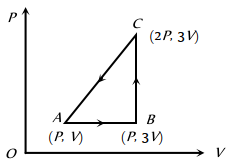
- A
- B
$\frac{1}{2} P V$
- C
$2 P V$
- ✓
$P V$
Answer(d) Work done $=$ Area enclosed by the curve$=\frac{1}{2}(3 V-V)(2 P-P)=P V$
View full question & answer→MCQ 271 Mark
In a mechanical refrigerator, the low temperature coils are at a temperature of $-23^{\circ} \mathrm{C}$ and the compressed gas in the condenser has a temperature of $27^{\circ} \mathrm{C}$. The theoretical coefficient of performance is
Answer
(a)Coefficient of performance
$ K=\frac{T_2}{T_1T_2}=\frac{(273-23)}{(273+27)-(273-23)}=\frac{250}{300-250}=\frac{250}{20}=5$
View full question & answer→MCQ 281 Mark
An ideal gas is taken around $A B C A$ as shown in the above $P-V$ diagram. The work done during a cycle is
- A
- B
$\frac{1}{2} P V$
- C
$2 P V$
- ✓
$P V$
Answer(d) Work done $=$ Area enclosed by the curve$=\frac{1}{2}(3 V-V)(2 P-P)=P V$
View full question & answer→MCQ 291 Mark
In a mechanical refrigerator, the low temperature coils are at a temperature of $-23^{\circ} \mathrm{C}$ and the compressed gas in the condenser has a temperature of $27^{\circ} \mathrm{C}$. The theoretical coefficient of performance is
Answer
(a)Coefficient of performance
$ K=\frac{T_2}{T_1T_2}=\frac{(273-23)}{(273+27)-(273-23)}=\frac{250}{300-250}=\frac{250}{20}=5$
View full question & answer→MCQ 301 Mark
An ideal gas is taken around $A B C A$ as shown in the above $P-V$ diagram. The work done during a cycle is
- A
- B
$\frac{1}{2} P V$
- C
$2 P V$
- ✓
$P V$
Answer(d) Work done $=$ Area enclosed by the curve$=\frac{1}{2}(3 V-V)(2 P-P)=P V$
View full question & answer→MCQ 311 Mark
How much work to be done in decreasing the volume of and ideal gas by an amount of $2.4 \times 10^{-4} \mathrm{~m}^3$ at normal temperature and constant normal pressure of $1 \times 10^5 \mathrm{~N} / \mathrm{m}^2$
- A
$28$ joule
- B
$27$ joule
- C
$25$ joule
- ✓
$24$ joule
AnswerCorrect option: D. $24$ joule
$W=P \Delta V=2.4 \times 10^{-4} \times 1 \times 10^5=24$ J
View full question & answer→MCQ 321 Mark
Adiabatic modulus of elasticity of a gas is $2.1 \times 10^5 \mathrm{~N} / \mathrm{m}^2$. What will be its isothermal modulus of elasticity $\left(\frac{C_p}{C_v}=1.4\right)$
- A
$1.8 \times 10^5 \mathrm{~N} / \mathrm{m}^2$
- ✓
$1.5 \times 10^5 \mathrm{~N} / \mathrm{m}^2$
- C
$1.4 \times 10^5 \mathrm{~N} / \mathrm{m}^2$
- D
$1.2 \times 10^5 \mathrm{~N} / \mathrm{m}^2$
AnswerCorrect option: B. $1.5 \times 10^5 \mathrm{~N} / \mathrm{m}^2$
(b)$\frac{\operatorname{Adiabaticelasticicty}\left(E_\phi\right)}{\text { Isothermal elasticicty }\left(E_\theta\right)}=\gamma \Rightarrow E_\theta=\frac{E_\phi}{\gamma}\$\Rightarrow E_\theta=\frac{2.1 \times 10^5}{1.4}=1.5 \times 10^5 \mathrm{~N}\mathrm{m^2}$
View full question & answer→MCQ 331 Mark
How much work to be done in decreasing the volume of and ideal gas by an amount of $2.4 \times 10^{-4} \mathrm{~m}^3$ at normal temperature and constant normal pressure of $1 \times 10^5 \mathrm{~N} / \mathrm{m}^2$
- A
$28$ joule
- B
$27$ joule
- C
$25$ joule
- ✓
$24$ joule
AnswerCorrect option: D. $24$ joule
$W=P \Delta V=2.4 \times 10^{-4} \times 1 \times 10^5=24$ J
View full question & answer→MCQ 341 Mark
Adiabatic modulus of elasticity of a gas is $2.1 \times 10^5 \mathrm{~N} / \mathrm{m}^2$. What will be its isothermal modulus of elasticity $\left(\frac{C_p}{C_v}=1.4\right)$
- A
$1.8 \times 10^5 \mathrm{~N} / \mathrm{m}^2$
- ✓
$1.5 \times 10^5 \mathrm{~N} / \mathrm{m}^2$
- C
$1.4 \times 10^5 \mathrm{~N} / \mathrm{m}^2$
- D
$1.2 \times 10^5 \mathrm{~N} / \mathrm{m}^2$
AnswerCorrect option: B. $1.5 \times 10^5 \mathrm{~N} / \mathrm{m}^2$
$\frac{\operatorname{Adiabaticelasticicty}\left(E_\phi\right)}{\text { Isothermal elasticicty }\left(E_\theta\right)}=\gamma \Rightarrow E_\theta=\frac{E_\phi}{\gamma}\$\Rightarrow E_\theta=\frac{2.1 \times 10^5}{1.4}=1.5 \times 10^5 \mathrm{~N}\mathrm{m^2}$
View full question & answer→MCQ 351 Mark
How much work to be done in decreasing the volume of and ideal gas by an amount of $2.4 \times 10^{-4} \mathrm{~m}^3$ at normal temperature and constant normal pressure of $1 \times 10^5 \mathrm{~N} / \mathrm{m}^2$
Answer(d) $W=P \Delta V=2.4 \times 10^{-4} \times 1 \times 10^5=24$ J
View full question & answer→MCQ 361 Mark
Adiabatic modulus of elasticity of a gas is $2.1 \times 10^5 \mathrm{~N} / \mathrm{m}^2$. What will be its isothermal modulus of elasticity $\left(\frac{C_p}{C_v}=1.4\right)$
- A
$1.8 \times 10^5 \mathrm{~N} / \mathrm{m}^2$
- ✓
$1.5 \times 10^5 \mathrm{~N} / \mathrm{m}^2$
- C
$1.4 \times 10^5 \mathrm{~N} / \mathrm{m}^2$
- D
$1.2 \times 10^5 \mathrm{~N} / \mathrm{m}^2$
AnswerCorrect option: B. $1.5 \times 10^5 \mathrm{~N} / \mathrm{m}^2$
$\frac{\operatorname{Adiabaticelasticicty}\left(E_\phi\right)}{\text { Isothermal elasticicty }\left(E_\theta\right)}=\gamma \Rightarrow E_\theta=\frac{E_\phi}{\gamma}\$\Rightarrow E_\theta=\frac{2.1 \times 10^5}{1.4}=1.5 \times 10^5 \mathrm{~N}\mathrm{m^2}$
View full question & answer→MCQ 371 Mark
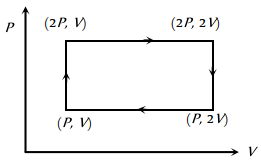
Work done in the given $P$ - $V$ diagram in the cyclic process is
- ✓
$P V$
- B
$2 P V$
- C
$\mathrm{PV} / 2$
- D
$3 P V$
Answer(a) Work done $=$ Area of closed $P V$ diagram$=(2 V-V) \times(2 P-P)=P V$
View full question & answer→MCQ 381 Mark
Work done in the given $P$ - $V$ diagram in the cyclic process is
- ✓
$P V$
- B
$2 P V$
- C
$\mathrm{PV} / 2$
- D
$3 P V$
Answer(a) Work done $=$ Area of closed $P V$ diagram$=(2 V-V) \times(2 P-P)=P V$
View full question & answer→MCQ 391 Mark
Work done in the given $P$ - $V$ diagram in the cyclic process is
- ✓
$P V$
- B
$2 P V$
- C
$\mathrm{PV} / 2$
- D
$3 P V$
Answer(a) Work done $=$ Area of closed $P V$ diagram$=(2 V-V) \times(2 P-P)=P V$
View full question & answer→MCQ 401 Mark
Which one of the following gases possesses the largest internal energy
- A
2 moles of helium occupying $1 \mathrm{~m}^3$ at $300 \mathrm{~K}$
- ✓
$56 \mathrm{~kg}$ of nitrogen at $107 \mathrm{Nm}^{-2}$ and $300 \mathrm{~K}$
- C
8 grams of oxygen at $8 \mathrm{~atm}$ and $300 \mathrm{~K}$
- D
$6 \times 10^{26}$ molecules of argon occupying $40 \mathrm{~m}^3$ at $900 \mathrm{~K}$
AnswerCorrect option: B. $56 \mathrm{~kg}$ of nitrogen at $107 \mathrm{Nm}^{-2}$ and $300 \mathrm{~K}$
(b)
$\Delta U=\mu C_V \Delta T=\frac{m}{M} C_V \Delta T=\frac{N}{N_A} C_V \Delta T$
$\Rightarrow(\Delta U)_N=\frac{56 \times 10^3}{14} \times \frac{5}{2} R \times 300 $
$\text { and }(\Delta U)_A=\frac{6 \times 10^{26}}{6 \times 10^{23}} \times \frac{3}{2} R \times 900 $
$\Rightarrow(\Delta U)_N > (\Delta U)_A$
View full question & answer→MCQ 411 Mark
Which one of the following gases possesses the largest internal energy
- A
2 moles of helium occupying $1 \mathrm{~m}^3$ at $300 \mathrm{~K}$
- ✓
$56 \mathrm{~kg}$ of nitrogen at $107 \mathrm{Nm}^{-2}$ and $300 \mathrm{~K}$
- C
8 grams of oxygen at $8 \mathrm{~atm}$ and $300 \mathrm{~K}$
- D
$6 \times 10^{26}$ molecules of argon occupying $40 \mathrm{~m}^3$ at $900 \mathrm{~K}$
AnswerCorrect option: B. $56 \mathrm{~kg}$ of nitrogen at $107 \mathrm{Nm}^{-2}$ and $300 \mathrm{~K}$
(b)
$\Delta U=\mu C_V \Delta T=\frac{m}{M} C_V \Delta T=\frac{N}{N_A} C_V \Delta T$
$\Rightarrow(\Delta U)_N=\frac{56 \times 10^3}{14} \times \frac{5}{2} R \times 300 $
$\text { and }(\Delta U)_A=\frac{6 \times 10^{26}}{6 \times 10^{23}} \times \frac{3}{2} R \times 900 $
$\Rightarrow(\Delta U)_N > (\Delta U)_A$
View full question & answer→MCQ 421 Mark
Which one of the following gases possesses the largest internal energy
- A
2 moles of helium occupying $1 \mathrm{~m}^3$ at $300 \mathrm{~K}$
- ✓
$56 \mathrm{~kg}$ of nitrogen at $107 \mathrm{Nm}^{-2}$ and $300 \mathrm{~K}$
- C
8 grams of oxygen at $8 \mathrm{~atm}$ and $300 \mathrm{~K}$
- D
$6 \times 10^{26}$ molecules of argon occupying $40 \mathrm{~m}^3$ at $900 \mathrm{~K}$
AnswerCorrect option: B. $56 \mathrm{~kg}$ of nitrogen at $107 \mathrm{Nm}^{-2}$ and $300 \mathrm{~K}$
(b)
$\Delta U=\mu C_V \Delta T=\frac{m}{M} C_V \Delta T=\frac{N}{N_A} C_V \Delta T$
$\Rightarrow(\Delta U)_N=\frac{56 \times 10^3}{14} \times \frac{5}{2} R \times 300 $
$\text { and }(\Delta U)_A=\frac{6 \times 10^{26}}{6 \times 10^{23}} \times \frac{3}{2} R \times 900 $
$\Rightarrow(\Delta U)_N > (\Delta U)_A$
View full question & answer→MCQ 431 Mark
A gas is being compressed adiabatically. The specific heat of the gas during compression is
Answer(a) $\Delta Q=m c \Delta \theta$. Here $\Delta Q=0$, hence $c=0$
View full question & answer→MCQ 441 Mark
A gas is being compressed adiabatically. The specific heat of the gas during compression is
Answer(a) $\Delta Q=m c \Delta \theta$. Here $\Delta Q=0$, hence $c=0$
View full question & answer→MCQ 451 Mark
A gas is being compressed adiabatically. The specific heat of the gas during compression is
Answer(a) $\Delta Q=m c \Delta \theta$. Here $\Delta Q=0$, hence $c=0$
View full question & answer→MCQ 461 Mark
One mole of helium is adiabatically expanded from its initial state $\left(P_i, V_i, T_i\right)$ to its final state $\left(P_f, V_f, T_f\right)$. The decrease in the internal energy associated with this expansion is equal to
- ✓
$C_V\left(T_i-T_f\right)$
- B
$C_P\left(T_i-T_f\right)$
- C
$\frac{1}{2}\left(C_P+C_V\right)\left(T i-T_f\right)$
- D
$\left(C_P-C_V\right)\left(T_i-T_f\right)$
AnswerCorrect option: A. $C_V\left(T_i-T_f\right)$
(a)$\Delta U=\mu C_V \Delta T=1 \times C_V\left(T_fT_i\right)=C_V\left(T_i-T_f\right) $
View full question & answer→MCQ 471 Mark
One mole of helium is adiabatically expanded from its initial state $\left(P_i, V_i, T_i\right)$ to its final state $\left(P_f, V_f, T_f\right)$. The decrease in the internal energy associated with this expansion is equal to
- ✓
$C_V\left(T_i-T_f\right)$
- B
$C_P\left(T_i-T_f\right)$
- C
$\frac{1}{2}\left(C_P+C_V\right)\left(T i-T_f\right)$
- D
$\left(C_P-C_V\right)\left(T_i-T_f\right)$
AnswerCorrect option: A. $C_V\left(T_i-T_f\right)$
(a)$\Delta U=\mu C_V \Delta T=1 \times C_V\left(T_fT_i\right)=C_V\left(T_i-T_f\right) $
View full question & answer→MCQ 481 Mark
One mole of helium is adiabatically expanded from its initial state $\left(P_i, V_i, T_i\right)$ to its final state $\left(P_f, V_f, T_f\right)$. The decrease in the internal energy associated with this expansion is equal to
- ✓
$C_V\left(T_i-T_f\right)$
- B
$C_P\left(T_i-T_f\right)$
- C
$\frac{1}{2}\left(C_P+C_V\right)\left(T i-T_f\right)$
- D
$\left(C_P-C_V\right)\left(T_i-T_f\right)$
AnswerCorrect option: A. $C_V\left(T_i-T_f\right)$
(a)$\Delta U=\mu C_V \Delta T=1 \times C_V\left(T_fT_i\right)=C_V\left(T_i-T_f\right) $
View full question & answer→MCQ 491 Mark
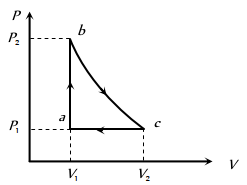
Carbon monoxide is carried around a closed cycle $a b c$ in which $b c$ is an isothermal process as shown in the figure. The gas absorbs 7000 $J$ of heat as its temperature increases from $300 K$ to $1000 K$ in going from $a$ to $b$. The quantity of heat rejected by the gas during the process $c a$ is
- A
$4200 \mathrm{~J}$
- B
$5000 \mathrm{~J}$
- C
$9000 \mathrm{~J}$
- ✓
$9800 \mathrm{~J}$
AnswerCorrect option: D. $9800 \mathrm{~J}$
(d) For path $a b:(\Delta U)_{a b}=7000 \mathrm{~J}$By using $\Delta U=\mu C_V \Delta T$
$7000=\mu \times \frac{5}{2} R \times 700 \Rightarrow \mu=0.48$
For path $c a$ :$(\Delta Q)_{c a}=(\Delta U)_{c a}+(\Delta W)_{c a} $
$\because(\Delta U)_{a b}+(\Delta U)_{b c}+(\Delta U)_{c a}=0 $
$\therefore 7000 +0+(\Delta U)_{ca}=0\Rightarrow (\Delta U)_{c a}=-7000 \mathrm{~J}$
Also $(\Delta W)_{ca}=P_1 \left(V_1-V_2\right)=\mu R\left(T_1-T_2\right)$
$=0.48\times8.31\times(300-1000)=-2792.16\mathrm{~J}$
on solving equations (i), (ii) and (iii)
$(\Delta Q)_{c a}=-7000-2792.16=-9792.16 \mathrm{~J}=-9800 \mathrm{~J}$
View full question & answer→MCQ 501 Mark
A cycle tyre bursts suddenly. This represents an
Answer(d) The process is very fast, so the gas fails to gain or lose heat. Hence this process in adiabatic
View full question & answer→