MCQ
A given system undergoes a change in which the work done by the system equals the decrease in its internal energy. The system must have undergone an
  • A
    lsothermal change
  • Adiabatic change
  • C
    lsobaric change
  • D
    Isochoric change

Answer

Correct option: B.
Adiabatic change
In adiabatic change $Q=$ constant $\Rightarrow \Delta Q=0$
So $(\Delta W=\Delta U(\because \Delta Q=\Delta U+\Delta W)$

Need a full question paper?

Generate a complete, print-ready paper with questions like this in minutes — across 16+ boards, with answer keys.
Start Generating Free

Similar questions

A bucket tied at the end of a $1.6 m$ long string is whirled in a vertical circle with constant speed. What should be the minimum speed so that the water from the bucket does not spill, when the bucket is at the highest position $($Take $g=10 m / \sec ^2 )$
A short magnet of moment $6.75 \mathrm{Am}$ produces a neutral point on its axis. If horizontal component of earth's magnetic field is $5 \times 10^{-5} \mathrm{~Wb} / \mathrm{m}^2$, then the distance of the neutral point should be
A beam of plane polarized light falls normally on a polarizer of cross sectional area $3 \times 10^{-4} m ^2$. Flux of energy of incident ray in $10 W$. The polarizer rotates with an angular frequency of $31.4 rad / sec$. The energy of light passing through the polarizer per revolution will be
A square of side $3 \mathrm{~cm}$ is placed at a distance of $25 \mathrm{~cm}$ from a concave mirror of focal length $10 \mathrm{~cm}$. The centre of the square is at the axis of the mirror and the plane is normal to the axis. The area enclosed by the image of the square is
Intensity of $X$-rays depends upon the number of
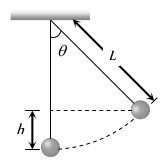
A simple pendulum with bob of mass $m$ and conducting wire of length $L$ swings under gravity through an angle $2 \theta$. The earth's magnetic field component in the direction perpendicular to swing is B. Maximum potential difference induced across the pendulum is
Image
The volume of an ideal gas is 1 litre and its pressure is equal to $72 \mathrm{~cm}$ of mercury column. The volume of gas is made $900 \mathrm{~cm}$ by compressing it isothermally. The stress of the gas will be
Radius of orbit of satellite of earth is $R$. Its kinetic energy is proportional to
A body takes 4 minutes to cool from $100^{\circ} \mathrm{C}$ to $70^{\circ} \mathrm{C}$. To cool from $70^{\circ} \mathrm{C}$ to $40^{\circ} \mathrm{C}$ it will take (room temperature is $15^{\circ} \mathrm{C}$ )
How much work to be done in decreasing the volume of and ideal gas by an amount of $2.4 \times 10^{-4} \mathrm{~m}^3$ at normal temperature and constant normal pressure of $1 \times 10^5 \mathrm{~N} / \mathrm{m}^2$