MCQ
A glass capillary tube of internal radius $r=0.25\,mm$ is immersed in water. The top end of the tube projected by $2\,cm$ above the surface of the water. At $...........^{\circ}$ angle does the liquid meet the tube.Surface tension of water $=0.7\,N / m$.
  • $70$
  • B
    $90$
  • C
    $45$
  • D
    $35$

Answer

Correct option: A.
$70$
a
Water wets glass and so the angle of contact is zero.

Neglecting the small mass in the meniscus, for full rise,

$2 \pi r T=\pi r^2 h \rho g$

$\rho=\frac{2 T}{r \rho g}=\frac{2 \times 0.07}{0.25 \times 10^{-3} \times 1000 \times 9.8}=0.057 m =5.7 cm$

But there the tbe is only $2 cm$ above the water and so water will rise by $2 cm$ and meet the tube at an angle such that

$2 \pi r T \cos 0^{\circ}=\pi r^2 h^{\prime} \rho g$

$\Rightarrow 2 T \cos \theta=h^{\prime} r \rho g$

$\Rightarrow \cos \theta=\frac{h^{\prime} r \rho g}{2 T}$

$\therefore \cos \theta=\frac{2 \times 10^{-2} \times 0.25 \times 10^{-3} \times 1000 \times 9.8}{2 \times 0.07}$

$\Rightarrow \theta=70^{\circ}$
Need a full question paper?

Generate a complete, print-ready paper with questions like this in minutes — across 16+ boards, with answer keys.

Start Generating Free

Similar questions

A body has a weight $90\, kg$ on the earth's surface, the mass of the moon is $1/9$ that of the earth's mass and its radius is $1/2$ that of the earth's radius. On the moon the weight of the body is .......... $kg$
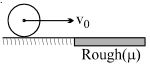
$A$ ring of mass $M$ and radius $R$ sliding with a velocity $v_0$ suddenly enters into rough surface where the coefficient of friction is $\mu$ , as shown in figure.  Choose the correct statement $(s)$
The escape velocity from earth is ${v_{es}}.$ A body is projected with velocity $2{v_{es}}$ with what constant velocity will it move in the inter planetary space
The maximum horizontal range of a projectile is $400\;m$.The maximum height atteined by it?
What is the range of the gravitational force?
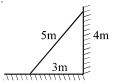
$A$ uniform ladder of length $5m$ is placed against the wall as shown in the figure. If coefficient of friction $\mu$ is the same for both the walls, what is the minimum value of $\mu$ for it not to slip?
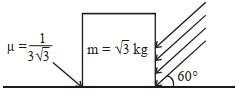
As shown in the figure, a block of mass $\sqrt{3}\, kg$ is kept on a horizontal rough surface of coefficient of friction $\frac{1}{3 \sqrt{3}}$. The critical force to be applied on the vertical surface as shown at an angle $60^{\circ}$ with horizontal such that it does not move, will be $3 x$. The value of $3x$ will be

$\left[ g =10 m / s ^{2} ; \sin 60^{\circ}=\frac{\sqrt{3}}{2} ; \cos 60^{\circ}=\frac{1}{2}\right]$

A vehicle travels half the distance with speed $v$ and the remaining distance with speed $2\,v$.Its average speed is :
A particle of mass m is executing oscillations about the origin on the $X-$axis. Its potential energy is $U(x) = k{[x]^3}$, where $k$ is a positive constant. If the amplitude of oscillation is $a$, then its time period $T$ is
A metal sheet is placed in front of a strong magnetic pole. A force needed to: