A glass tube of uniform internal radius ( $\mathrm{r}$ ) has a valve separating the two identical ends. Initially, the valve is in a tightly closed position. End $1$ has a hemispherical soap bubble of radius $\mathrm{r}$. End $2$ has sub-hemispherical soap bubble as shown in figure. Just after opening the valve,
Figure: $Image$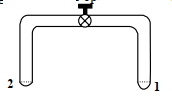
IIT 2008, Advanced


Download our appand get started for free
Experience the future of education. Simply download our apps or reach out to us for more information. Let's shape the future of learning together!No signup needed.*
Similar Questions
- 1The blades of a windmill sweep out a circle of area $A$. If the wind flows at a velocity $b$ perpendicular to the circle, then the mass of the air of density $\rho $ passing through it in time $t$ isView Solution
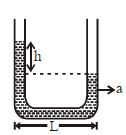
- 2In a $U-$ tube, the liquid level stands at same level when it is at rest. When $U-$ tube is accelerated towards right, as shown in figure, the difference $h$ between level of two arms will beView Solution
- 3A metal ball of density $7800\ kg/m^3$ is suspected to have a large number of cavities . It weighs $9.8$ $kg$ when weighed directly on a balance and $1.5$ $kg$ less when immersed in water . The fraction by volume of the cavities in the metal ball is approximately ....... $\%$View Solution
- 4Pressure at the bottom of a tank of water is $3P$, where $P$ is atmospheric pressure. If water is drawn out till the level of water is lowered by one fifth, then the pressure at the bottom of the tank isView Solution
- 5Assertion $(A):$ The stream of water flowing at high speed from a garden hose, pipe tends to spread like a fountain when held vertically up but tends to narrow down when held vertically down.View Solution
Reason $(R):$ In any steady flow of an incompressible fluid, the volume flow rate of the fluid remains constant.
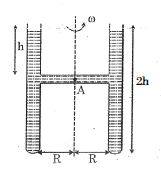
- 6The shown $H$ shaped apparatus contains an ideal incompressible liquid and has dimension as shown in figure . The diameters of the Tubes are small as compared to $h$ and $R$. The apparatus is rotated with a constant angular velocity $\omega$ about a symmetric vertical axis as shown in figure. The pressure at point $A$ isView Solution
- 7A bubble of radius $R$ in water of density $\rho$ is expanding uniformly at speed $v$. Given that water is incompressible, the kinetic energy of water being pushed isView Solution
- 8View SolutionCorrect Bernoulli's equation is (symbols have their usual meaning) :
- 9A large drop of oil (density $0.8\,g / cm ^3$ and viscosity $\eta_0$) floats up through a column of another liquid (density $1.2\,g / cm ^3$ and viscosity $\eta_L$ ). Assuming that the two liquids do not mix, the velocity with which the oil drop rises will depend on.View Solution
- 10A beaker containing water is placed on the platform of a spring balance. The balance reads $1.5$ $kg$. A stone of mass $0.5$ $kg$ and density $500$ $kg/m^3$ is immersed in water without touching the walls of beaker. What will be the balance reading now ? ..... $kg$View Solution