Pressure at the bottom of a tank of water is $3P$, where $P$ is atmospheric pressure. If water is drawn out till the level of water is lowered by one fifth, then the pressure at the bottom of the tank is
Medium


Download our appand get started for free
Experience the future of education. Simply download our apps or reach out to us for more information. Let's shape the future of learning together!No signup needed.*
Similar Questions
- 1View SolutionSelect incorrect statement regarding turbulent flow
- 2A body of density $\rho$ is dropped from rest from a height $h$ into a lake of density $\sigma$, where $\sigma > \rho$. Neglecting all dissipative forces, the maximum depth to which the body sinks before returning to float on surface ..........View Solution
- 3The velocity of a small ball of mass $0.3\,g$ and density $8\,g / cc$ when dropped in a container filled with glycerine becomes constant after some time. If the density of glycerine is $1.3\,g / cc$, then the value of viscous force acting on the ball will be $x \times 10^{-4}\,N$, the value of $x$ is [use $g=10\,m / s ^{2}$ ]View Solution
- 4Water is pumped from a depth of $10 $ $m$ and delivered through a pipe of cross section $10^{-2}$ $m^2$. If it is needed to deliver a volume of $10^{-1} $ $m^3$ per second the power required will be ........ $kW$View Solution
- 5If $\rho$ is the density and $\eta$ is coefficient of viscosity of fluid which flows with a speed $v$ in the pipe of diameter $d$, the correct formula for Reynolds number $R _{ e }$ is ..............View Solution
- 6A liquid is kept in a cylindrical vessel which is being rotated about a vertical axis through the centre of the circular base. If the radius of the vessel is $ r $ and angular velocity of rotation is $\omega $, then the difference in the heights of the liquid at the centre of the vessel and the edge isView Solution
- 7$Assertion :$ Falling raindrops acquire a terminal velocity.View Solution
$Reason :$ A constant force in the direction of motion and a velocity dependent force opposite to the direction of motion, always result in the acquisition of terminal velocity. - 8Two large, identical water tanks, $1$ and $2$ , kept on the top of a building of height $H$, are filled with water up to height $h$ in each tank. Both the tanks contain an identical hole of small radius on their sides, close to their bottom. A pipe of the same internal radius as that of the hole is connected to tank $2$ , and the pipe ends at the ground level. When the water flows the tanks $1$ and $2$ through the holes, the times taken to empty the tanks are $t_1$ and $t_2$, respectively. If $H=\left(\frac{16}{9}\right) h$, then the ratio $t_1 / t_2$ is. . . . .View Solution
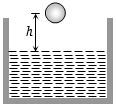
- 9A ball of radius $r $ and density $\rho$ falls freely under gravity through a distance $h$ before entering water. Velocity of ball does not change even on entering water. If viscosity of water is $\eta$, the value of $h$ is given byView Solution
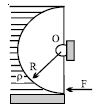
- 10A light semi cylindrical gate of radius $R$ is piovted at its mid point $O$, of the diameter as shown in the figure holding liquid of density $\rho $. The force $F$ required to prevent the rotation of the gate is equal toView Solution