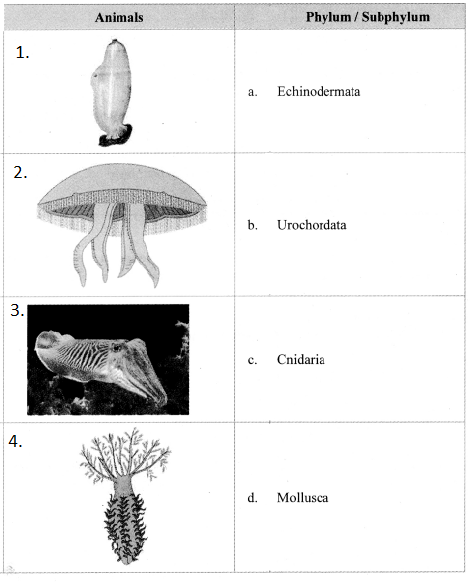
Question
| ‘A’ Group | ‘B’ Group |
| 1. Muscle | (a) Perichondrium |
| 2. Bone | (b) Sarcolemma |
| 3. Nerve cell | (c) Periosteum |
| 4. Cartilage | (d) Neurilemma |
| ‘A’ Group | ‘B’ Group |
| 1. Muscle | (a) Perichondrium |
| 2. Bone | (b) Sarcolemma |
| 3. Nerve cell | (c) Periosteum |
| 4. Cartilage | (d) Neurilemma |
| ‘A’ Group | ‘B’ Group |
| 1. Muscle | (b) Sarcolemma |
| 2. Bone | (c) Periosteum |
| 3. Nerve cell | (d) Neurilemma |
| 4. Cartilage | (a) Perichondrium |
Generate a complete, print-ready paper with questions like this in minutes — across 16+ boards, with answer keys.
| i. | Crypts of Lieberkuhn | P | Pancreas |
| ii. | Glisson’s Capsule | q. | Duodenum |
| iii. | Islets of Langerhans | r. | Small intestine |
| iv. | Brunner’s Glands | s. | Liver |
| i. | Descending limb of Henle’s loop | a. | Reabsorption of salts only |
| ii. | Proximal convoluted tubule | b. | Reabsorption of water only |
| iii. | Ascending limb of Henle’s loop | c. | Conditional reabsorption of sodium ions and water |
| iv. | Distal convoluted tubule | d. | Reabsorption of ions, water and organic nutrients |
| Column – I | Column – II |
| 1. Saprophyte | (a) Symbiotic association of fungi with plants roots |
| 2. Parasite | (b) Decomposition of dead |
| 3. Lichens | (c) Living on living plants or animals |
| 4. Mycorrhiza | (d) Symbiotic association of algae and fungi |
| Column-I | Column-II | ||
| i. | Podocytes | a. | Crystallised oxalates |
| ii. | Protonephridia | b. | Annelids |
| iii. | Nephridia | c. | Amphioxus |
| iv. | Renal calculi | d. | Filtration slits |
| Column I | Column II |
| 1. Cuboidal epithelium | a. Fallopian tube |
| 2. Squamous epithelium | b. Kidney |
| 3. Ciliated epithelium | c. Intestine |
| 4. Columnar epithelium | d. Endothelium |
| Column I | Column II |
| (a) Golgi apparatus | (i) Synthesis of protein |
| (b) Lysosomes | (ii) Trap waste and excretory products |
| (c) Vacuoles | (iii) Formation of glycoproteins and glycolipids |
| (d) Ribosomes | (iv) Digesting biomolecules |
| Column I | Column II | |
| i. | Cardiac Sphincter Pyloric | a. Regulates the flow of food from stomach to small intestine. |
| ii. | sphincter | b. Controls the passage of food from oesophagus into the stomach. |
| iii. | Gastro-oesophageal sphincter | c. Prevents back flow of food from stomach to oesophagus. |